 Back
Fungi: Colonization of Land, Morphology, Diversity, and Symbiosis
Study Guide - Smart Notes
 Tailored notes based on your materials, expanded with key definitions, examples, and context.
THE ORIGIN OF FUNGI
Evolutionary Relationships
Fungi are a distinct kingdom of eukaryotes, more closely related to animals than to plants or most other eukaryotes. Molecular evidence shows that fungi are most closely related to nucleariids, a group of amoebas, while animals are related to choanoflagellates. Multicellularity evolved independently in fungi and animals, and molecular clock analysis estimates their divergence over 1 billion years ago. The oldest undisputed terrestrial fungal fossils date to 440 million years ago.
MORPHOLOGICAL ADAPTATIONS OF FUNGI
Enzymatic Digestion and Absorption
Fungi secrete hydrolytic enzymes into their surroundings, breaking down complex molecules into small organic compounds that are absorbed through their hyphae. This allows fungi to digest a wide range of food sources, both living and dead. Fungal cell walls are strengthened by chitin, a strong polysaccharide, which protects cells from bursting due to osmotic pressure.
Structure: Hyphae and Mycelium
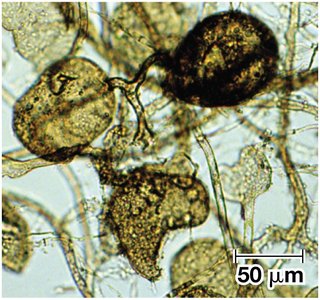
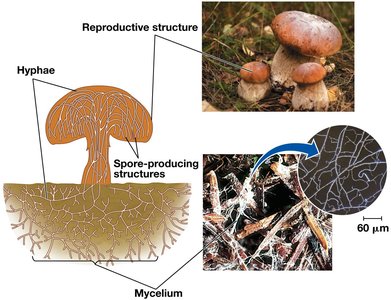
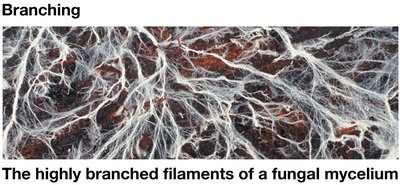
Fungi are composed of an interwoven mass of branched hyphae called a mycelium. The branched structure maximizes surface-to-volume ratio, enhancing absorption efficiency. Some fungi, such as yeasts, grow as single cells. The efficiency of nutrient uptake is influenced by the absorptive surface area, which can be increased through branching, flattening, folding, and projections.
Hyphae: Filamentous structures that absorb nutrients.
Mycelium: Network of hyphae, main body of fungus.
Chitin: Structural polysaccharide in cell walls.
DIVERSIFICATION OF FUNGI
Major Fungal Groups
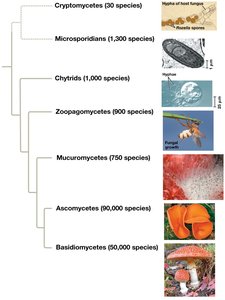
Molecular analyses have clarified evolutionary relationships among fungi, revealing new groups and reclassifying others. For example, Zygomycota is no longer recognized as a valid group due to its paraphyletic nature. Microsporidians, unicellular parasites, are now considered an early diverging group of fungi.
Group | Species Count | Main Features |
|---|---|---|
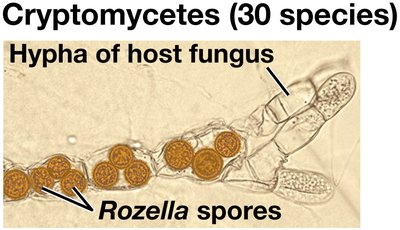
Cryptomycetes | 30 | Parasites of fungi/protists, found in soil and water |
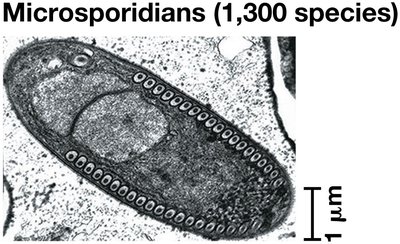
Microsporidians | 1,300 | Unicellular parasites, reduced mitochondria, harpoon-like organelle |
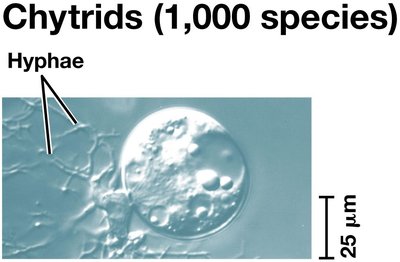
Chytrids | 1,000 | Flagellated spores, aquatic/soil habitats |
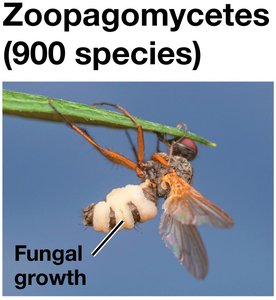
Zoopagomycetes | 900 | Parasites/symbionts of animals, filamentous hyphae |
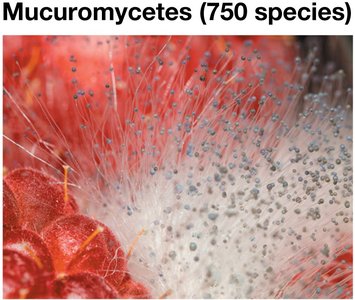
Mucuromycetes | 750 | Fast-growing molds, zygosporangium, includes glomeromycetes |
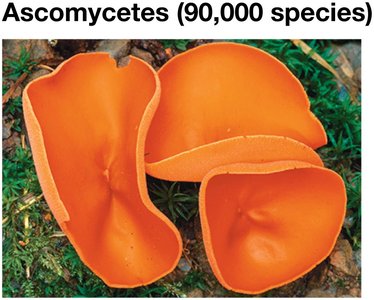
Ascomycetes | 90,000 | Sac fungi, cup-shaped ascocarps, diverse habitats |
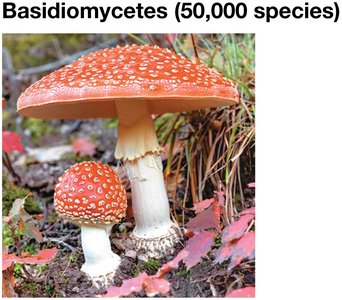
Basidiomycetes | 50,000 | Club fungi, mushrooms, decomposers, ectomycorrhizal |
Representative Images of Fungal Groups
Cryptomycetes: Parasites of other fungi, Rozella spores.
Microsporidians: Unicellular parasites with reduced mitochondria.
Chytrids: Flagellated spores, aquatic environments.
Zoopagomycetes: Parasites of insects, induce host behavior.
Mucuromycetes: Fast-growing molds, food spoilage.
Ascomycetes: Sac fungi, ascocarps.
Basidiomycetes: Club fungi, mushrooms.
FUNGAL REPRODUCTION
Sexual and Asexual Reproduction
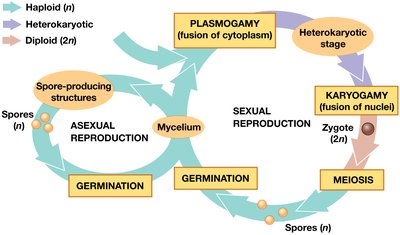
Fungi reproduce both sexually and asexually, often producing vast numbers of spores. Sexual reproduction involves two main stages:
Plasmogamy: Fusion of cytoplasm from two haploid mycelia.
Karyogamy: Fusion of haploid nuclei to form diploid cells, which is followed by meiosis to restore the haploid condition.
The diploid phase is brief, and meiosis produces genetically diverse spores. Asexual reproduction occurs via mitosis, producing haploid spores (molds) or by budding in yeasts.
SYMBIOSIS BETWEEN PLANTS AND FUNGI
Mycorrhizae
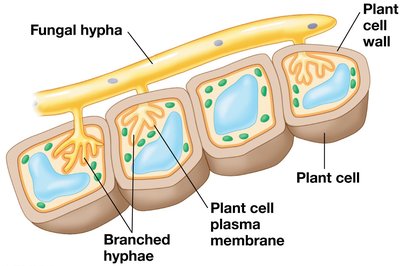
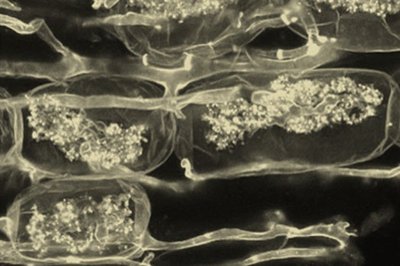
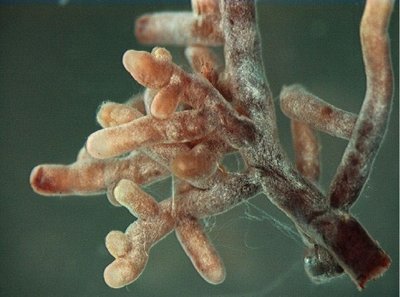
The earliest land plants lacked true roots and leaves, relying on symbiotic associations with fungi called mycorrhizae to obtain nutrients. In mycorrhizae, fungal hyphae transfer nutrients from the soil to the plant partner. There are two main types:
Arbuscular mycorrhizal fungi: Extend hyphae into root cell walls but do not penetrate the plasma membrane.
Ectomycorrhizal fungi: Grow around the root surface and into extracellular spaces of the root cortex.
LICHENS
Symbiotic Associations
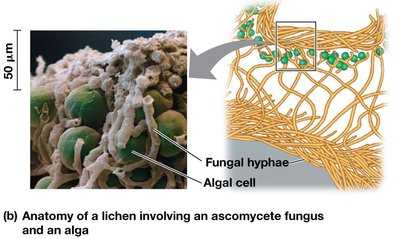
Lichens are symbiotic associations between fungi and photosynthetic microorganisms (algae or cyanobacteria). They played a role in the colonization of land by modifying rocks and soil. Lichens take three common forms: crustose, foliose, and fruticose.
FUNGI AS MUTUALISTS AND PATHOGENS
Mutualism and Parasitism
Mutualistic fungi absorb nutrients from a host and reciprocate with benefits, such as deterring herbivores or increasing stress tolerance. Endophytes are harmless symbiotic fungi (or bacteria) living inside plant tissues. Parasitic fungi absorb nutrients without providing benefits, and about 30% of known fungal species are parasites or pathogens, mostly affecting plants. For example, Cryphonectria parasitica causes chestnut blight.
Summary Table: Major Fungal Groups and Their Features
Group | Habitat | Key Features |
|---|---|---|
Cryptomycetes | Soil, water | Parasites, Rozella spores |
Microsporidians | Protists, animals | Unicellular, harpoon-like organelle |
Chytrids | Lakes, soil | Flagellated spores |
Zoopagomycetes | Animals | Parasites, insect host manipulation |
Mucuromycetes | Food, plants | Molds, zygosporangium |
Ascomycetes | Marine, freshwater, terrestrial | Sac fungi, ascocarps |
Basidiomycetes | Terrestrial | Club fungi, mushrooms |
Key Terms and Concepts
Hyphae: Filamentous structures for absorption
Mycelium: Network of hyphae
Chitin: Structural component of cell walls
Plasmogamy: Fusion of cytoplasm
Karyogamy: Fusion of nuclei
Mycorrhizae: Symbiotic association with plant roots
Lichens: Symbiosis between fungi and photosynthetic organisms
Endophytes: Symbiotic fungi inside plant tissues
Important Equations
Surface Area to Volume Ratio
The surface area to volume ratio is critical for absorption efficiency in fungi:
As organisms grow, volume increases faster than surface area, so branching and other adaptations maximize absorptive efficiency.
----------------------------------------
