 Back
BackFungi: Diversity, Structure, and Ecological Roles
Study Guide - Smart Notes
 Tailored notes based on your materials, expanded with key definitions, examples, and context.
Fungi: The Decomposers and Network Builders
Introduction to Fungi
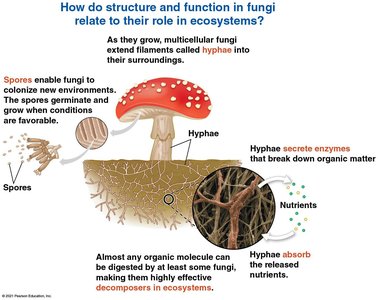
Fungi are a diverse group of eukaryotic organisms that play essential roles in ecosystems, particularly as decomposers. Despite their sedentary lifestyle, fungi are evolutionarily more closely related to animals than to plants. They are heterotrophs, meaning they obtain their nutrients by absorbing organic matter from their surroundings.
Heterotrophs: Fungi secrete digestive enzymes to break down complex organic substances.
Ecological Importance: Fungi are major contributors to nutrient cycling in the biosphere.
Evolutionary Relationship: Fungi share a closer evolutionary lineage with animals than with plants.
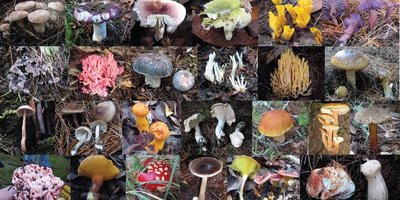
Fungi and the Carboniferous Period
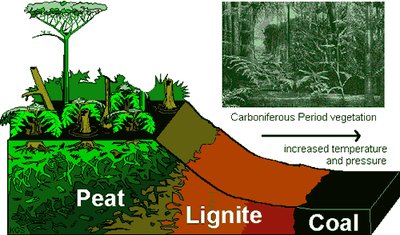
During the Carboniferous Period (358.9–298 million years ago), vast forests produced large amounts of plant material. At that time, no organism could digest lignin, a complex component of plant cell walls, so dead wood accumulated and eventually became coal. The evolution of fungi and bacteria capable of digesting lignin marked a turning point in decomposition and nutrient cycling.
Lignin Decomposition: Fungi developed enzymes to break down lignin, enabling decomposition of wood.
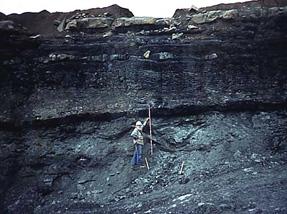
Coal Formation: Undecomposed plant material from the Carboniferous period formed coal deposits.

Fungal Structure and Function
Cellular Organization
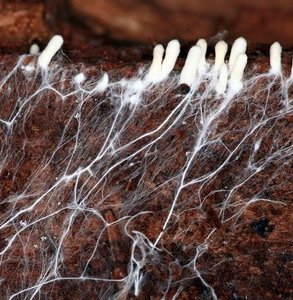
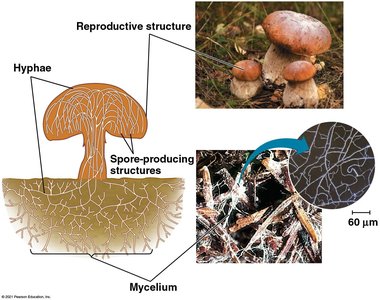
Fungi may be unicellular (yeasts) or multicellular (filamentous forms). The multicellular structure consists of hyphae, which collectively form a mycelium.
Hyphae: Thread-like structures that grow and spread through substrates.
Mycelium: A network of hyphae that increases surface area for nutrient absorption.
Cell Wall Composition: Fungal cell walls contain chitin, a structural polysaccharide also found in arthropods.
Hyphal Types
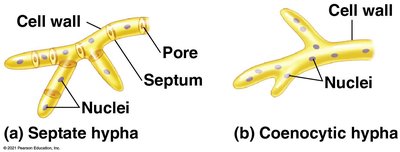
Fungal hyphae can be classified as septate (with cross-walls called septa) or coenocytic (without septa, containing many nuclei in a continuous cytoplasm).
Septate Hyphae: Hyphae divided by septa with pores for cytoplasmic streaming.
Coenocytic Hyphae: Hyphae lacking septa, resulting in a multinucleate cell.
Fungal Reproduction
Fungi reproduce both sexually and asexually, often via spores. Spores are adapted for dispersal and survival in various environments.
Sexual Reproduction: Involves fusion of hyphae from different individuals, leading to genetic recombination.
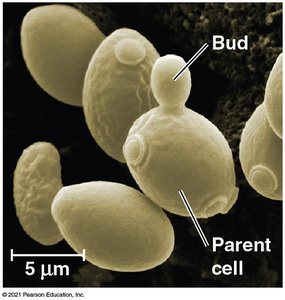
Asexual Reproduction: Commonly occurs via budding (in yeasts) or spore formation (in filamentous fungi).
: /
Major Groups of Fungi
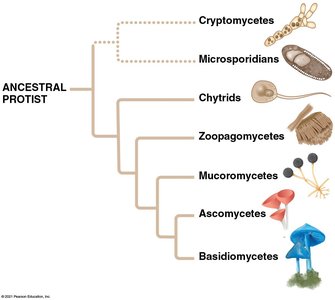
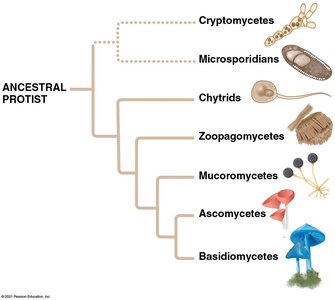
Phylogeny of Fungi
Fungi are classified into several major groups based on their reproductive structures and genetic relationships.
Chytridiomycota: Fungi with motile zoospores, often found in aquatic environments.
Mucoromycota: Formerly Zygomycota, characterized by non-septate hyphae and reproduction via zygospores.
Ascomycota: Sac fungi, with septate hyphae and reproduction via ascospores.
Basidiomycota: Club fungi, with septate hyphae and reproduction via basidiospores.
Chytridiomycota
Chytrids are unique among fungi for their motile zoospores. They are primarily aquatic and play roles in decomposition and parasitism.
Zoospores: Flagellated spores adapted for movement in water.
Habitat: Soil and aquatic environments.
Mucoromycota (Formerly Zygomycota)
Mucoromycota includes fungi with non-septate hyphae and both sexual and asexual reproductive cycles.
Zygospores: Sexual spores formed by fusion of hyphae.
Sporangiospores: Asexual spores produced in sporangia.
Examples: Bread mold, fungi on decaying organic material.
Ascomycota (Sac Fungi)
Ascomycota are characterized by the production of ascospores in sac-like structures called asci.
Dikaryotic Stage: Hyphae contain two genetically distinct nuclei (n+n).
Examples: Yeast, Penicillium, chestnut blight fungus, morels, truffles, most lichens.
Basidiomycota (Club Fungi)
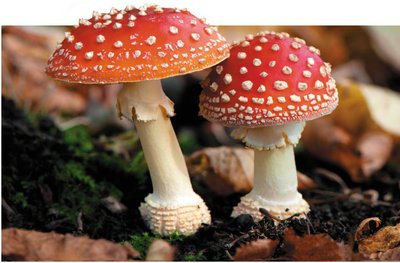
Basidiomycota produce basidiospores on club-shaped structures called basidia.
Dikaryotic Stage: Hyphae contain two nuclei (n+n).
Examples: Most edible mushrooms, rusts, smuts.
Fungal Associations with Other Organisms
Mycorrhiza
Mycorrhiza refers to the symbiotic relationship between fungi and plant roots. Fungal hyphae enhance water and nutrient uptake for plants, while plants provide fungi with carbohydrates.
Ecological Role: Mycorrhiza is crucial for plant survival and ecosystem health.
Wood Wide Web: Mycorrhizal networks connect trees, facilitating nutrient exchange.
Truffles: Ectomycorrhizal fungi that require association with host trees.
Lichens
Lichens are symbiotic associations between a fungus (usually Ascomycota) and a photosynthetic partner (green algae or cyanobacteria).
Forms: Crustose, foliose, and fruticose.
Environmental Sensitivity: Lichens are resistant to drought but sensitive to air pollution.
Mycoheterotrophic Plants
Some plants lack functional chloroplasts and rely on fungi for nutrients, acting as fungal parasites.
Examples: Ghost Pipe (Monotropa uniflora), Burmannia championii.
Fungal Parasites
Fungi can parasitize living hosts, causing diseases in plants and animals.
Difference from Decomposition: Parasitism involves living hosts, while decomposition targets dead organic matter.
Human Applications of Fungi
Antibiotics and Drugs
Fungi are sources of important pharmaceuticals, including antibiotics like penicillin.
Edible Mushrooms
Many fungi are cultivated or foraged for food, such as mushrooms and truffles.
Biological Controls
Fungi are used in agriculture to control pests and diseases.
Fungal Enzymes
Fungal enzymes are exploited industrially for various applications, including food production and biotechnology.
Summary
Fungi are eukaryotic heterotrophs, primarily decomposers.
Fungal structure includes hyphae and mycelium, with chitin as the main cell wall component.
Major groups: Chytridiomycota, Mucoromycota, Ascomycota, Basidiomycota.
Fungi form associations with plants (mycorrhiza), photosynthetic partners (lichens), and act as parasites.
Fungi have significant ecological and industrial importance.
Additional info: Expanded explanations and context were added to ensure completeness and academic quality.
