 Back
Fungi: Origin, Diversity, Structure, and Ecological Roles
Study Guide - Smart Notes
 Tailored notes based on your materials, expanded with key definitions, examples, and context.
Fungi: Origin, Diversity, Structure, and Ecological Roles
Patterns of Origin and Transition to Land
The evolutionary history of fungi, plants, and animals reveals distinct patterns in their origin, multicellularity, and transition to terrestrial environments. Fungi first appeared about 900 million years ago, became multicellular around 500 million years ago, and transitioned to land at the same time. Plants evolved from multicellular green algae and transitioned to land about 470 million years ago, while animals moved to land around 400 million years ago.
Fungi evolved before plants and animals, with early forms likely involved in soil formation and decomposition.
Multicellularity in fungi and animals occurred around 500 mya, while plants evolved multicellularity slightly earlier.
Transition to land was facilitated by mutualisms, such as lichens (fungi + photosynthetic partners), and mycorrhizal associations in plants.
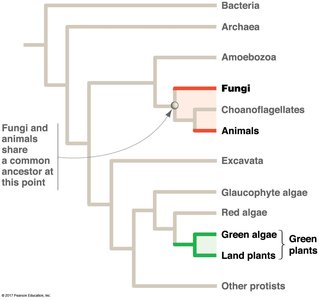
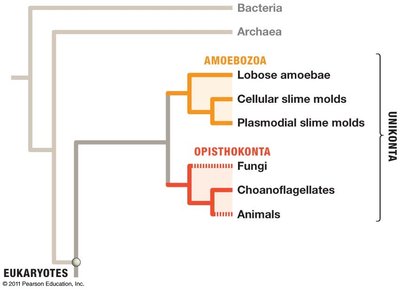
Comparative Features of Fungi, Plants, and Animals
Fungi share some characteristics with plants and animals, but also possess unique features. They are nonmotile, reproduce by spores, and produce cell walls containing chitin. Fungi are heterotrophic and store carbohydrates as glycogen, similar to animals.
Nonmotile: Fungi and plants are primarily nonmotile, unlike animals.
Reproduction: Fungi and plants reproduce by spores; animals do not.
Cell walls: Both fungi and plants have cell walls, but only fungi synthesize chitin.
Heterotrophy: Fungi and animals are heterotrophic, while plants are autotrophic.
Carbohydrate storage: Fungi and animals store glycogen; plants store cellulose.
Fungi are more closely related to animals than plants, as evidenced by DNA sequence data, chitin synthesis, flagella structure, and glycogen storage.
Early Fungi and Fossil Evidence
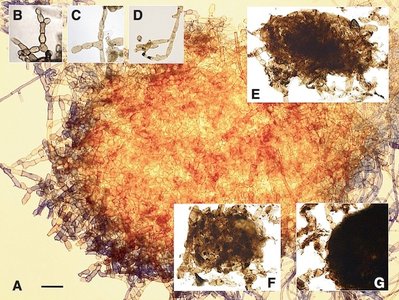
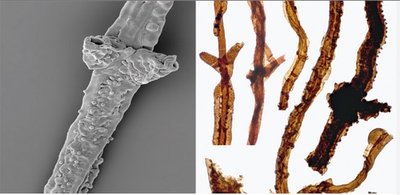
Early fungi were likely unicellular and not photosynthetic. They played a crucial role in soil formation and decomposition of bacteria and algae. Fossil evidence, such as Tortotubus mycelium parts, dates back to 440 million years ago.
Earliest fungi: Unicellular forms (yeasts) still exist today.
Soil formation: Fungi contributed to decomposition and nutrient cycling.
Distribution and Diversity of Fungi
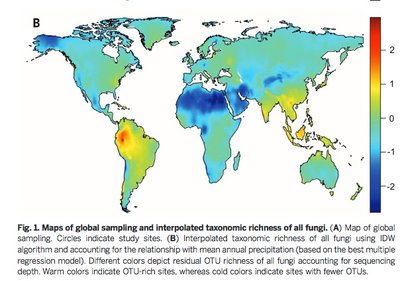
Moisture is a major driver of fungal distribution, with patterns similar to those of plants and animals. Fungi are globally distributed, with taxonomic richness varying by region and precipitation.
Global distribution: Fungi are found worldwide, with diversity highest in moist regions.
Taxonomic richness: Warm colors on global maps indicate OTU-rich sites, while cold colors indicate fewer OTUs.
Characteristics of Fungi
Body Plans
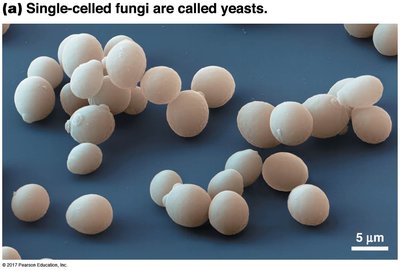
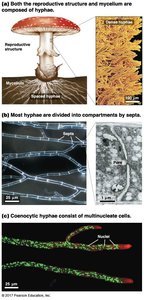
Fungi exhibit two basic body plans: filamentous (multicellular hyphae forming a mycelium) and single-celled (yeasts). The mycelium has a high surface area and is mostly seen during reproduction as fruiting bodies (mushrooms).
Filamentous: Multicellular hyphae form a mycelium with no defined shape.
Single-celled: Yeasts are unicellular fungi.
Cell Wall Composition
Fungi have cell walls containing chitin, a polysaccharide also found in animal exoskeletons.
Absorptive Heterotrophy
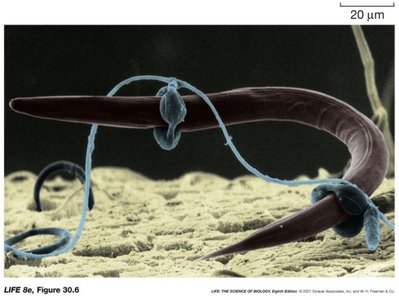
Fungi are absorptive heterotrophs, meaning they digest food externally and absorb nutrients. They can be parasitic, decomposers, or predatory.
Saprophytic: Most fungi are saprobes, decomposing dead organic matter.
Parasitic: Some fungi infect plants and animals.
Predatory: Certain fungi capture and digest small organisms.
Reproduction
Fungi reproduce both sexually and asexually. Sexual reproduction can include heterokaryotic (n+n) stages, where cytoplasm from two individuals fuse but nuclei remain distinct. Asexual reproduction involves spore formation.
Sexual reproduction: Involves plasmogamy (fusion of cytoplasm) and karyogamy (fusion of nuclei).
Asexual reproduction: Produces spores via mitosis.
Heterokaryotic stage: Cytoplasm fuses, but nuclei remain genetically distinct.
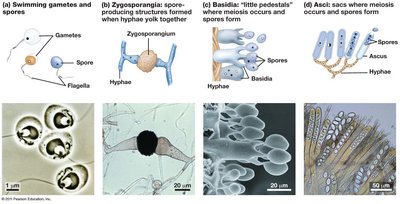
Types of Reproductive Structures
Fungi produce various reproductive structures, including swimming gametes and spores, zygosporangia, asci, and basidia. Asexual spores are produced in conidia.
Swimming gametes and spores: Found in chytrids.
Zygosporangia: Formed when hyphae yoke together.
Asci: Sac-like structures where meiosis occurs.
Basidia: Pedestal-like structures where spores form.
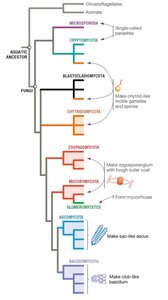
Fungal Taxonomy
Fungi are classified into monophyletic groups based on DNA data: Glomeromycota, Basidiomycota, Ascomycota, with unresolved relationships for chytrids and zygomycetes. Morphological features, such as reproductive structures, were previously used for classification.
Monophyletic groups: Classification based on DNA sequence data.
Polytomy: Unresolved relationships among some groups.
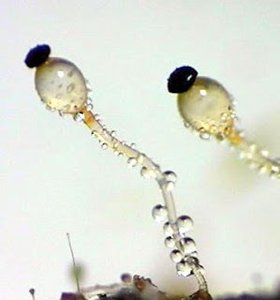
Lichens: Mutualism Between Fungi and Photosynthetic Partners
Lichens are symbiotic associations between fungi and cyanobacteria or green algae. They may have been among the first life forms on land and can survive in extreme habitats. About 20% of fungi associate as lichens.
Mutualism: Fungi provide structure and protection; photosynthetic partners provide sugars.
Ecological importance: Lichens contribute to soil formation and colonization of harsh environments.
Fungi in Medicine and Parasitism
Fungi produce secondary compounds, such as penicillin, and can be parasites on plants and animals. Drug-resistant fungal infections are a growing concern, with limited classes of antifungal medications available.
Medicinal compounds: Penicillin and other antibiotics are derived from fungi.
Parasitism: Fungi infect plants, animals, and humans, sometimes causing severe diseases.
Drug resistance: Overuse of fungicides has led to resistant strains.
Fungal Diseases in Animals
White-nose Syndrome in Bats
White-nose syndrome, caused by Pseudogymnoascus destructans, affects hibernating bats, disrupting their hibernation and leading to dehydration and energy loss. It has killed millions of bats in the US.
Chytrid Fungus in Amphibians
Batrachochytrium dendrobatidis infects frogs, causing chytridiomycosis and leading to extinction of multiple species.
Mycorrhizae: Fungal-Plant Mutualism
Mycorrhizae are symbiotic associations between fungi and plant roots, crucial for water and nutrient uptake in exchange for sugars. Major types include ectomycorrhizal (EMF) and arbuscular mycorrhizal (AMF), with AMF present in 80% of plants.
Fungal-Animal Mutualism
Leafcutter ants farm fungi for nutrients, collecting leaf fragments for fungal decomposition. Many animals also disperse fungal spores.
Role of Fungi in the Carbon Cycle
Fungi digest dead organic matter, acting as saprophytic organisms and major determinants of carbon storage in soil. Their activity influences the carbon cycle and ecosystem functioning.
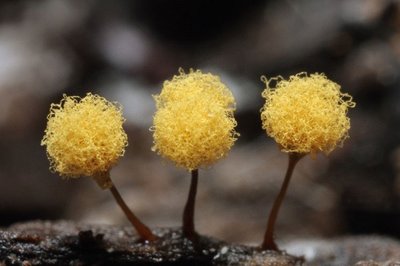
Example: Fungi breaking down dead wood, returning carbon to the soil and atmosphere.
Summary Table: Comparison of Fungi, Plants, and Animals
Feature | Fungi | Plants | Animals |
|---|---|---|---|
Nonmotile | ✓ | ✓ | ✗ |
Reproduce by spores | ✓ | ✓ | ✗ |
Produce cell walls | ✓ | ✓ | ✗ |
Synthesize chitin | ✓ | ✗ | ✓ |
Heterotrophic | ✓ | ✗ | ✓ |
Store carbohydrates as glycogen | ✓ | ✗ | ✓ |
Key Terms
Mycelium: Network of fungal hyphae.
Hyphae: Filamentous structures forming the body of fungi.
Chitin: Structural polysaccharide in fungal cell walls.
Heterokaryotic: Stage with fused cytoplasm but distinct nuclei.
Mycorrhizae: Symbiotic association between fungi and plant roots.
Lichen: Mutualism between fungi and photosynthetic partners.
Important Equations
Fungal reproduction involves mitosis and meiosis:
Additional info: Academic context was added to clarify evolutionary timelines, mutualisms, and ecological roles, as well as to expand on fungal taxonomy and reproductive strategies.
