 Back
BackFungi: Structure, Function, Diversity, and Life Cycles
Study Guide - Smart Notes
 Tailored notes based on your materials, expanded with key definitions, examples, and context.
Fungi: Structure, Function, Diversity, and Life Cycles
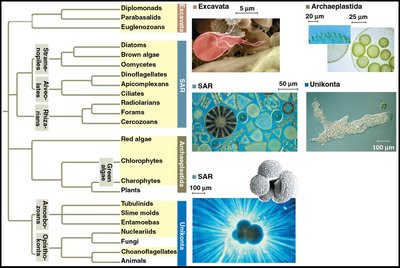
Overview of Fungal Phylogeny and Eukaryotic Supergroups
Fungi are a diverse group of eukaryotic organisms that play essential roles in ecosystems as decomposers, mutualists, and pathogens. They are part of the Unikonta supergroup, which also includes animals. Understanding fungal diversity requires knowledge of their evolutionary relationships within the broader context of eukaryotic life.
What is a Fungus?
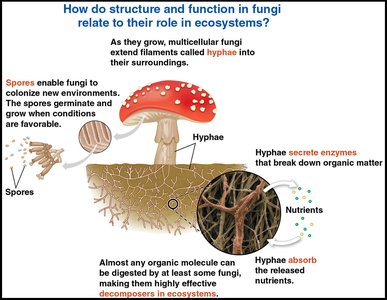
Fungi are eukaryotic, mostly multicellular organisms that are heterotrophic by absorption. They secrete enzymes into their environment to break down complex molecules and then absorb the resulting smaller organic molecules. This absorptive nutrition distinguishes them from animals, which ingest food.
Fungal Nutrition
Heterotrophic: Obtain nutrients by absorption, not ingestion.
Exoenzymes: Secreted to digest complex molecules externally.
Decomposers: Many fungi can digest almost any organic molecule, making them highly effective decomposers in ecosystems.
Structure and Function in Fungi
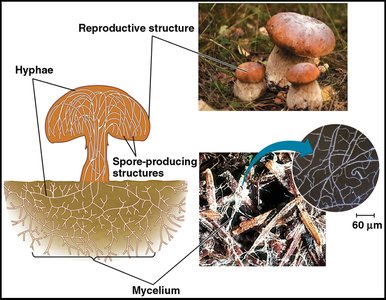
Fungi grow as networks of filaments called hyphae, which collectively form a mycelium. These structures allow fungi to efficiently absorb nutrients from their environment and play a critical role in their ecological functions.
Fungal Structure: Hyphae and Mycelium
The main body of a fungus is composed of hyphae—thin, tubular threads that are usually haploid. Hyphae massed together form a mat called a mycelium, which is responsible for nutrient absorption and growth.
Types of Hyphae
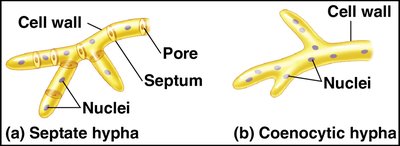
Septate hyphae: Hyphae divided by cross-walls (septa) with pores allowing organelles to pass between cells.
Coenocytic hyphae: Hyphae lacking septa, forming a continuous cytoplasmic mass with many nuclei.
Major Fungal Lineages
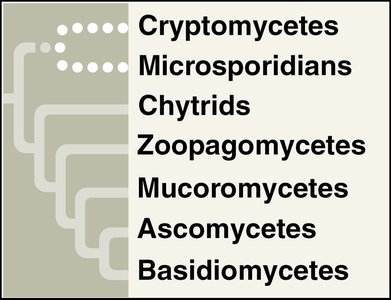
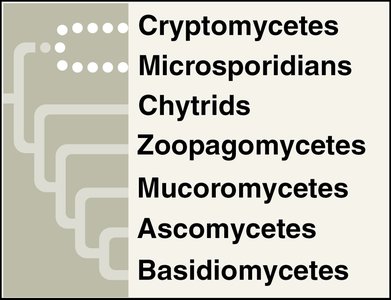
Fungi are classified into several major lineages based on molecular and morphological data. These include Cryptomycetes, Microsporidians, Chytrids, Zoopagomycetes, Mucoromycetes, Ascomycetes, and Basidiomycetes.
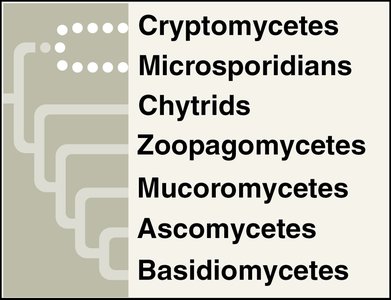
Cryptomycetes and Microsporidians
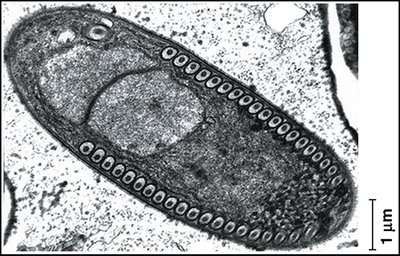
Microsporidians (Phylum Microsporidia): Unicellular, non-flagellated spores, harpoon-like organelle for infection, primarily parasitic.
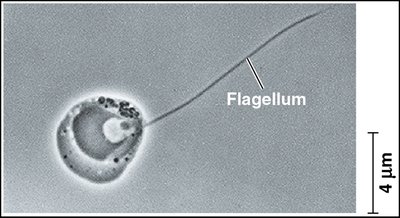
Chytrids (Phylum Chytridiomycota)
Flagellated zoospores, unicellular and multicellular forms.
Ecological roles: parasitic, mutualists, decomposers.
Notable for causing amphibian population declines.
Zoopagomycetes (Phylum Zoopagomycota)
900 species, characterized by zygosporangium in sexual reproduction and nonflagellated spores in asexual reproduction.
Ecological roles: parasitic or commensal, often infecting insects.
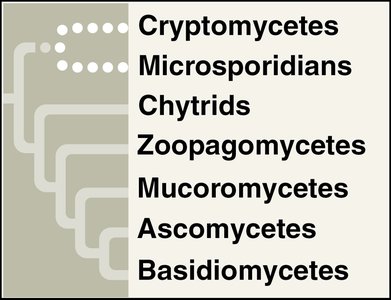
Mucoromycetes (Phylum Mucoromycota)
Includes many molds, such as Rhizopus stolonifer (black bread mold).
Characterized by multicellular structure and zygosporangium.
Ecological roles: pathogens, decomposers, mutualists (many mycorrhizae).
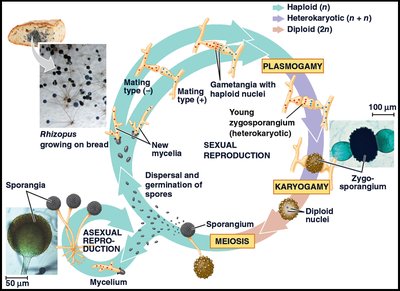
Life Cycle: Involves both sexual and asexual reproduction. Sexual reproduction includes plasmogamy (fusion of cytoplasm), formation of a heterokaryotic zygosporangium, karyogamy (fusion of nuclei), meiosis, and spore dispersal. Asexual reproduction occurs via sporangia producing genetically identical spores.
Ascomycetes (Phylum Ascomycota)
Known as "sac fungi" due to the production of spores in sac-like asci within fruiting bodies called ascocarps.
90,000 species, including unicellular yeasts and multicellular molds and morels.
Ecological roles: pathogens, decomposers, mutualists (mycorrhizae, lichens).
Lichen Growth Forms
Lichens are mutualistic associations between ascomycete fungi and photosynthetic organisms (algae or cyanobacteria), exhibiting diverse growth forms.
Life Cycle of Ascomycetes (e.g., Neurospora crassa)
Asexual reproduction: Mycelia produce conidia (haploid spores) that germinate into new mycelia.
Sexual reproduction: Fusion of conidia and specialized hyphae of opposite mating types, formation of dikaryotic hyphae, karyogamy in asci, meiosis, and mitosis to produce eight ascospores per ascus.
Basidiomycetes (Phylum Basidiomycota)
Known as "club fungi" due to the club-shaped basidia where karyogamy and meiosis occur.
50,000 species, including mushrooms, puffballs, and shelf fungi.
Ecological roles: pathogens (rusts, smuts), decomposers (especially of lignin), mutualists (mycorrhizae).
Life Cycle of Basidiomycetes
Two haploid mycelia of different mating types undergo plasmogamy to form a dikaryotic mycelium.
Dikaryotic mycelium forms basidiocarps (mushrooms) in response to environmental cues.
Basidia on gills undergo karyogamy and meiosis, producing four haploid basidiospores each.
Basidiospores are dispersed and germinate into new haploid mycelia.
Generalized Fungal Life Cycle
Asexual reproduction: Mycelium forms spore-producing structures that generate haploid spores, which germinate into new mycelia.
Sexual reproduction: Involves plasmogamy (fusion of cytoplasm), heterokaryotic stage (cells with two different nuclei), karyogamy (fusion of nuclei to form diploid zygote), meiosis (producing haploid spores), and germination.
Key Terms: Plasmogamy (fusion of cytoplasm), Karyogamy (fusion of nuclei), Heterokaryotic (cells with two or more genetically distinct nuclei).
Fungal Nutrition and Lifestyles
Decomposers (Saprotrophs): Break down dead organic matter, recycling nutrients.
Parasites: Infect living hosts, sometimes causing disease.
Mutualists: Form beneficial associations with other organisms (e.g., mycorrhizae with plants, lichens with algae/cyanobacteria).
Predators: Some fungi trap and consume small animals (e.g., nematodes).
Mutualistic Mycorrhizae
Mycorrhizae are mutualistic associations between fungal hyphae and plant roots. Both partners exchange resources: fungi provide phosphorus and other minerals, while plants supply carbohydrates. However, each partner can penalize the other for poor resource delivery, maintaining the mutualism's stability.
Summary Table: Major Fungal Lineages and Their Characteristics
Lineage | Key Features | Ecological Roles |
|---|---|---|
Cryptomycetes | Unicellular, flagellated spores | Parasitic |
Microsporidians | Unicellular, non-flagellated spores, harpoon-like organelle | Parasitic |
Chytrids | Flagellated zoospores, unicellular/multicellular | Parasitic, mutualists, decomposers |
Zoopagomycetes | Zygosporangium (sexual), nonflagellated spores (asexual) | Parasitic, commensal |
Mucoromycetes | Multicellular, zygosporangium | Pathogens, decomposers, mutualists |
Ascomycetes | Ascocarps, asci, conidia | Pathogens, decomposers, mutualists |
Basidiomycetes | Basidiocarps, basidia | Pathogens, decomposers, mutualists |
Key Equations and Concepts
Plasmogamy: $\text{n} + \text{n} \rightarrow \text{n} + \text{n}$ (heterokaryotic stage)
Karyogamy: $\text{n} + \text{n} \rightarrow 2\text{n}$ (diploid zygote)
Meiosis: $2\text{n} \rightarrow \text{n}$ (haploid spores)
Additional info: Fungi are essential for nutrient cycling, plant health, and ecosystem stability. Their diverse reproductive strategies and ecological roles make them a key group for study in biology.
