 Back
BackFungi: Structure, Life Cycle, Diversity, and Importance
Study Guide - Smart Notes
 Tailored notes based on your materials, expanded with key definitions, examples, and context.
Fungi: Structure, Life Cycle, Diversity, and Importance
Introduction to Fungi
Fungi are a diverse kingdom of eukaryotic organisms that play critical roles in ecosystems as decomposers, mutualists, and pathogens. They are more closely related to animals than plants and exhibit unique modes of nutrient acquisition and reproduction.
Fungal Structure and Nutrient Absorption
Modes of Nutrient Acquisition
Heterotrophs: Fungi obtain nutrients by absorbing organic molecules from their environment.
External Digestion: They secrete hydrolytic enzymes to break down complex molecules outside their bodies and absorb the resulting small molecules.
Ecological Roles: Fungi function as decomposers, parasites, or mutualists.
Fungal Body Structure
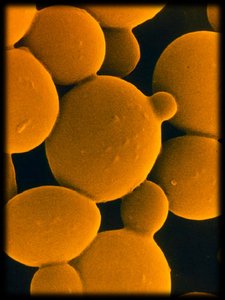
Yeasts: Unicellular fungi that reproduce by budding.
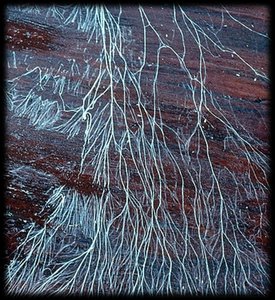
Hyphae: Multicellular filaments that form the main body of most fungi. Hyphae are tubular and have cell walls made of chitin.
Mycelium: A mass of hyphae that forms the main vegetative structure of a fungus, maximizing surface area for absorption.
Hyphal Structure
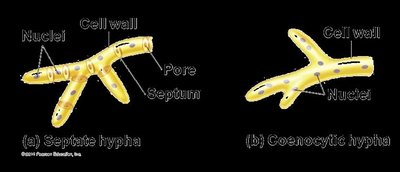
Septate Hyphae: Hyphae divided into cells by cross-walls called septa, with pores allowing cytoplasmic streaming.
Coenocytic Hyphae: Hyphae lacking septa, resulting in a continuous cytoplasmic mass with many nuclei.
Fungal Reproduction
Spore Dispersal
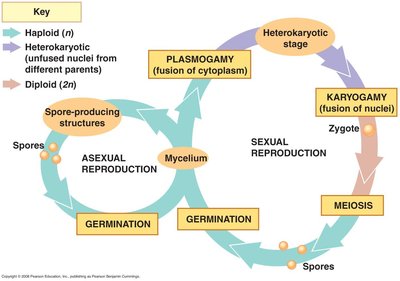
Fungi reproduce by producing spores, which are highly effective at dispersal and can germinate into new mycelia. Both sexual and asexual reproduction are common in fungi.
Asexual Reproduction
Many fungi reproduce asexually by producing haploid spores through mitosis.
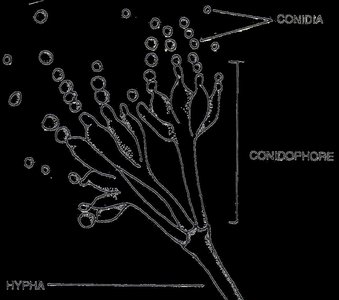
Filamentous fungi produce spores called conidia at the tips of hyphae.
Yeasts reproduce by budding, a process where a new cell forms from the parent cell.
Sexual Reproduction
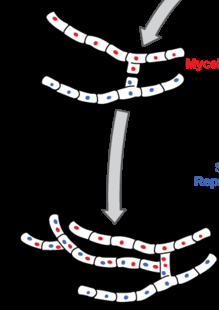
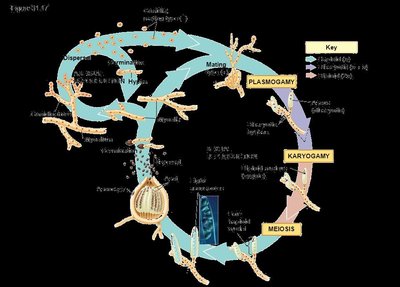
Sexual reproduction involves the fusion of compatible haploid hyphae.
Plasmogamy: Fusion of cytoplasm from two parent mycelia.
Heterokaryotic Stage: Cells contain two or more genetically distinct nuclei.
Karyogamy: Fusion of nuclei to form a diploid zygote, followed by meiosis to produce haploid spores.
Fungal Diversity
Major Groups of Fungi
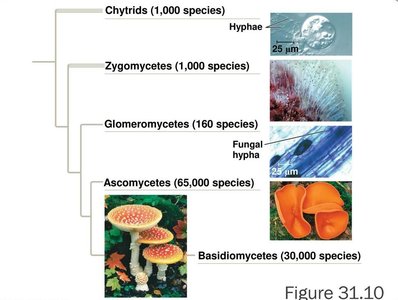
Fungi are classified into several major groups based on their reproductive structures and genetic data.
Group | Key Features |
|---|---|
Chytrids | Flagellated spores (zoospores); aquatic and soil habitats; decomposers, parasites, mutualists |
Zygomycetes | Produce zygosporangia; many are molds on food; some are parasites or symbionts |
Glomeromycetes | Form arbuscular mycorrhizae with plants; critical for plant nutrient uptake |
Ascomycetes | Produce spores in asci; includes yeasts, molds, and lichen formers |
Basidiomycetes | Produce spores on basidia; includes mushrooms, puffballs, and shelf fungi |
Chytrids
Found in lakes and soil; earliest diverging fungal lineage.
Unique for having flagellated spores (zoospores).
Roles include decomposition, parasitism, and mutualism.
Zygomycetes
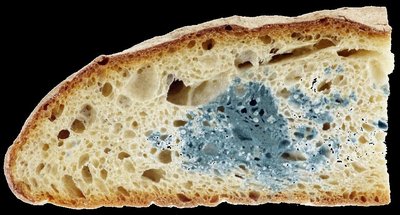
Commonly found on decaying food (e.g., bread mold).
Form resistant zygosporangia during sexual reproduction.
Can act as parasites or neutral symbionts of animals.

Glomeromycetes
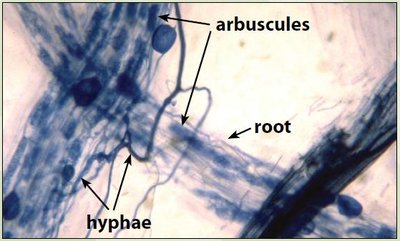
Form arbuscular mycorrhizal associations with plant roots.
Essential for plant nutrient uptake, especially phosphorus.
About 80% of plant species depend on these fungi.
Ascomycetes
Largest fungal group; includes marine, freshwater, and terrestrial species.
Produce sexual spores in sac-like asci and asexual spores (conidia) at hyphal tips.
Many form lichens in symbiosis with algae or cyanobacteria.
Basidiomycetes
Includes mushrooms, puffballs, and shelf fungi.
Important decomposers of wood and plant material.
Some are plant pathogens (e.g., rusts and smuts).
Fungal Symbioses and Ecological Roles
Mycorrhizal Fungi
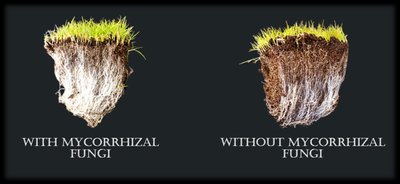
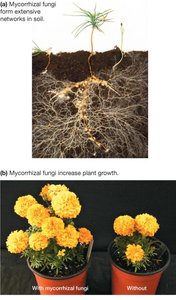
Form mutualistic relationships with plant roots, enhancing water and nutrient uptake.
Two main types: Ectomycorrhizal Fungi (EMF) and Arbuscular Mycorrhizal Fungi (AMF).
Critical for plant health and agricultural productivity.
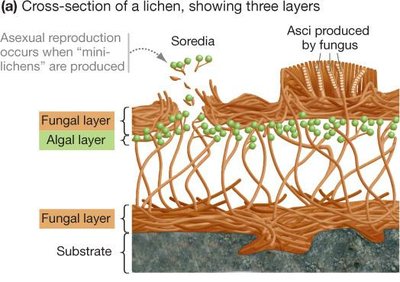
Lichens
Symbiotic associations between fungi (usually ascomycetes) and photosynthetic algae or cyanobacteria.
Algae provide carbohydrates via photosynthesis; fungi offer shelter, moisture, and nutrients.
Lichens are important pioneers in ecological succession and indicators of air quality.
Other Symbioses
Endophytes: Fungi living inside plant tissues, often conferring stress resistance.
Pathogens: Some fungi cause diseases in plants, animals, and humans (e.g., white-nose syndrome in bats, athlete’s foot in humans).
Commensals: Fungi that live in or on other organisms without causing harm, sometimes influencing host immune systems.
Economic and Health Importance of Fungi
Economic Benefits
Edible fungi (mushrooms), fermentation (yeasts for bread, beer, wine), and production of antibiotics (e.g., penicillin).
Fungi are essential for plant health and thus for agriculture.
Economic and Health Challenges
Fungal pathogens destroy crops (rusts, smuts, mildews, wilts, blights), causing significant economic losses.
Fungi can cause human diseases such as athlete’s foot, ringworm, and more serious systemic infections.
Fungi in Evolution and Classification
Fungi are more closely related to animals than plants, as shown by DNA sequence data, chitin synthesis, and storage of glucose as glycogen.
Fungal flagella are structurally similar to those in animals.
Summary Table: Major Fungal Groups and Their Features
Group | Key Sexual Structure | Ecological Role | Example |
|---|---|---|---|
Chytrids | Motile zoospores | Decomposers, parasites | Batrachochytrium dendrobatidis |
Zygomycetes | Zygosporangium | Decomposers, parasites | Bread mold (Rhizopus) |
Glomeromycetes | Arbuscular mycorrhizae | Mutualists | AMF species |
Ascomycetes | Ascus | Diverse (decomposers, pathogens, mutualists) | Yeast, morels, truffles |
Basidiomycetes | Basidium | Decomposers, pathogens | Mushrooms, puffballs |
Key Learning Objectives
Describe the mode of nutrient acquisition in fungi.
Explain the general fungal life cycle and distinguish between asexual and sexual reproduction.
Recognize the differences between the five main groups of fungi and their reproductive structures.
Discuss the ecological, economic, and health importance of fungi.
Identify examples of symbiotic relationships involving fungi.
