 Back
BackGas Exchange Across Specialized Respiratory Surfaces
Study Guide - Smart Notes
 Tailored notes based on your materials, expanded with key definitions, examples, and context.
Gas Exchange Across Specialized Respiratory Surfaces
Introduction to Gas Exchange
Gas exchange is the biological process by which organisms obtain molecular oxygen (O2) from their environment and release carbon dioxide (CO2). This process is essential for cellular respiration and energy production in all aerobic organisms. Gas exchange occurs across specialized surfaces adapted to maximize efficiency, depending on the organism's habitat and physiology.
Partial Pressure Gradients and Gas Exchange
Partial Pressure and Its Role
Partial pressure is the pressure exerted by a specific gas in a mixture of gases. It determines the direction and rate of gas diffusion across respiratory surfaces.
Gases diffuse from regions of higher partial pressure to regions of lower partial pressure, following their pressure gradients.
The rate of diffusion is proportional to the magnitude of the partial pressure gradient.
At sea level, atmospheric pressure is 760 mm Hg. Since O2 makes up 21% of air, its partial pressure (PO2) is mm Hg.
Partial pressures also apply to gases dissolved in liquids, such as water, but the actual concentration depends on solubility.
Comparing Air and Water as Respiratory Media
The efficiency and challenges of gas exchange differ greatly between air and water due to differences in O2 content, density, and viscosity.
Air (Sea Level) | Water (20°C) | Air-to-Water Ratio | |
|---|---|---|---|
O2 partial pressure | 160 mm | 160 mm | 1:1 |
O2 concentration | 210 mL/L | 7 mL/L | 30:1 |
Density | 0.0013 kg/L | 1 kg/L | 1:770 |
Viscosity | 0.02 cP | 1 cP | 1:50 |
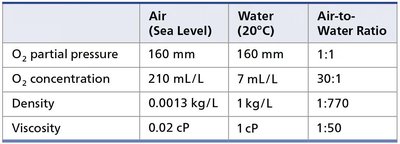
O2 is much more abundant and easier to extract from air than water.
Water's higher density and viscosity make gas exchange more energetically demanding for aquatic animals.
Respiratory Surfaces and Adaptations
General Properties of Respiratory Surfaces
Respiratory surfaces must be thin, moist, and have a large surface area to facilitate rapid diffusion of gases.
In simple animals, every cell is close to the environment, allowing direct gas exchange. In larger or more complex animals, specialized organs (gills, tracheae, lungs) are required.
The rate of diffusion is described by Fick's Law:
Types of Respiratory Organs
Skin: Used by earthworms and some amphibians, where capillaries just below the skin facilitate exchange.
Gills: Outfoldings of the body surface, highly branched or folded to increase surface area, found in many aquatic animals.
Tracheal Systems: Networks of air tubes in insects that deliver O2 directly to cells.
Lungs: Infolded respiratory surfaces found in most terrestrial vertebrates, with internal branching to maximize surface area.
Gills in Aquatic Animals
Structure and Function of Gills
Gills are specialized for extracting O2 from water. Their structure varies among animal groups but always maximizes surface area for diffusion.
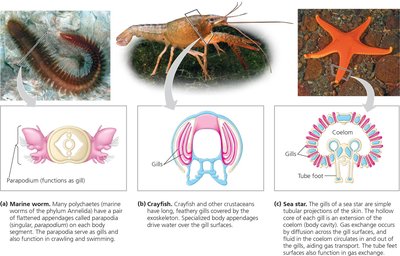
Gills may be external (e.g., marine worms), protected by exoskeleton (e.g., crayfish), or distributed along body projections (e.g., sea stars).
Ventilation (movement of water over gills) is essential to maintain O2 and CO2 gradients.
Fish Gills and Countercurrent Exchange
Fish gills are highly efficient due to their structure and the use of countercurrent exchange, where blood and water flow in opposite directions to maximize O2 uptake.
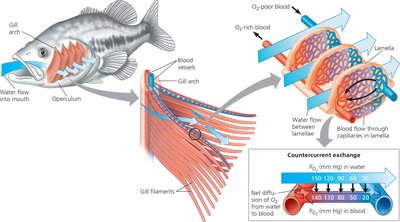
Water flows over gill filaments and lamellae, where blood in capillaries picks up O2.
Countercurrent exchange maintains a gradient favoring O2 diffusion into blood along the entire gill.
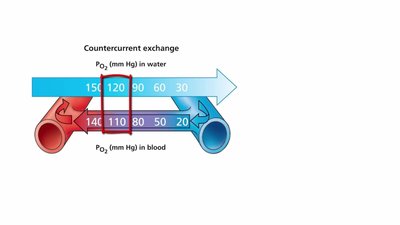
More than 80% of O2 in water can be extracted by fish gills due to this mechanism.
Tracheal Systems in Insects
Structure and Function
Insects possess a tracheal system—a network of tubes that delivers air directly to body cells, bypassing the need for a circulatory system in gas transport.
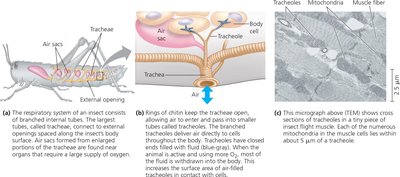
Tracheae open to the outside via spiracles and branch into finer tracheoles that reach every cell.
Gas exchange occurs by diffusion at the moist tips of tracheoles.
Active insects ventilate their tracheal system by body movements, increasing O2 delivery during flight.
Lungs: Structure and Function in Mammals
Anatomy of the Mammalian Respiratory System
Mammalian lungs are highly branched, localized organs where gas exchange occurs in microscopic alveoli. The lungs are ventilated by the movement of the diaphragm and rib cage.
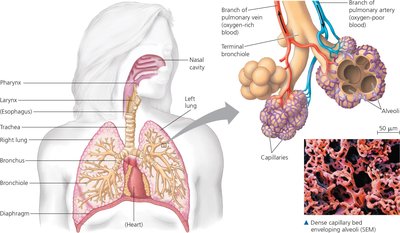
Air enters through the nasal cavity, passes through the pharynx, larynx, trachea, bronchi, and bronchioles, and finally reaches the alveoli.
Alveoli are surrounded by capillaries, providing a large surface area (~100 m2) for gas exchange.
O2 diffuses from alveoli into blood; CO2 diffuses from blood into alveoli.
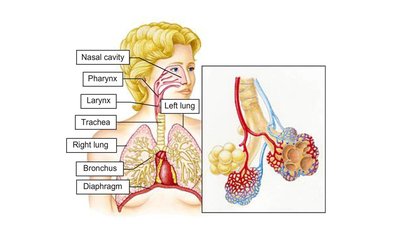
The "mucus escalator" (cilia and mucus in airways) helps remove particulates from the respiratory tract.
Alveoli are lined with surfactant, a substance that reduces surface tension and prevents collapse.
Clinical Connection: Surfactant and Respiratory Distress Syndrome (RDS)
Surfactant is essential for keeping alveoli open. Premature infants may lack surfactant, leading to RDS, a potentially fatal condition.
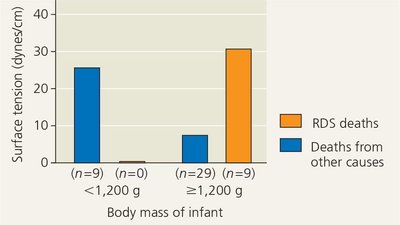
Research by Mary Ellen Avery demonstrated that high surface tension in alveoli (due to lack of surfactant) is associated with RDS in preterm infants.
Artificial surfactants are now used to treat RDS, greatly improving survival rates for premature infants.
Summary Table: Comparison of Respiratory Structures
Organism | Respiratory Structure | Key Adaptation |
|---|---|---|
Earthworm | Skin | Dense capillary network under moist skin |
Fish | Gills | Countercurrent exchange maximizes O2 uptake |
Insect | Tracheal system | Direct delivery of air to cells via tracheae |
Mammal | Lungs | Highly branched airways and alveoli; surfactant reduces surface tension |
Key Terms
Partial pressure (PO2, PCO2): The pressure exerted by a single gas in a mixture.
Ventilation: Movement of the respiratory medium (air or water) over the respiratory surface.
Countercurrent exchange: Mechanism where fluids flow in opposite directions to maximize exchange efficiency.
Surfactant: Substance that reduces surface tension in alveoli, preventing collapse.
Alveolus (plural: alveoli): Tiny air sac in the lung where gas exchange occurs.
Bronchus (plural: bronchi): Major airway branch leading into the lungs.
Additional info: Countercurrent exchange is also used in thermoregulation (e.g., in bird legs) and in the kidney for concentrating urine.
