 Back
Gas Exchange and Circulation: Mechanisms and Adaptations in Animals
Study Guide - Smart Notes
 Tailored notes based on your materials, expanded with key definitions, examples, and context.
Gas Exchange and Circulation
Overview of Respiration
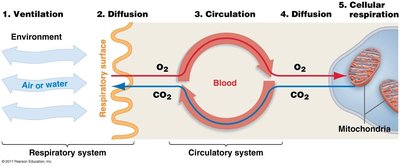
The process of respiration in animals involves the coordinated function of the respiratory and circulatory systems to deliver oxygen to cells and remove carbon dioxide. Oxygen is brought from the environment to the mitochondria, while carbon dioxide is transported back to the environment.
Ventilation: Movement of air or water across respiratory surfaces.
Diffusion: Passive movement of gases across membranes.
Circulation: Transport of gases via blood or hemolymph.
Cellular Respiration: Use of oxygen and production of carbon dioxide in mitochondria.
Physics of Respiration
Both air and water are fluids, and their movement is driven by pressure differences (bulk flow). The rate of flow depends on pressure differential, viscosity, and diameter of the tubes.
Bulk Flow: Movement of fluids due to pressure differences.
Fick's Law: Describes the rate of diffusion of gases across membranes.
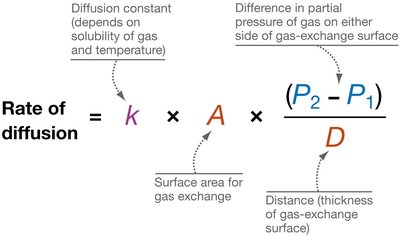
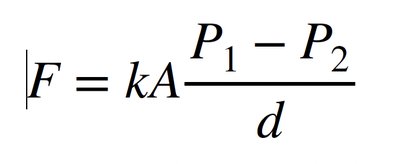
Fick's Law Equation:
k: Diffusion constant (depends on solubility and temperature)
A: Surface area for gas exchange
P1 - P2: Partial pressure difference
d: Thickness of gas-exchange surface
Partial Pressure and Solubility
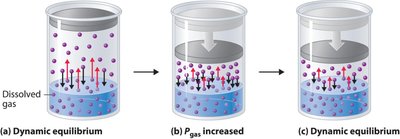
Gas diffusion is driven by partial pressure gradients. Partial pressure can be calculated for gases in air, dissolved in water, or bound to carriers. The solubility of gases in water is influenced by temperature and the presence of other solutes.
Partial Pressure: The pressure exerted by a single gas in a mixture.
Solubility: Amount of gas that dissolves in water depends on partial pressure and solubility.
Temperature: Higher temperatures decrease gas solubility.
Other Solutes: Seawater holds less dissolved gas than freshwater.
Gas Exchange Organs in Animals
Diffusion Across Body Surface
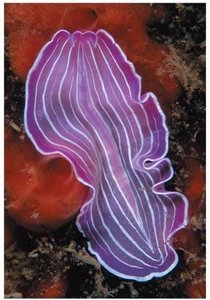
Some small or thin animals rely on diffusion across their body surface for gas exchange. This method is effective only in moist environments and for organisms with high surface area to volume ratios.
Gills
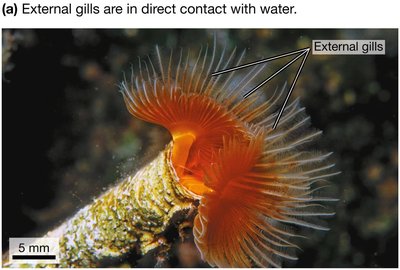
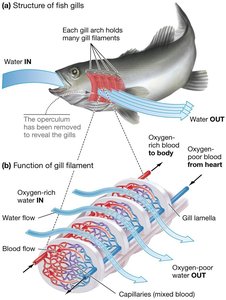
Gills are specialized outgrowths used for gas exchange in aquatic animals. They can be external or internal and are adapted for efficient oxygen extraction from water.
External Gills: Direct contact with water, often seen in larval or sessile aquatic animals.
Internal Gills: Protected within the body, as in fish.
Counter-current Exchange: Blood flows opposite to water, maximizing oxygen uptake.
Tracheal System in Insects
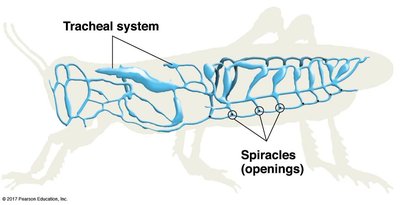
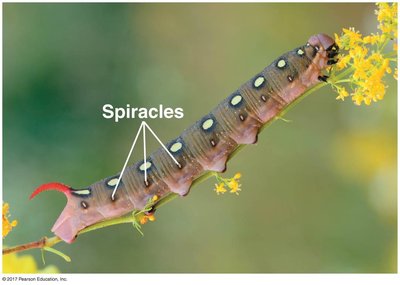
Insects and some other arthropods use a tracheal system, a network of tubes that deliver air directly to tissues. Spiracles are openings that regulate air entry and water loss.
Tracheae: Tubes for direct gas transport.
Spiracles: Openings that can close to prevent water loss.
Gas Movement: Driven by diffusion and sometimes by muscle movement.
Vertebrate Lungs
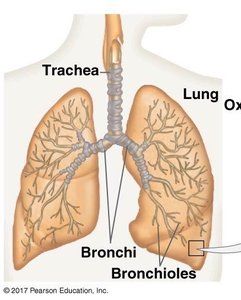
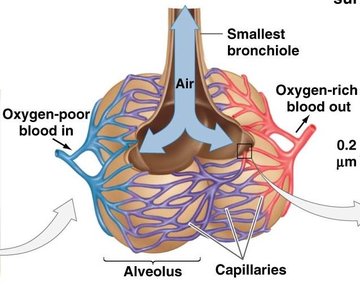
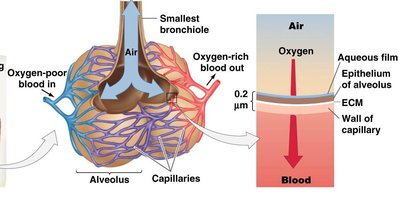
Most terrestrial vertebrates have lungs, which are invaginated structures that minimize water loss and maximize gas exchange. Air enters through the nose and mouth, travels down the trachea, and branches into bronchi and bronchioles within the lungs.
Bronchi and Bronchioles: Branching tubes that distribute air.
Alveoli: Small sacs where gas exchange occurs.
Mechanisms of Ventilation
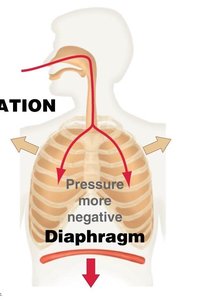
Ventilation in vertebrates is achieved by changes in thoracic cavity volume, primarily through the action of the diaphragm. Negative pressure draws air into the lungs, while relaxation allows exhalation.
Negative Pressure Ventilation: Expansion of thoracic cavity lowers pressure, drawing air in.
Diaphragm: Muscular sheet that contracts to increase chest volume.
Avian Ventilation
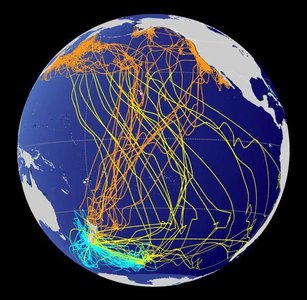
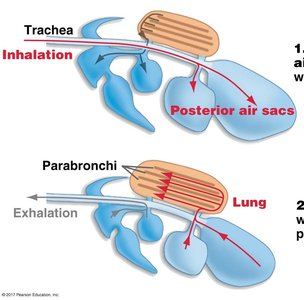
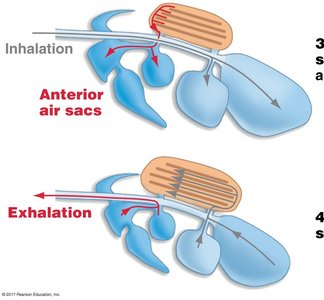
Birds have a highly efficient respiratory system with one-way airflow through lungs, supported by air sacs. Gas exchange occurs during both inhalation and exhalation, enabling birds to extract oxygen even at high altitudes.
Air Sacs: Enable unidirectional airflow.
Parabronchi: Sites of gas exchange.
Gas Transport in Blood
Respiratory Pigments
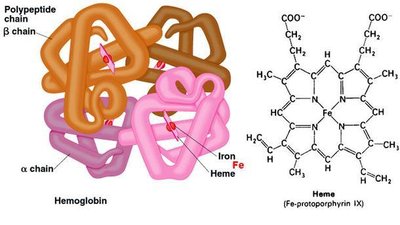
Due to low solubility of oxygen in water, animals use respiratory pigments to transport oxygen. Hemoglobin (iron-based) is the primary pigment in vertebrates, while hemocyanin (copper-based) is found in some invertebrates.
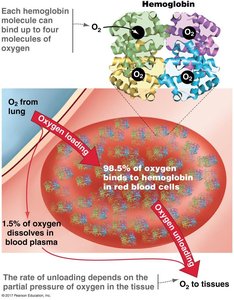
Hemoglobin: Found in red blood cells, binds up to four O2 molecules.
Cooperative Binding: Binding of one O2 increases affinity for more.
Oxygen Equilibrium Curve
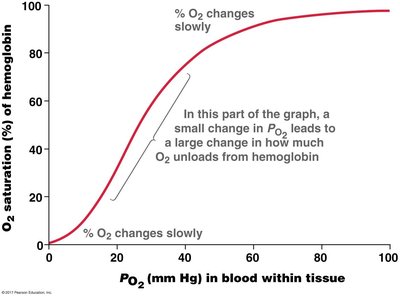
The relationship between partial pressure of oxygen (PO2) and hemoglobin saturation is non-linear due to cooperative binding. At tissue-level PO2, small changes can lead to large changes in O2 unloading.
Carbon Dioxide Transport
Most CO2 in blood is converted to bicarbonate, which helps regulate extracellular fluid pH. Increased ventilation decreases CO2 and increases pH.
Circulatory Systems
Types of Circulatory Systems
Animals may have open or closed circulatory systems. Open systems are found in most invertebrates, while closed systems are characteristic of vertebrates and support higher metabolic rates.
Open System: Hemolymph flows through open spaces (sinuses).
Closed System: Blood remains in vessels, allowing precise delivery.
Blood Vessels
Arteries: Carry blood away from the heart, thick-walled, high pressure.
Veins: Carry blood to the heart, thin-walled, low pressure, contain valves.
Capillaries: One cell thick, allow exchange of gases, nutrients, and waste.
Pressure Differences and Lymph Formation
Pressure differences in capillaries create interstitial fluid, some of which is reclaimed by osmotic pressure. Excess fluid is collected by the lymphatic system and returned to circulation.
Characteristic | Open System | Closed System |
|---|---|---|
Circulating Fluid | Hemolymph | Blood |
Pressure | Lower | Higher |
Rate of Flow | Lower | Higher |
Control of Flow | Limited | Significant |
Diffusion Distance | Lower | Higher |
Example: Fish have closed circulatory systems with specialized gills for gas exchange, while insects have open systems with tracheal tubes.
Additional info: The notes expand on the original content by providing definitions, examples, and context for each topic, ensuring completeness and academic quality for exam preparation.
