 Back
Gas Exchange and Photosynthesis in Plants
Study Guide - Smart Notes
 Tailored notes based on your materials, expanded with key definitions, examples, and context.
Photosynthetic Organisms
Types of Photoautotrophs
Photoautotrophs are organisms that produce their own food using light energy. They play a crucial role in the biosphere by converting solar energy into chemical energy through photosynthesis.
Cyanobacteria: Prokaryotic, photosynthetic bacteria found in aquatic environments. They are among the earliest photosynthetic organisms on Earth.
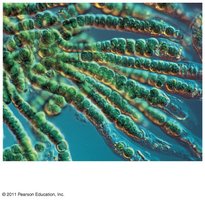
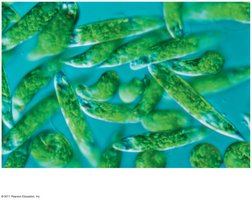
Unicellular Protists: Single-celled eukaryotes, such as Euglena and Chlamydomonas, that perform photosynthesis.
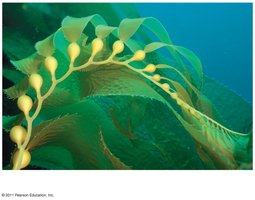
Multicellular Algae: Large, complex algae like kelp, which form underwater forests and contribute significantly to marine photosynthesis.
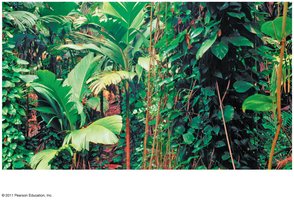
Plants: Terrestrial multicellular organisms that dominate land photosynthesis.
Gas Exchange in Land Plants
Stomata Function and Regulation
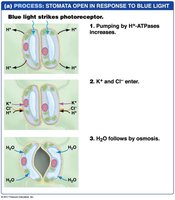
Gas exchange in plants occurs through stomata, pores in the epidermis controlled by two guard cells. Stomata regulate the intake of CO2 and release of O2, as well as water vapor loss.
Open Stomata: Guard cells swell by ion transport and osmosis, allowing gas exchange.
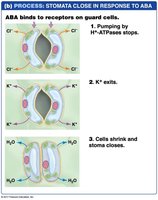
Closed Stomata: Guard cells shrink, closing the pore to conserve water.
Regulation: Blue light triggers stomatal opening by increasing ion concentration in guard cells, leading to water influx and cell swelling.
Closure: Dehydration triggers the hormone abscisic acid (ABA), causing ion efflux and water loss from guard cells, resulting in stomatal closure.
Key Terms: Stoma (singular), Guard cells, Abscisic acid (ABA)
Overview of Photosynthesis
Chloroplast Anatomy
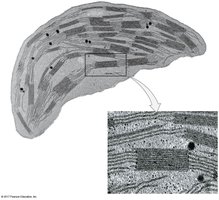
The chloroplast is the organelle responsible for photosynthesis in plants and algae. It contains its own DNA and ribosomes, and is structured with inner and outer membranes, stroma, and thylakoids.
Thylakoids: Membrane-bound sacs containing chlorophyll.
Granum: Stack of thylakoids.
Stroma: Fluid surrounding thylakoids where the Calvin cycle occurs.
Photosynthesis Summary Equation
Photosynthesis converts carbon dioxide and water into sugars and oxygen using light energy:
Equation:
CO2 Fixation: CO2 is incorporated into a 3-carbon sugar.
H2O Splitting: Water is split to provide electrons and protons, releasing O2.
Two Stages of Photosynthesis
Light Reactions: Occur in thylakoids; convert light energy to chemical energy (ATP, NADPH).
Calvin Cycle: Occurs in stroma; uses ATP and NADPH to fix carbon and produce sugars.
Light Reactions
Light Absorption and Pigments
Photosynthetic pigments absorb specific wavelengths of visible light (380–750 nm). Chlorophyll a absorbs blue and red light most effectively, reflecting green/yellow.
Visible Light Spectrum: Shorter wavelengths have higher energy.
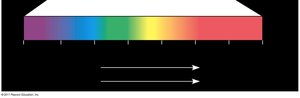
Absorption Spectra: Shows which wavelengths are absorbed by chlorophyll and carotenoids.
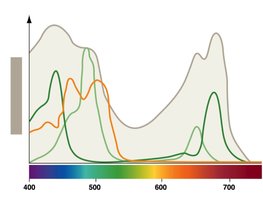
Example: Engelmann's experiment demonstrated that photosynthesis is most effective under blue-violet and red light.
Photosystems and Electron Transport
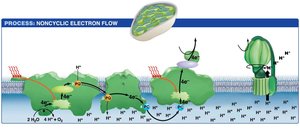
Light reactions occur in two photosystems (PSII and PSI) embedded in the thylakoid membrane. These complexes absorb photons, excite electrons, and drive electron transport chains.
Photosystem II (PSII): Splits water to replace electrons, releases O2, and pumps protons into thylakoid lumen.
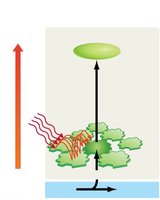
Electron Transport Chain: Transfers electrons from PSII to PSI, generating ATP via proton-motive force.
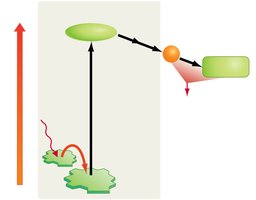
Photosystem I (PSI): Excited electrons are transferred to NADP+ to form NADPH.
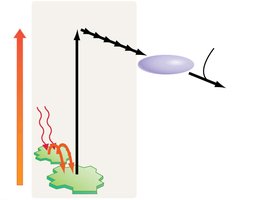
Key Terms: P680, P700, ATP synthase, NADP+ reductase
ATP and NADPH Production
ATP is produced as protons flow down their concentration gradient through ATP synthase. NADPH is generated by the reduction of NADP+ at the end of the electron transport chain.
ATP: Synthesized in the stroma.
NADPH: Provides reducing power for the Calvin cycle.
Calvin Cycle
Phases of the Calvin Cycle
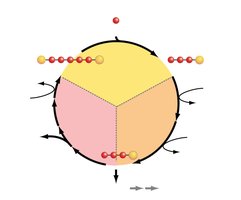
The Calvin cycle uses ATP and NADPH to fix carbon dioxide and produce sugars. It occurs in three main phases:
Fixation: CO2 is attached to ribulose bisphosphate (RuBP) by the enzyme Rubisco, forming two 3-phosphoglycerate (3PGA) molecules.
Reduction: 3PGA is reduced to glyceraldehyde-3-phosphate (G3P) using ATP and NADPH.
Regeneration: Most G3P is recycled to regenerate RuBP, enabling the cycle to continue.
Equation:
CO2 Storage in Hot, Dry Habitats
Adaptations in Grasses and Cacti
Plants in arid environments have evolved mechanisms to optimize CO2 fixation while minimizing water loss.
Grasses (Simultaneous): CO2 fixation occurs in different cell types at the same time using phosphoenolpyruvate carboxylase and Rubisco.
Cacti (Asynchronous): CO2 is fixed at night when stomata are open, then released internally for the Calvin cycle during the day when stomata are closed.
Key Terms: Phosphoenolpyruvate carboxylase, Rubisco, CAM pathway, C4 pathway
Mini-Review: Stages of Photosynthesis
Comparison of Light Reactions and Calvin Cycle
Stage | Requirements | Products | Location |
|---|---|---|---|
Light Reactions | Photons, H2O | ATP, NADPH, O2 | Thylakoids |
Calvin Cycle | ATP, NADPH, CO2 | Sugar (G3P) | Stroma |
Comparison: ATP Production in Photosynthesis vs. Cellular Respiration
Photosynthesis: ATP is produced in chloroplasts during light reactions and used for carbon fixation.
Cellular Respiration: ATP is produced in mitochondria by oxidizing organic molecules.
Both: Use electron transport chains and chemiosmosis for ATP synthesis.
Example: Plant cells contain both chloroplasts and mitochondria, allowing them to perform photosynthesis and cellular respiration.
