 Back
BIO 102 Chapter 42 Part 2 A
Study Guide - Smart Notes
 Tailored notes based on your materials, expanded with key definitions, examples, and context.
BIO 102 Chapter 42 Part 2
Overview of Gas Exchange
Gas exchange is a fundamental biological process in which organisms take in oxygen (O2) from the environment and release carbon dioxide (CO2) produced by cellular metabolism. This exchange is essential for sustaining life and occurs across specialized respiratory surfaces.
Gas exchange: Uptake of O2 and discharge of CO2.
Driven by partial pressure gradients between the environment and internal tissues.
Partial Pressure Gradients in Gas Exchange
Partial Pressure and Its Role
Partial pressure is the pressure exerted by a specific gas within a mixture of gases. It is a key factor in driving the diffusion of gases across respiratory surfaces. Partial pressures also apply to gases dissolved in liquids, such as water.
Partial pressure: Determines the direction and rate of gas diffusion.
Gas exchange occurs from regions of higher partial pressure to lower partial pressure.
Comparison of Air and Water as Respiratory Media
Air and water differ significantly as respiratory media, affecting the efficiency and mechanisms of gas exchange in organisms.
Property | Air (Sea Level) | Water (20°C) | Air-to-Water Ratio |
|---|---|---|---|
O2 Partial Pressure | 160 mm Hg | 160 mm Hg | 1:1 |
O2 Concentration | 210 mL/L | 7 mL/L | 30:1 |
Density | 0.0013 kg/L | 1 kg/L | 1:770 |
Viscosity | 0.02 cP | 1 cP | 1:50 |
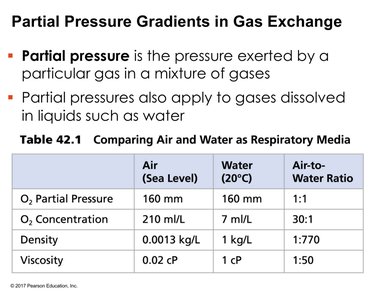
Key implications: Water contains much less O2 than air, is denser, and more viscous, requiring aquatic organisms to have highly efficient respiratory adaptations.
Respiratory Surfaces
Types and Mechanisms
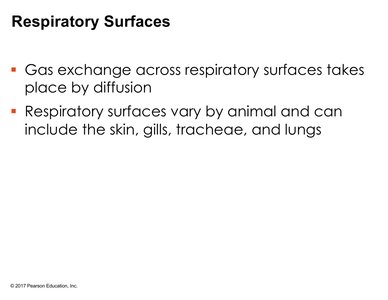
Gas exchange across respiratory surfaces occurs by diffusion. The type and structure of respiratory surfaces vary among animals, depending on their environment and metabolic needs.
Examples: Skin, gills, tracheae, lungs.
Efficiency depends on surface area, thickness, and exposure to the respiratory medium.
Ventilation in Aquatic Animals
Diversity of Gills
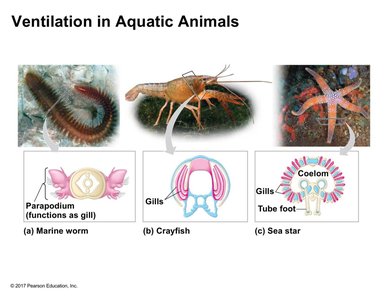
Gills are specialized extensions of tissue that facilitate gas exchange in aquatic animals. Their structure and organization vary widely, increasing surface area for efficient oxygen extraction from water.
External gills (e.g., marine worms, sea stars) are exposed and require constant movement for fresh water contact.
Internal gills (e.g., crayfish) are protected by body structures, reducing damage risk.
All gills serve to maximize surface area for gas exchange.
Countercurrent Exchange in Fish
Mechanism and Efficiency
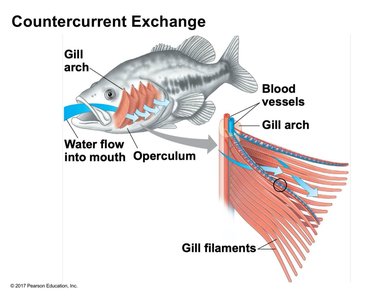
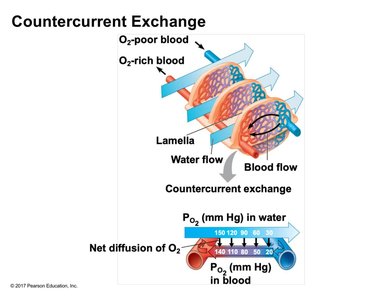
Bony fish utilize a countercurrent exchange mechanism in their gills to maximize oxygen uptake. Water flows through the mouth, across the gills, and out via the operculum. Blood flows in the opposite direction to water, maintaining a gradient for oxygen diffusion.
Gill arches contain gill filaments with lamellae, increasing surface area.
Countercurrent flow ensures blood is always less saturated with O2 than the water it encounters.
Net diffusion of O2 occurs along the entire length of the gill.
Equation for diffusion: Where J is the rate of diffusion, D is the diffusion coefficient, C is concentration, and x is distance.
Tracheal Systems in Insects
Structure and Function
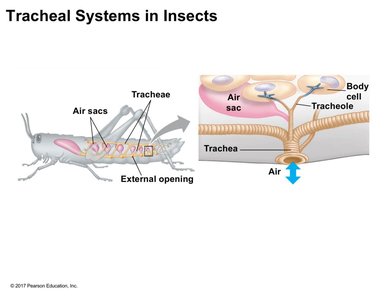
Insects possess a tracheal system composed of branched air ducts (tracheae) that deliver oxygen directly to body cells. Air enters through external openings called spiracles and diffuses through tracheoles in direct contact with cells.
Tracheae branch into tracheoles, reaching individual cells.
Gas exchange occurs independently of the circulatory system.
Spiracles regulate air entry and prevent water loss.
The Mammalian Respiratory System
Anatomy and Function
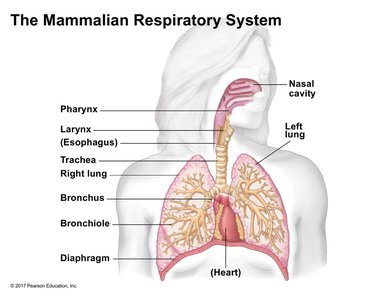
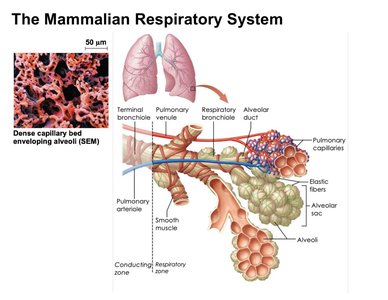
Mammals have a complex respiratory system consisting of multiple organs and passageways. Air is taken in through the nasal cavity, passes through the pharynx, larynx, trachea, bronchi, and bronchioles, and finally reaches the lungs.
Nasal cavity: Warms, moistens, and filters air.
Pharynx: Conduit for air.
Larynx: Routes air and food, produces sound.
Trachea: Supported by cartilage rings, prevents collapse.
Bronchi/Bronchioles: Branching pathways for air.
Lungs: Site of gas exchange.
Conducting and Respiratory Zones
The mammalian respiratory system is divided into the conducting zone (passageways for air) and the respiratory zone (sites of gas exchange). Gas exchange occurs in alveoli, which are closely associated with pulmonary capillaries.
Conducting zone: Cleans, humidifies, and warms air.
Respiratory zone: Alveoli and associated capillaries; site of O2 and CO2 exchange.
Close relationship between respiratory and cardiovascular systems.
Alveolar Surface Tension and Surfactants
Role of Surfactants
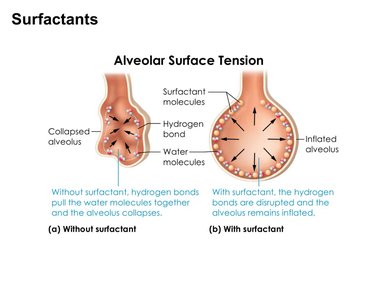
Alveoli are the primary sites of gas exchange in mammals. A thin layer of water covers the alveolar epithelium, creating surface tension due to hydrogen bonding. Excessive surface tension can cause alveolar collapse, impeding gas exchange. Surfactants, composed of amphiphilic proteins and phospholipids, disrupt hydrogen bonds and reduce surface tension, allowing alveoli to remain inflated.
Surfactants: Reduce surface tension, prevent alveolar collapse.
Deficiency in surfactants (e.g., in premature infants) leads to breathing difficulties.
Hydrogen bonding between water molecules is the source of surface tension.
Example: Premature infants often require medical intervention to compensate for insufficient surfactant production.
Additional info: The role of surfactants is critical in maintaining proper lung function and efficient gas exchange.
