 Back
Gene Expression and Its Regulation: Transcription, Translation, and Control in Prokaryotes and Eukaryotes
Study Guide - Smart Notes
 Tailored notes based on your materials, expanded with key definitions, examples, and context.
Gene Expression Overview
The Gene Concept, Chromosomes, and Proteins
Genes are segments of DNA that encode instructions for building proteins, which perform most cellular functions. Genes are organized on chromosomes, and each gene's expression results in the synthesis of a specific protein or functional RNA molecule.
Gene: A DNA sequence that codes for a functional product (protein or RNA).
Chromosome: A DNA molecule containing many genes, regulatory elements, and associated proteins.
Protein: A polymer of amino acids, whose sequence is determined by the gene's nucleotide sequence.
The Genetic Code
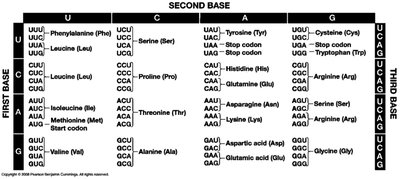
The genetic code is a set of rules by which information encoded in DNA or RNA sequences is translated into proteins by living cells. It is read in triplets called codons, each specifying an amino acid or a stop signal during translation.
Codon: A sequence of three nucleotides in mRNA that specifies a particular amino acid.
The genetic code is universal (shared by most organisms), redundant (multiple codons for one amino acid), and unambiguous (each codon specifies only one amino acid).
The Central Dogma of Molecular Biology
The central dogma describes the flow of genetic information: DNA → RNA → Protein. DNA is transcribed into RNA, which is then translated into protein.
Transcription: Synthesis of RNA from a DNA template.
Translation: Synthesis of protein from an mRNA template.
Example: A DNA sequence is transcribed into mRNA, which is then translated into a polypeptide chain using the genetic code.
Transcription
Overview and Key Players
Transcription is the process by which RNA is synthesized from a DNA template. It produces all types of RNA, including mRNA, tRNA, and rRNA.
RNA Polymerase: The enzyme that synthesizes RNA by reading the DNA template strand.
Sigma Factor (prokaryotes): A protein that helps RNA polymerase recognize promoter regions.
Holoenzyme: The complex of RNA polymerase and sigma factor.
Template Strand: The DNA strand used as a template for RNA synthesis.
Coding Strand: The DNA strand with the same sequence as the RNA (except T for U).
Mechanism of Transcription
Initiation: In prokaryotes, sigma factor binds to the promoter, recruiting RNA polymerase. In eukaryotes, transcription factors perform this role.
Elongation: RNA polymerase synthesizes RNA in the 5’→3’ direction.
Termination: In prokaryotes, hairpin structures in RNA signal termination. In eukaryotes, a poly(A) signal triggers termination.
RNA Processing in Eukaryotes
5’ Capping: Addition of a modified guanine nucleotide to the 5’ end of mRNA.
Intron Splicing: Removal of non-coding sequences (introns) from pre-mRNA.
3’ Polyadenylation: Addition of a poly(A) tail to the 3’ end of mRNA.
Spliceosome
The spliceosome is a complex of small nuclear RNAs (snRNAs) and proteins that removes introns from pre-mRNA and joins exons together, producing mature mRNA.
Translation
Key Players
mRNA: Carries the genetic code from DNA to the ribosome.
tRNA: Brings amino acids to the ribosome and matches them to the mRNA codons via its anticodon.
Ribosome: The molecular machine that assembles proteins, composed of rRNA and proteins.
Aminoacyl-tRNA Synthetases
These enzymes attach the correct amino acid to its corresponding tRNA, ensuring accurate translation of the genetic code.
Mechanism of Translation
Initiation: Initiation factors, initiator tRNA, and ribosomal subunits assemble at the start codon.
Elongation: The ribosome reads mRNA codons, and tRNAs deliver amino acids, which are joined to form a polypeptide.
Termination: Stop codons are recognized by release factors, ending translation and releasing the protein.
Post-Translational Modifications
Proteins may be chemically modified (e.g., phosphorylation, methylation, acetylation) to alter their activity, stability, or location.
Regulation of Gene Expression in Prokaryotes
Replica Plating
Replica plating is a technique used to identify bacterial mutants by transferring colonies to different media and observing growth patterns, helping to identify genes involved in metabolism.
Operon Structure
An operon is a cluster of genes under the control of a single promoter and regulatory elements, allowing coordinated expression.
Negative and Positive Control
Negative Control: Repressors bind to operators to block transcription (e.g., lac repressor in the lac operon).
Positive Control: Activators enhance transcription (e.g., CAP-cAMP complex in the lac operon).
Lac Repressor vs Trp Repressor
Lac Repressor: Inducible; inactivated by allolactose, allowing transcription when lactose is present.
Trp Repressor: Repressible; activated by tryptophan, blocking transcription when tryptophan is abundant.
Regulons
Regulons are groups of genes or operons controlled by a common regulatory protein, enabling global control of gene expression.
Regulation of Gene Expression in Eukaryotes
Chromatin Structure and Remodeling
Chromatin: DNA-protein complex that packages DNA in the nucleus.
Nucleosomes: DNA wrapped around histone proteins.
Chromosome Condensation: Compaction of chromatin during cell division.
Histones: Proteins that organize DNA into nucleosomes.
HAT (Histone Acetyltransferase): Adds acetyl groups to histones, loosening chromatin and promoting transcription.
HDAC (Histone Deacetylase): Removes acetyl groups, tightening chromatin and repressing transcription.
Cellular Differentiation and Stem Cells
Cellular differentiation is the process by which cells become specialized, driven by selective gene expression. Stem cells are undifferentiated cells capable of giving rise to various cell types.
Levels of Control
Chromatin Remodeling: Modifies DNA accessibility for transcription.
Transcription Initiation: Involves promoter proximal elements, enhancers, transcription factors, activators, and DNA bending proteins. Transcription factors are activated by signals and translocated to the nucleus.
RNA Processing: Alternative splicing allows a single gene to produce multiple mRNA variants.
RNA Stability: RNA interference and cap/tail removal regulate mRNA lifespan.
Post-Translational Control: Proteins are selectively degraded by proteasomes.
Comparison: Prokaryotic vs Eukaryotic Gene Regulation
Prokaryotes: Operons, simultaneous transcription and translation, simple regulation.
Eukaryotes: Chromatin structure, multiple regulatory levels, spatial and temporal separation of transcription and translation.
Higher Order Thinking Questions (with Academic Context)
Alleles and Isozymes: Different alleles can produce isozymes—distinct forms of the same enzyme with slightly different properties. The products may be the same or different, depending on the alleles.
Exceptions to the Central Dogma: Examples include reverse transcription (RNA → DNA), and non-coding RNAs that function without being translated.
Transcription in Eukaryotes vs Bacteria: Both use RNA polymerase, but eukaryotes have more complex initiation and RNA processing. See table below.
Simultaneous vs Separated Transcription/Translation: In bacteria, both processes occur together in the cytoplasm. In eukaryotes, transcription occurs in the nucleus and translation in the cytoplasm.
Aminoacyl-tRNA Synthetases: These enzymes recognize specific tRNAs and amino acids. Misloading leads to incorrect protein sequences; failure to load prevents translation.
Silent Mutation Example: Changing UUU to UUC is a silent mutation (codes for the same amino acid, phenylalanine). If the tRNA for UUC is less abundant, translation may slow.
Mutation Effects: Point mutations can be silent, missense, or nonsense, affecting protein function differently. Chromosome-level mutations can alter gene dosage or regulation; most are neutral or harmful.
Gene Types: Constitutive genes are always expressed (e.g., housekeeping genes), inducible genes are turned on by signals (e.g., lac operon), and repressible genes are turned off by signals (e.g., trp operon).
Signal Response Sequence: External signals (e.g., insulin) trigger intracellular pathways, activating transcription factors, chromatin remodeling, and gene expression changes.
Epigenetics vs Genetics: Genetics involves changes in DNA sequence; epigenetics involves heritable changes in gene expression without altering DNA sequence (e.g., DNA methylation, histone modification).
Table: Comparison of Prokaryotic and Eukaryotic Transcription
Feature | Prokaryotes | Eukaryotes |
|---|---|---|
Location | Cytoplasm | Nucleus |
RNA Polymerase | Single type | Multiple types (I, II, III) |
Initiation Factors | Sigma factor | Transcription factors |
RNA Processing | None | 5’ cap, splicing, 3’ poly(A) tail |
Transcription & Translation | Simultaneous | Separated |
Additional info: Some explanations and examples were expanded for clarity and completeness based on standard molecular biology curricula.
