 Back
BackGene Expression and Regulation: DNA Structure, Replication, and Protein Synthesis
Study Guide - Smart Notes
 Tailored notes based on your materials, expanded with key definitions, examples, and context.
Gene Expression and Regulation
Discovery of DNA as Genetic Material
The identification of DNA as the genetic material was a pivotal moment in biology, established through a series of experiments by Griffith, Hershey and Chase, and others. These experiments demonstrated that DNA, not protein, is responsible for heredity.
Griffith's Experiment: Showed that a 'transforming factor' could transfer genetic information between bacteria.
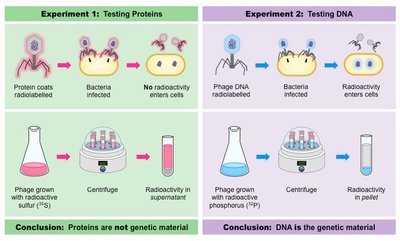
Hershey and Chase Experiment: Used radioactive labeling to show that DNA, not protein, enters bacteria during viral infection, confirming DNA as the genetic material.
Chargaff's Rules: Established that DNA composition varies between species, but the ratio of bases is characteristic.
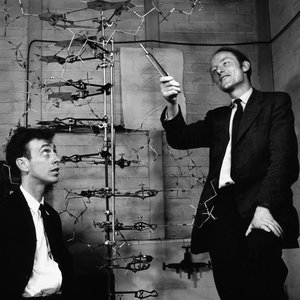
Watson, Crick, and Franklin: Double Helix Model
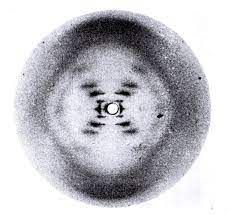
The structure of DNA was elucidated by Watson and Crick, who built upon Rosalind Franklin's X-ray diffraction images. The double helix model explained how DNA could store and transmit genetic information.
Double Helix: Two antiparallel strands twisted around each other.
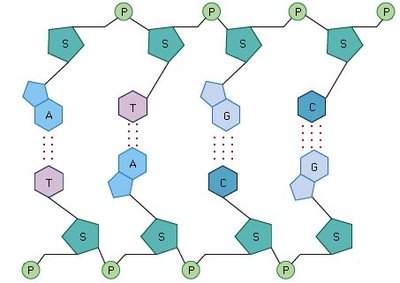
Base Pairing: Adenine pairs with Thymine (A-T), Guanine pairs with Cytosine (G-C).
Antiparallel Strands: One strand runs 5' to 3', the other 3' to 5'.
Structure of DNA
Nucleotide Composition and Bonding
DNA is composed of nucleotides, each containing a phosphate group, a deoxyribose sugar, and a nitrogenous base. The sequence of these bases encodes genetic information.
Pyrimidines: Single-ring bases (Thymine, Cytosine).
Purines: Double-ring bases (Adenine, Guanine).
Hydrogen Bonds: Hold base pairs together (2 between A-T, 3 between G-C).
Phosphodiester Bonds: Link phosphate and sugar groups in the backbone.
DNA vs. RNA
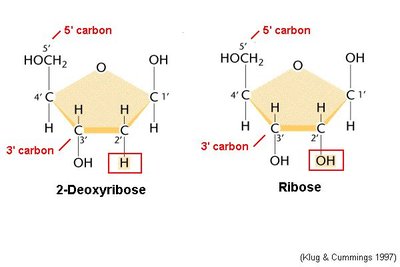
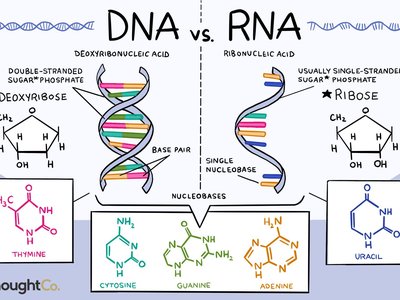
DNA and RNA are both nucleic acids but differ in structure and function. DNA is double-stranded and contains deoxyribose, while RNA is single-stranded and contains ribose.
DNA: Deoxyribose sugar, Thymine, double-stranded.
RNA: Ribose sugar, Uracil, single-stranded.
DNA in Prokaryotes vs. Eukaryotes
Chromosome Structure and Location
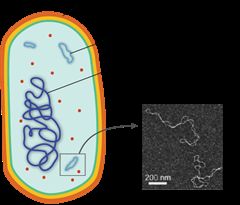
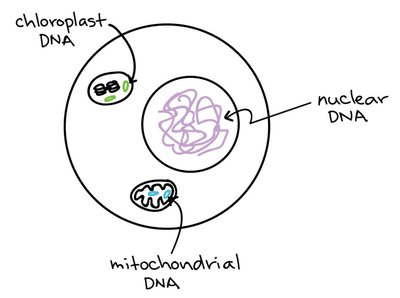
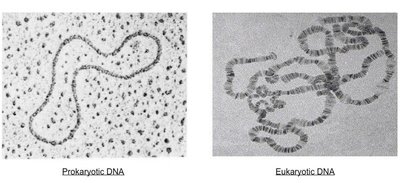
Prokaryotes and eukaryotes differ in the organization and location of their DNA. Prokaryotes have circular chromosomes and plasmids, while eukaryotes have multiple linear chromosomes located in the nucleus.
Prokaryotes: Circular chromosomes, plasmids, DNA in cytoplasm.
Eukaryotes: Linear chromosomes, DNA in nucleus, wrapped around histones.
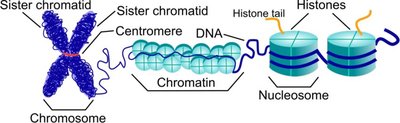
DNA Replication
Semiconservative Replication
DNA replication is the process by which DNA is copied before cell division. Each new DNA molecule consists of one old (parent) strand and one new strand, a process known as semiconservative replication.
Occurs in S phase: During the cell cycle.
Base Pairing: Ensures accurate copying.
Semiconservative: Each daughter DNA has one original and one new strand.
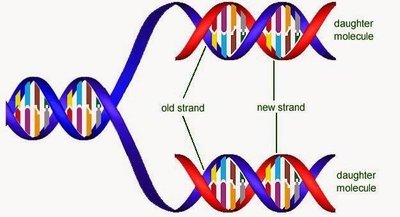
Enzymes Involved in DNA Replication
Several enzymes coordinate the replication process, ensuring accuracy and efficiency.
Helicase: Unwinds the DNA double helix.
Topoisomerase: Relieves strain from unwinding.
DNA Polymerase: Synthesizes new DNA strands, proofreads and edits.
Primase (RNA Polymerase): Adds RNA primers to start synthesis.
Ligase: Joins DNA fragments (especially on the lagging strand).
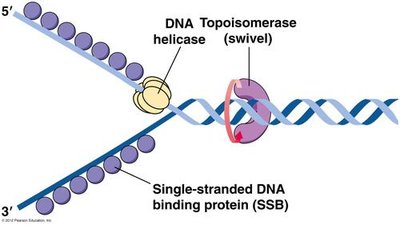
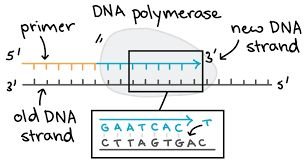
Leading and Lagging Strands
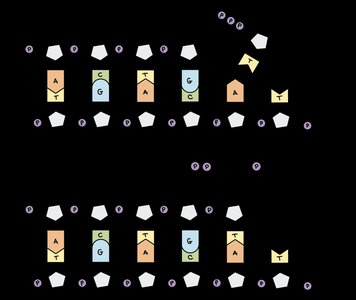
DNA polymerase can only add nucleotides to the 3' end, resulting in continuous synthesis on the leading strand and discontinuous synthesis (Okazaki fragments) on the lagging strand.
Leading Strand: Synthesized continuously in 5' to 3' direction.
Lagging Strand: Synthesized in fragments, later joined by ligase.
Telomeres and Chromosome Ends
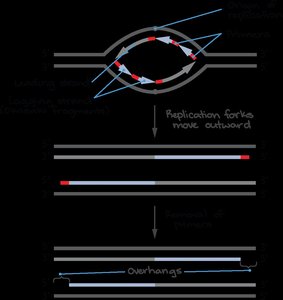
Telomeres are repetitive, non-coding sequences at the ends of eukaryotic chromosomes that protect genetic information. Telomerase can extend telomeres, but its activity is limited in most somatic cells.
Telomeres: Protect chromosome ends, shorten with each replication.
Telomerase: Enzyme that extends telomeres, active in stem cells and cancer.
DNA Replication in Prokaryotes vs. Eukaryotes
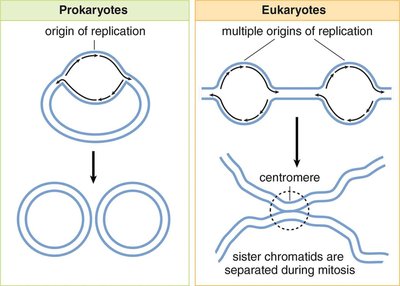
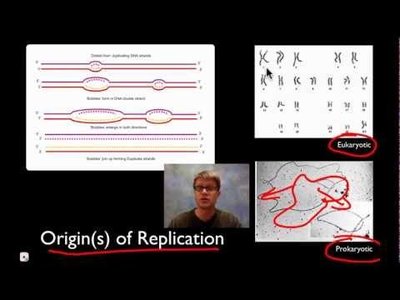
Replication mechanisms differ between prokaryotes and eukaryotes, reflecting their chromosome structure and cell division processes.
Prokaryotes: Single origin of replication, circular DNA.
Eukaryotes: Multiple origins of replication, linear DNA, sister chromatids separated during mitosis.
Protein Synthesis
RNA Types and Functions
RNA plays a central role in protein synthesis, with several types performing distinct functions.
mRNA: Carries genetic information from DNA to ribosome.
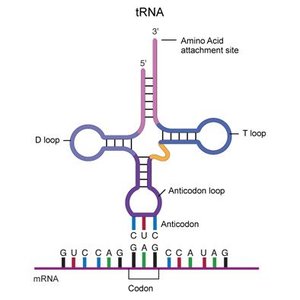
tRNA: Brings amino acids to ribosome.
rRNA: Structural component of ribosomes.
microRNA: Regulates gene expression by degrading mRNA.
Transcription
Transcription is the process by which a complementary mRNA sequence is synthesized from a DNA template. It uses many of the same enzymes as DNA replication.
Template Strand: The DNA strand used to make mRNA.
Direction: RNA polymerase synthesizes mRNA in 5' to 3' direction.
Base Pairing: A-U, T-A, G-C, C-G.
Post-Transcriptional Modification
Before mRNA leaves the nucleus in eukaryotes, it undergoes modifications to protect and prepare it for translation.
Poly-A Tail: Added to 3' end for stability.
GTP Cap: Added to 5' end for protection and ribosome recognition.
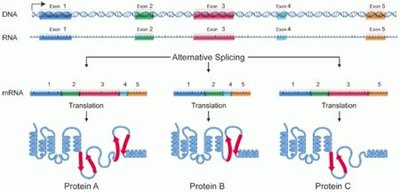
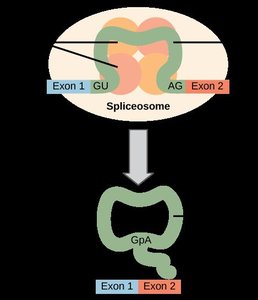
Splicing: Removal of introns, joining of exons; alternative splicing allows for multiple proteins from one gene.

Translation
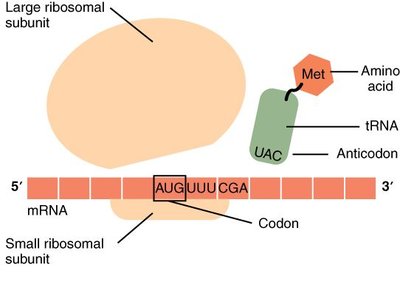
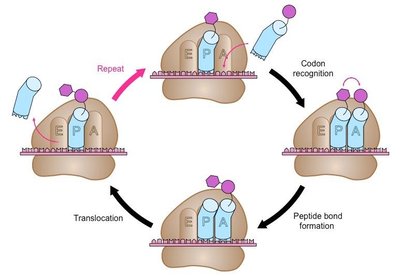
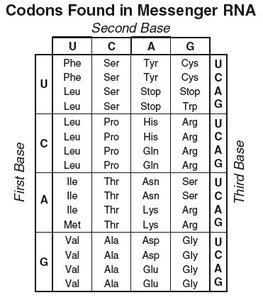
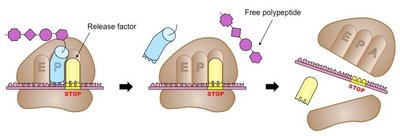
Translation is the process by which ribosomes synthesize proteins using the sequence of codons in mRNA. It occurs in three steps: initiation, elongation, and termination.
Initiation: Small ribosomal subunit binds to mRNA and initiator tRNA; large subunit joins.
Elongation: Ribosome moves along mRNA, tRNA brings amino acids, peptide bonds form.
Termination: Ribosome reaches stop codon, release factor causes polypeptide release.
Protein Folding and Processing
After translation, polypeptides fold into their functional shapes and may be modified or combined with other polypeptides.
Secondary/Tertiary Structure: Folding based on amino acid sequence.
Chaperonins: Assist in proper folding.
Quaternary Structure: Multiple polypeptides combine.
ER and Golgi: Further modification and packaging.
Protein Synthesis in Prokaryotes vs. Eukaryotes
Protein synthesis differs between prokaryotes and eukaryotes, reflecting their cellular organization.
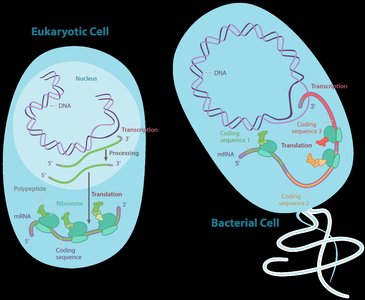
Prokaryotes: Transcription and translation occur simultaneously in cytoplasm; no mRNA editing.
Eukaryotes: Transcription in nucleus, mRNA editing, translation in cytoplasm after transcription.
Mutations
Types and Effects of Mutations
Mutations are changes in the DNA sequence that can arise from external mutagens or errors in replication and cell division. Their effects can be positive, negative, or neutral.
Point Mutations: Substitution of a single base; can be silent, missense, or nonsense.
Frameshift Mutations: Insertion or deletion shifts the reading frame, altering downstream codons.
Effects: Can cause diseases, confer advantages, or have no effect.
Regulation of Gene Expression
Gene Regulation in Eukaryotes
Gene expression is tightly regulated in eukaryotes to ensure cell differentiation and proper function. Regulation occurs at multiple levels.
Chromatin Structure: DNA wrapped around histones; acetylation loosens DNA, methylation tightens.
Transcription Initiation: Transcription factors, activators, and repressors control RNA polymerase binding.
Post-Transcriptional Regulation: Alternative splicing, mRNA degradation, translation initiation, protein processing, microRNAs.
Gene Regulation in Prokaryotes
Prokaryotes regulate gene expression primarily at the transcriptional level using operons, which are clusters of genes controlled by a single promoter.
Operon Structure: Promoter, operator, genes.
Repressible Operons: Turned off when end product is present (e.g., trp operon).
Inducible Operons: Turned on when substrate is present (e.g., lac operon).
Biotechnology
Restriction Enzymes and DNA Analysis
Biotechnology tools allow manipulation and analysis of DNA for research and medical applications.
Restriction Enzymes: Cut DNA at specific sequences.
PCR: Amplifies DNA for analysis.
Gel Electrophoresis: Separates DNA fragments by size.
Bacterial Transformation: Introduction of recombinant plasmids into bacteria.
DNA Sequencing: Determines the order of bases in DNA.
Viruses
Structure and Life Cycles
Viruses are non-cellular entities that require host cells to reproduce. They consist of a protein coat (capsid) and genetic material (DNA or RNA).
Lytic Cycle: Virus replicates rapidly, causing cell lysis and symptoms.
Lysogenic Cycle: Viral DNA integrates into host genome, remains dormant until triggered.
Retroviruses: Use reverse transcriptase to convert RNA to DNA, which integrates into host genome.
Gene Therapy
Gene therapy uses viral vectors to deliver functional genes to cells, offering potential treatments for genetic disorders.
