 Back
BackGene Expression: DNA Structure, Replication, Transcription, and Translation
Study Guide - Smart Notes
 Tailored notes based on your materials, expanded with key definitions, examples, and context.
Gene Expression and Regulation
Overview of Unit
This unit covers the molecular mechanisms by which genetic information is stored, replicated, and expressed in living organisms. The focus is on DNA and RNA structure, DNA replication, transcription, RNA processing, and translation, as well as the regulation of gene expression. These processes are fundamental to understanding how traits are inherited and how cells function.
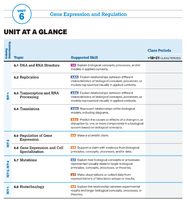
DNA and RNA Structure
Structure of DNA
Deoxyribonucleic acid (DNA) is the hereditary material in almost all living organisms. Its structure is a double helix composed of two antiparallel strands held together by hydrogen bonds between complementary nitrogenous bases.
Nucleotide: The basic unit of DNA, consisting of a phosphate group, deoxyribose sugar, and a nitrogenous base (adenine, thymine, cytosine, or guanine).
Base Pairing: Adenine (A) pairs with Thymine (T), and Cytosine (C) pairs with Guanine (G).
Antiparallel Orientation: The two DNA strands run in opposite directions (5' to 3' and 3' to 5').
Double Helix: The twisted ladder shape of DNA, with sugar-phosphate backbones on the outside and base pairs on the inside.
Chargaff's Rules: In any DNA sample, the amount of adenine equals thymine, and the amount of cytosine equals guanine.
Structure of RNA
Ribonucleic acid (RNA) is typically single-stranded and contains ribose sugar. RNA uses uracil (U) instead of thymine (T).
Types of RNA: Messenger RNA (mRNA), transfer RNA (tRNA), and ribosomal RNA (rRNA).
Base Pairing in RNA: Adenine pairs with uracil, and cytosine pairs with guanine.
DNA Replication
Mechanism of Replication
DNA replication is the process by which a cell duplicates its DNA before cell division. It is semiconservative, meaning each new DNA molecule consists of one old strand and one new strand.
Origin of Replication: Specific sequence where replication begins.
Helicase: Enzyme that unwinds and separates the DNA strands.
DNA Polymerase: Enzyme that adds nucleotides to the growing DNA strand in the 5' to 3' direction, reading the template strand 3' to 5'.
Leading Strand: Synthesized continuously toward the replication fork.
Lagging Strand: Synthesized discontinuously away from the replication fork in short segments called Okazaki fragments.
Primase: Synthesizes RNA primers to provide a starting point for DNA polymerase.
Ligase: Joins Okazaki fragments together.
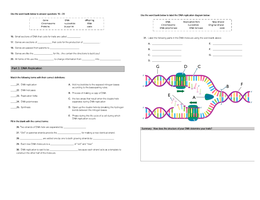
Directionality: DNA polymerase can only add nucleotides to the 3' end of a growing strand, so synthesis always proceeds 5' to 3'.
Key Concepts in Replication
Semiconservative Replication: Each new DNA molecule contains one original and one new strand.
Okazaki Fragments: Short DNA fragments synthesized on the lagging strand.
Replication Fork: The Y-shaped region where the DNA is split into two separate strands for copying.
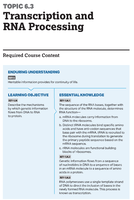
Transcription and RNA Processing
Transcription
Transcription is the process by which the information in a DNA sequence is copied into a complementary RNA sequence. This process occurs in the nucleus of eukaryotic cells.
Initiation: RNA polymerase binds to the promoter region (TATA box in eukaryotes) with the help of transcription factors.
Elongation: RNA polymerase moves along the DNA template strand (3' to 5'), synthesizing the mRNA strand in the 5' to 3' direction.
Termination: In prokaryotes, transcription ends at a termination sequence. In eukaryotes, a polyadenylation signal (AAUAAA) signals the end, and the pre-mRNA is released.
RNA Processing (Eukaryotes)
Before mRNA can be translated, it must be processed:
5' Cap: Addition of a modified guanine nucleotide to the 5' end.
Poly-A Tail: Addition of 50-250 adenine nucleotides to the 3' end.
RNA Splicing: Removal of non-coding introns and joining of coding exons.
These modifications help the mRNA leave the nucleus, protect it from degradation, and assist in ribosome binding.
The Genetic Code and Translation
The Genetic Code
The genetic code is the set of rules by which the nucleotide sequence of mRNA is translated into the amino acid sequence of a protein.
Codon: A sequence of three mRNA nucleotides that codes for a specific amino acid.
Start Codon: AUG (codes for methionine) signals the start of translation.
Stop Codons: UAA, UAG, UGA signal the end of translation.
Redundancy: Multiple codons can code for the same amino acid.
Universality: The genetic code is nearly universal among all organisms.
Translation
Translation is the process by which the sequence of codons in mRNA is used to assemble amino acids into a polypeptide chain at the ribosome.
Initiation: The ribosome assembles around the start codon (AUG) on the mRNA.
Elongation: tRNA molecules bring amino acids to the ribosome, matching their anticodons to the mRNA codons.
Termination: When a stop codon is reached, the polypeptide is released.
Practice and Application
Example: Complementary DNA and mRNA Strands
If a DNA template strand reads 3'-ACGAGA-5', the mRNA transcript will read 5'-UGCUCU-3'.
Using a codon chart, this mRNA codes for cysteine (cys) and serine (ser).
Summary Table: Key Differences Between DNA and RNA
Feature | DNA | RNA |
|---|---|---|
Sugar | Deoxyribose | Ribose |
Strands | Double-stranded | Single-stranded |
Bases | A, T, C, G | A, U, C, G |
Location | Nucleus | Nucleus & Cytoplasm |
Function | Genetic blueprint | Protein synthesis |
Key Terms and Definitions
Gene Expression: The process by which information from a gene is used to synthesize a functional gene product, usually a protein.
Transcription: The synthesis of RNA from a DNA template.
Translation: The synthesis of a polypeptide using the information in mRNA.
Replication: The process of copying DNA before cell division.
Codon: A three-nucleotide sequence in mRNA that specifies an amino acid.
Anticodon: A three-nucleotide sequence in tRNA that pairs with a codon in mRNA.
Introns and Exons: Introns are non-coding regions removed from pre-mRNA; exons are coding regions joined together.
Additional info:
Some images, such as those of animals or unrelated objects, were excluded as they do not directly support the biological concepts discussed.
Practice questions and quick checks reinforce understanding of complementary base pairing and the flow of genetic information.
