 Back
BackGene Expression: From DNA to Protein
Study Guide - Smart Notes
 Tailored notes based on your materials, expanded with key definitions, examples, and context.
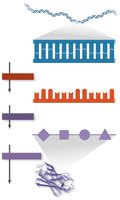
Q6. Label the gene, DNA, RNA, amino acids, and protein on the figure below. Next, label the three steps in the process and describe each.
Background
Topic: Central Dogma of Molecular Biology
This question is testing your understanding of how genetic information flows from DNA to RNA to protein, a process known as gene expression. This is a foundational concept in biology that explains how the instructions in DNA are used to build proteins, which carry out most cellular functions.
Key Terms and Concepts
Gene: A segment of DNA that contains the instructions for making a specific protein.
DNA (Deoxyribonucleic Acid): The molecule that stores genetic information in cells.
RNA (Ribonucleic Acid): A molecule that acts as a messenger, carrying instructions from DNA for controlling the synthesis of proteins.
Amino Acids: The building blocks of proteins.
Protein: A molecule composed of amino acids that performs a specific function in the cell.
Key Processes and Steps
Transcription: The process by which a gene's DNA sequence is copied to make an RNA molecule.
RNA Processing (in eukaryotes): The RNA transcript is modified before it leaves the nucleus (not always shown in simple diagrams).
Translation: The process by which the sequence of bases in mRNA is used to assemble amino acids into a protein.
Step-by-Step Guidance
Identify the structures in the diagram: The topmost structure is the DNA double helix, which contains the gene to be expressed.
The next structure below DNA represents the process of transcription, where a complementary RNA strand is synthesized from the DNA template.
The single-stranded RNA (often shown as a red or orange strand) carries the genetic code from the nucleus to the cytoplasm.
During translation, the RNA sequence is read by ribosomes, and amino acids (depicted as various shapes) are assembled in the correct order to form a polypeptide chain (protein).
The final structure is the folded protein, which is made up of the linked amino acids and performs a specific function in the cell.
Try solving on your own before revealing the answer!
Final Answer:
The diagram shows the following steps and labels:
Top: DNA (gene)
Second: Transcription (making RNA from DNA)
Third: RNA (messenger RNA)
Fourth: Translation (assembling amino acids)
Bottom: Protein (folded polypeptide chain)
Each step represents a key part of gene expression: DNA is transcribed to RNA, which is then translated into a protein made of amino acids.
