 Back
Ch. 17
Study Guide - Smart Notes
 Tailored notes based on your materials, expanded with key definitions, examples, and context.
Gene Expression and the Central Dogma
Genes Specify Proteins
Genes are specific sequences in DNA that dictate the synthesis of proteins, which in turn determine an organism's traits. Proteins serve as the link between genotype and phenotype, and gene expression is the process by which DNA directs protein synthesis.
Key Point: The fundamental relationship between genes and proteins was discovered through studies of metabolic defects and nutritional mutants.
Key Point: The central dogma describes the flow of genetic information: DNA → RNA → Protein.
Example: Beadle and Tatum's experiments with Neurospora demonstrated that mutations in specific genes led to defects in enzymes required for arginine synthesis.
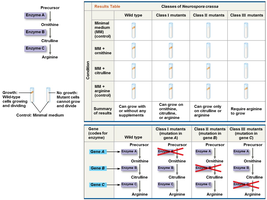
One Gene–One Enzyme Hypothesis
Beadle and Tatum hypothesized that one gene dictates the production of one specific enzyme. This concept evolved into the one gene–one protein (polypeptide) hypothesis, recognizing that not all proteins are enzymes and that some proteins are composed of multiple polypeptides.
Key Point: DNA and protein do not speak the same language; the process from DNA to protein involves two steps: transcription and translation.
Key Point: The central dogma of molecular biology states that genetic information flows from DNA to RNA to protein.
Transcription and Translation
Transcription
Transcription is the synthesis of RNA using information in DNA. It produces messenger RNA (mRNA), which carries the genetic code from the nucleus to the cytoplasm.
Key Point: RNA polymerase catalyzes transcription and does not require a primer.
Key Point: The DNA sequence where RNA polymerase attaches is called the promoter; transcription factors mediate this process.
Example: The TATA box is a crucial promoter element in eukaryotes.
Translation
Translation is the synthesis of a polypeptide using information in the mRNA. Ribosomes facilitate the translation process by coupling tRNA anticodons with mRNA codons.
Key Point: Translation occurs in the cytoplasm and involves ribosomes, tRNA, and mRNA.
Key Point: In prokaryotes, translation can begin before transcription is finished; in eukaryotes, transcription and translation are separated by the nuclear envelope.
The Genetic Code
Codons and Redundancy
The genetic code consists of triplets of nucleotides called codons, each specifying an amino acid. There are 64 codons, 61 of which code for amino acids and 3 are stop codons. The code is redundant but not ambiguous.
Key Point: Codons must be read in the correct reading frame to produce the correct polypeptide.
Key Point: The genetic code is nearly universal across all organisms.
Example: AUG is the start codon for translation.
RNA Processing in Eukaryotes
Modifications to pre-mRNA
Before leaving the nucleus, pre-mRNA undergoes several modifications:
5' Cap: Addition of a modified guanine nucleotide to the 5' end.
Poly-A Tail: Addition of a string of adenine nucleotides to the 3' end.
Splicing: Removal of introns (noncoding regions) and joining of exons (coding regions).
RNA Splicing and Ribozymes
Spliceosomes, composed of proteins and snRNPs, catalyze the removal of introns. Some RNA molecules, called ribozymes, can catalyze their own splicing.
Key Point: Alternative RNA splicing allows a single gene to code for multiple proteins.
Key Point: Protein domains are often encoded by different exons.
Molecular Components of Translation
Transfer RNA (tRNA)
tRNA molecules transfer amino acids to the growing polypeptide chain. Each tRNA has an anticodon that pairs with a codon on the mRNA.
Key Point: Aminoacyl-tRNA synthetase matches tRNA with its corresponding amino acid.
Key Point: Wobble pairing at the third base of a codon allows flexibility in tRNA binding.
Ribosomes and Translation
Ribosomes consist of a large and small subunit, composed of proteins and ribosomal RNA (rRNA). They coordinate the process of translation through three sites: P site (peptidyl), A site (aminoacyl), and E site (exit).
Key Point: Translation proceeds through initiation, elongation, and termination.
Key Point: rRNA catalyzes peptide bond formation.
Post-Translational Modifications and Protein Targeting
Post-Translational Modification (PTM)
Proteins may undergo modifications after translation, such as proteolysis, glycosylation, and phosphorylation. These modifications are essential for protein function and targeting.
Key Point: PTMs can change protein shape, activity, and location.
Key Point: Proteins are targeted to specific locations in the cell by signal peptides and signal-recognition particles (SRP).
Mutations and Their Effects
Types of Mutations
Mutations are changes in the genetic material of a cell or virus. They can be spontaneous or induced by mutagens such as chemicals or radiation.
Somatic Mutation: Occurs in non-reproductive cells and is not passed to offspring.
Germline Mutation: Occurs in reproductive cells and can be inherited.
Small Scale Mutations
Point mutations include nucleotide-pair substitutions, insertions, and deletions. These can result in silent, missense, or nonsense mutations, or frameshift mutations if the reading frame is altered.
Silent Mutation: No effect on the amino acid sequence.
Missense Mutation: Changes one amino acid to another.
Nonsense Mutation: Changes an amino acid codon to a stop codon.
Frameshift Mutation: Alters the reading frame, leading to extensive changes in the protein.
Examples of Mutation Effects
Mutations can cause diseases such as sickle cell anemia, which results from a missense mutation in the hemoglobin gene. Lactase persistence in adults is due to a mutation in the regulatory region of the lactase gene.
What Is a Gene?
Modern Definition
A gene is a region of DNA that can be expressed to produce a final functional product, either a polypeptide or an RNA molecule. This definition encompasses both protein-coding and non-coding RNA genes.
Key Point: Genes are discrete units of inheritance, regions of specific nucleotide sequence, and DNA sequences that code for specific polypeptide chains.
