 Back
Gene Expression: From DNA to Protein
Study Guide - Smart Notes
 Tailored notes based on your materials, expanded with key definitions, examples, and context.
Gene Expression: The Flow of Genetic Information
Overview of Gene Expression
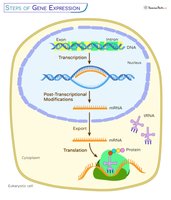
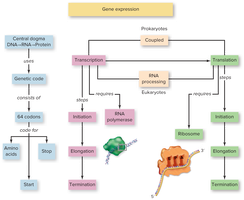
Gene expression is the process by which information encoded in DNA is used to direct the synthesis of proteins, which are responsible for an organism's traits. This process involves two main stages: transcription and translation.
Transcription: The synthesis of RNA from a DNA template.
Translation: The synthesis of a polypeptide (protein) from an mRNA template.
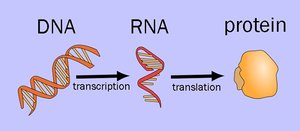
Central Dogma: The concept that genetic information flows from DNA to RNA to protein.
Genotype to Phenotype
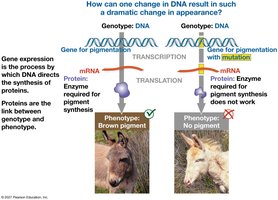
The DNA inherited by an organism determines its genotype, which in turn influences its phenotype through the synthesis of proteins. Proteins are the link between genotype and phenotype.
Gene expression involves transcription (DNA to mRNA) and translation (mRNA to protein).
Mutations in DNA can alter protein structure and function, leading to changes in phenotype.
Transcription and Translation: Basic Principles
Transcription vs. Translation
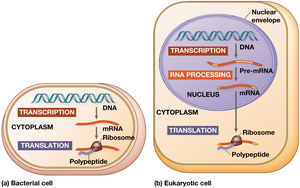
Transcription and translation are distinct processes that occur in different cellular locations in prokaryotes and eukaryotes.
Transcription: Occurs in the nucleus of eukaryotes and cytoplasm of prokaryotes.
Translation: Occurs in the cytoplasm for both cell types.
In prokaryotes, translation can begin before transcription is finished.
In eukaryotes, RNA processing modifies the primary transcript before translation.
Central Dogma and Gene Expression Pathway
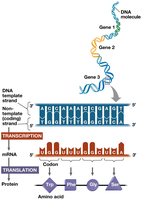
The central dogma describes the directional flow of genetic information: DNA → RNA → Protein.
DNA is transcribed to produce mRNA.
mRNA is translated to produce a polypeptide.
Proteins are then folded and modified to become functional.

The Genetic Code
Codons and the Triplet Code
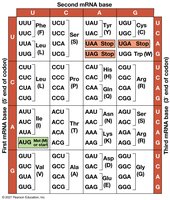
The genetic code is based on codons, which are sequences of three nucleotides in mRNA that specify amino acids.
There are 64 possible codons; 61 code for amino acids, 3 are stop signals.
The code is redundant but not ambiguous.
The reading frame is crucial for correct translation.
Polypeptides begin with methionine (AUG codon).
Transcription: DNA-Directed RNA Synthesis
Stages of Transcription
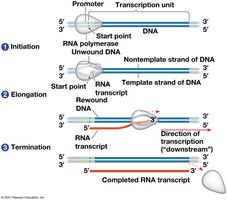
Transcription consists of three main stages: initiation, elongation, and termination.
Initiation: RNA polymerase binds to the promoter region of DNA.
Elongation: RNA polymerase synthesizes RNA by adding nucleotides to the 3' end.
Termination: Transcription ends at the terminator sequence (bacteria) or after the polyadenylation signal (eukaryotes).
Promoters and Transcription Initiation Complex
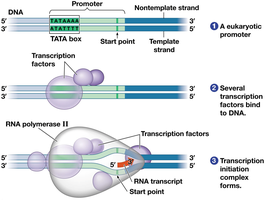
Promoters are DNA sequences that signal the start of transcription. In eukaryotes, transcription factors and RNA polymerase II form the transcription initiation complex.
The TATA box is a key promoter element in eukaryotes.
Transcription factors help RNA polymerase bind to the promoter.
Elongation and Termination
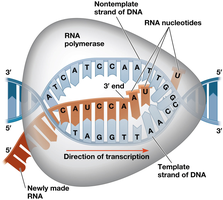
During elongation, RNA polymerase moves along the DNA, untwisting the helix and synthesizing RNA. Termination differs between bacteria and eukaryotes.
RNA is complementary to the DNA template strand.
Uracil (U) replaces thymine (T) in RNA.
RNA Processing in Eukaryotes
Modification of mRNA Ends
Eukaryotic pre-mRNA undergoes modifications before translation:
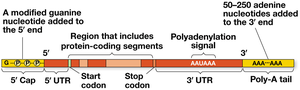
The 5' end receives a modified guanine nucleotide (5' cap).
The 3' end receives a poly-A tail (50-250 adenine nucleotides).
These modifications facilitate mRNA export, protect from degradation, and help ribosome binding.
RNA Splicing: Introns and Exons
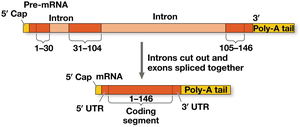
Most eukaryotic genes contain introns (noncoding regions) and exons (coding regions). Introns are removed and exons are spliced together to form mature mRNA.
Splicing is performed by spliceosomes, which contain proteins and small RNAs.
Alternative splicing allows for multiple protein products from a single gene.
Translation: Protein Synthesis
Components of Translation
Translation requires mRNA, tRNA, ribosomes, and various protein factors.
tRNA: Transfers specific amino acids to the growing polypeptide chain; contains an anticodon that pairs with mRNA codon.
Ribosomes: Facilitate the coupling of tRNA anticodons with mRNA codons; consist of large and small subunits.
Wobble: Flexible pairing at the third base of a codon allows tRNA to recognize multiple codons.
Stages of Translation
Translation occurs in three stages:
Initiation: Small ribosomal subunit binds mRNA and initiator tRNA (methionine); large subunit joins.
Elongation: Amino acids are added one by one; involves codon recognition, peptide bond formation, and translocation.
Termination: Occurs when a stop codon is reached; release factor causes polypeptide release.
Mutations and Their Effects
Types of Mutations
Mutations are changes in genetic information that can affect protein structure and function.
Point mutations: Changes in a single nucleotide pair.
Substitutions: Replace one nucleotide pair with another; can be silent, missense, or nonsense.
Insertions/Deletions: Add or remove nucleotide pairs; often cause frameshift mutations, which are usually more deleterious.
Mutagens: Physical or chemical agents that cause mutations (e.g., radiation, carcinogens).
Mutation Impact on Phenotype
Mutations can lead to genetic disorders or hereditary diseases.
Example: Sickle-cell disease is caused by a point mutation.
Gene Editing: CRISPR-Cas9
CRISPR-Cas9 Technology
CRISPR-Cas9 is a powerful gene-editing tool that allows for targeted modification of genes.
Cas9 protein and guide RNA can cut DNA at specific sites.
Used to correct disease-causing mutations in research and medicine.
Potential risks include off-target effects; caution is advised in human applications.
Summary Table: Comparison of Transcription and Translation in Prokaryotes and Eukaryotes
Feature | Prokaryotes | Eukaryotes |
|---|---|---|
Transcription Location | Cytoplasm | Nucleus |
Translation Location | Cytoplasm | Cytoplasm |
RNA Processing | None | 5' cap, poly-A tail, splicing |
Coupling of Transcription & Translation | Yes | No |
