 Back
Gene Expression: From DNA to Protein
Study Guide - Smart Notes
 Tailored notes based on your materials, expanded with key definitions, examples, and context.
Gene Expression: DNA to Protein
Overview of Gene Expression
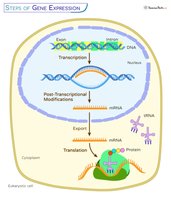
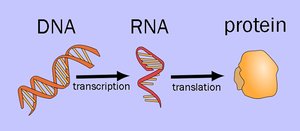
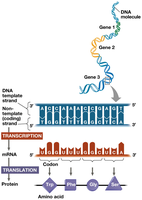
Gene expression is the process by which information encoded in DNA is used to direct the synthesis of proteins, which are essential for cellular structure and function. This process involves two main stages: transcription and translation. The flow of genetic information from DNA to RNA to protein is often referred to as the central dogma of molecular biology.
Transcription: The synthesis of RNA from a DNA template.
Translation: The synthesis of a polypeptide (protein) from an mRNA template.
Proteins: The final products that determine phenotype by performing cellular functions.
Genotype to Phenotype: The Role of Proteins
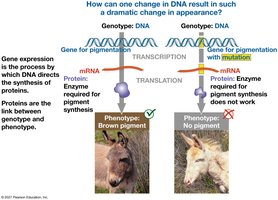
Genes, composed of DNA, are linearly arranged on chromosomes and specify the sequence of amino acids in proteins. Proteins are the molecular link between genotype (genetic makeup) and phenotype (observable traits). A single change in DNA can result in a dramatic change in phenotype by altering the protein product.
Transcription and Translation: The Central Dogma
Basic Principles
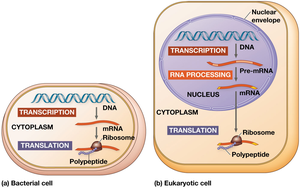
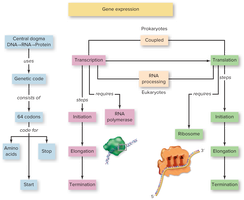
Transcription and translation are the two main steps in gene expression. In prokaryotes, these processes are coupled, while in eukaryotes, they are separated by the nuclear envelope and involve additional RNA processing steps.
Transcription: Occurs in the nucleus (eukaryotes) or cytoplasm (prokaryotes).
Translation: Occurs in the cytoplasm at ribosomes.
RNA Processing: Eukaryotic pre-mRNA undergoes modifications before translation.

The Genetic Code and Codons
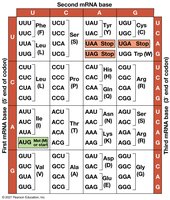
The genetic code is a set of rules by which information encoded in mRNA is translated into proteins. Each group of three nucleotides (codon) in mRNA specifies a particular amino acid. The code is nearly universal and redundant, with 64 codons coding for 20 amino acids and three stop signals.
Codon: A sequence of three mRNA nucleotides that codes for a specific amino acid.
Start Codon: AUG (codes for methionine, the first amino acid in most polypeptides).
Stop Codons: UAA, UAG, UGA (signal termination of translation).
Reading Frame: The way nucleotides are grouped into codons; shifting the frame changes the protein product.
Transcription: DNA-Directed Synthesis of RNA
Stages of Transcription
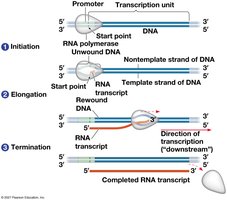
Transcription is catalyzed by RNA polymerase and occurs in three main stages: initiation, elongation, and termination.
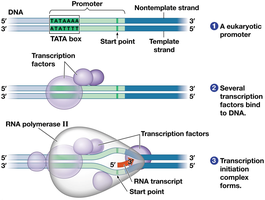
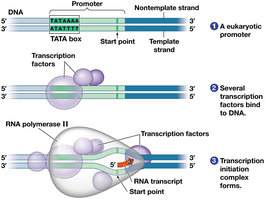
Initiation: RNA polymerase binds to the promoter region of DNA, aided by transcription factors in eukaryotes (e.g., TATA box).
Elongation: RNA polymerase moves along the DNA, synthesizing RNA in the 5' to 3' direction.
Termination: Transcription ends when RNA polymerase reaches a terminator sequence (bacteria) or polyadenylation signal (eukaryotes).
RNA Processing in Eukaryotes
Modification of mRNA Ends
Before mRNA leaves the nucleus, it undergoes several modifications:
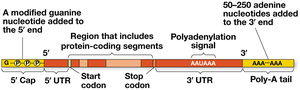
5' Cap: A modified guanine nucleotide added to the 5' end.
Poly-A Tail: 50-250 adenine nucleotides added to the 3' end.
These modifications protect mRNA, aid in export, and help ribosome binding.
RNA Splicing
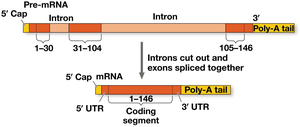
Most eukaryotic genes contain introns (noncoding regions) and exons (coding regions). Introns are removed and exons are joined together by spliceosomes, forming mature mRNA. Alternative splicing allows a single gene to code for multiple proteins.
Introns: Noncoding sequences removed from pre-mRNA.
Exons: Coding sequences that remain in mRNA.
Spliceosome: A complex of proteins and small RNAs that catalyzes splicing.
Translation: RNA-Directed Synthesis of Protein
Key Components
Translation occurs at ribosomes and requires several key molecules:
mRNA: Carries the genetic code from DNA.
tRNA: Transfers specific amino acids to the ribosome; each has an anticodon complementary to an mRNA codon.
Ribosome: The site of protein synthesis, composed of rRNA and proteins.
Translation proceeds in three stages: initiation, elongation, and termination. The process requires energy and various protein factors.
Mutations and Their Effects on Proteins
Types of Mutations
Mutations are changes in the genetic material that can affect protein structure and function. They can be classified as:
Point Mutations: Changes in a single nucleotide pair.
Substitutions: One base is replaced by another; can be silent, missense, or nonsense.
Insertions/Deletions: Addition or loss of nucleotide pairs; may cause frameshift mutations, often more harmful than substitutions.
Mutations can be caused by errors in DNA replication or by mutagens (physical or chemical agents).
Summary Table: Types of Point Mutations
Type | Description | Effect on Protein | Example |
|---|---|---|---|
Silent | Base change does not alter amino acid | No effect | GAA to GAG (both code for Glu) |
Missense | Base change alters amino acid | May alter protein function | Sickle-cell disease (Glu to Val) |
Nonsense | Base change creates stop codon | Premature termination, nonfunctional protein | UAC (Tyr) to UAA (Stop) |
Frameshift | Insertion/deletion shifts reading frame | Usually nonfunctional protein | Insertion of one base |
Key Equations and Concepts
Central Dogma:
Codon-Anticodon Pairing:
Additional info: This guide covers the essential concepts of gene expression, including the molecular mechanisms of transcription, RNA processing, translation, and the impact of mutations on protein synthesis. It is suitable for exam preparation in a General Biology college course.
