 Back
Gene Expression: From DNA to Protein
Study Guide - Smart Notes
 Tailored notes based on your materials, expanded with key definitions, examples, and context.
Gene Expression: From DNA to Protein
Overview of Gene Expression
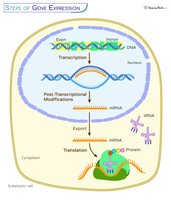
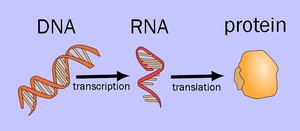
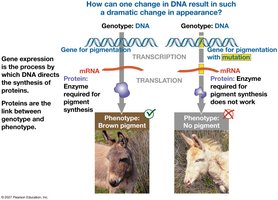
Gene expression is the process by which the information encoded in a gene is used to direct the synthesis of a protein. This process involves two main stages: transcription and translation. Proteins produced through gene expression are responsible for the traits (phenotypes) observed in organisms.
Transcription: The synthesis of RNA from a DNA template.
Translation: The synthesis of a polypeptide (protein) using the information in the RNA sequence.
Central Dogma: The flow of genetic information is typically from DNA → RNA → Protein.
Evidence and Principles of Gene Expression
Genes are composed of DNA and are linearly arranged on chromosomes. They specify the sequence of amino acids in proteins, which are the functional molecules in cells. The process of gene expression links genotype (genetic makeup) to phenotype (observable traits).
Proteins are the links between genotype and phenotype.
Gene expression includes transcription and translation.
Transcription: DNA-Directed Synthesis of RNA
Basic Principles of Transcription
Transcription is the process by which a segment of DNA is used as a template to synthesize a complementary RNA molecule. In eukaryotes, this occurs in the nucleus; in prokaryotes, it occurs in the cytoplasm.
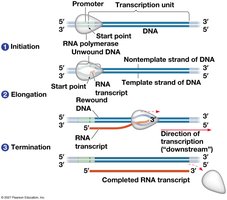
RNA polymerase is the enzyme that synthesizes RNA from the DNA template.
Promoter: DNA sequence where RNA polymerase binds to initiate transcription.
Terminator: Sequence signaling the end of transcription (mainly in prokaryotes).
Transcription unit: The stretch of DNA that is transcribed into RNA.
Stages of Transcription
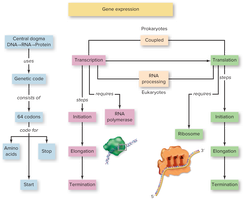
Initiation: RNA polymerase binds to the promoter with the help of transcription factors (in eukaryotes) and unwinds the DNA.
Elongation: RNA polymerase moves along the DNA, synthesizing RNA in the 5′ → 3′ direction.
Termination: RNA synthesis ends when the polymerase reaches a terminator sequence (prokaryotes) or after a polyadenylation signal (eukaryotes).
RNA Processing in Eukaryotes
Post-Transcriptional Modifications
In eukaryotic cells, the primary RNA transcript (pre-mRNA) undergoes several modifications before becoming mature mRNA that can be translated.
5′ Cap: A modified guanine nucleotide added to the 5′ end for stability and ribosome binding.
Poly-A Tail: A string of adenine nucleotides added to the 3′ end for stability and export from the nucleus.
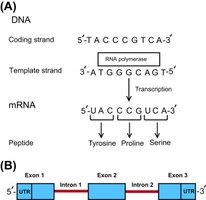
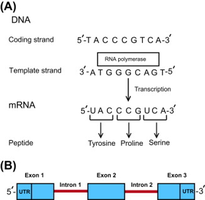
RNA Splicing: Removal of noncoding regions (introns) and joining of coding regions (exons).
Alternative RNA Splicing
Alternative splicing allows a single gene to code for multiple proteins by varying which exons are included in the final mRNA. This increases protein diversity without increasing the number of genes.
Spliceosomes: Complexes of proteins and small RNAs that carry out splicing.
Ribozymes: RNA molecules with catalytic activity, including some involved in splicing.
Translation: RNA-Directed Synthesis of Protein
The Genetic Code
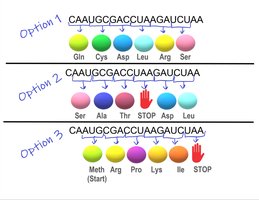
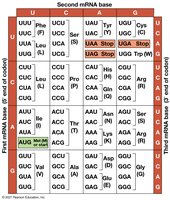
The genetic code is a set of rules by which the nucleotide sequence of mRNA is translated into the amino acid sequence of a protein. Each group of three nucleotides (codon) specifies one amino acid.
There are 64 possible codons (43 combinations of A, U, G, C).
61 codons code for amino acids; 3 are stop codons.
The code is redundant but not ambiguous (each codon codes for only one amino acid).
The start codon (AUG) codes for methionine, which is the first amino acid in most polypeptides.
Translation Process
Translation occurs in the cytoplasm at ribosomes and involves several key molecules:
mRNA: Carries the genetic code from DNA.
tRNA: Brings amino acids to the ribosome; each tRNA has an anticodon complementary to an mRNA codon.
Ribosomes: Complexes of rRNA and proteins that catalyze peptide bond formation.
The process occurs in three stages:
Initiation: The small ribosomal subunit binds to mRNA and the initiator tRNA (carrying methionine) at the start codon. The large subunit then joins.
Elongation: tRNAs bring amino acids to the ribosome, where they are added to the growing polypeptide chain.
Termination: When a stop codon is reached, a release factor binds, causing the polypeptide to be released.
Mutations and Their Effects on Proteins
Types of Mutations
Mutations are changes in the genetic material that can affect protein structure and function. They can be classified as:
Point mutations: Changes in a single nucleotide pair.
Substitutions: One base is replaced by another; can be silent, missense, or nonsense mutations.
Insertions/Deletions: Addition or loss of nucleotide pairs; may cause frameshift mutations, altering the reading frame and usually resulting in nonfunctional proteins.
Mutations can be caused by errors in DNA replication or by mutagens (physical or chemical agents).
Examples and Significance
Sickle-cell disease: Caused by a point mutation in the gene encoding β-globin, leading to abnormal hemoglobin and altered red blood cell shape.
Genetic disorders: Many are caused by mutations that disrupt normal protein function.
Summary Table: Types of Mutations
Mutation Type | Description | Effect on Protein | Example |
|---|---|---|---|
Silent | Base substitution with no change in amino acid | No effect | GAA → GAG (both code for Glu) |
Missense | Base substitution changes one amino acid | May alter protein function | Sickle-cell anemia (Glu → Val) |
Nonsense | Base substitution creates a stop codon | Premature termination; usually nonfunctional protein | CAG → TAG (Gln → Stop) |
Frameshift | Insertion or deletion shifts reading frame | Usually nonfunctional protein | Insertion of one base in coding region |
Key Equations and Concepts
Central Dogma:
Codon-Anticodon Pairing:
Conclusion
Gene expression is a fundamental process in biology, linking genetic information to the functional molecules that determine phenotype. Understanding transcription, RNA processing, translation, and the effects of mutations is essential for grasping how genes control the traits of living organisms.
