 Back
Gene Expression: From DNA to Protein (Central Dogma, Transcription, and Translation)
Study Guide - Smart Notes
 Tailored notes based on your materials, expanded with key definitions, examples, and context.
Gene Expression and the Central Dogma
Overview of Gene Expression
Gene expression is the process by which information encoded in DNA is used to direct the synthesis of proteins, which are essential for cellular structure and function. This process links genotype to phenotype and involves two main steps: transcription and translation.
Central Dogma: The flow of genetic information is from DNA → RNA → Protein.
Proteins: Serve as the functional links between genotype (genetic makeup) and phenotype (observable traits).
Gene: A region of DNA that can be expressed to produce a final functional product, either a polypeptide or an RNA molecule.
The Central Dogma and Coding Redundancy
The central dogma describes the directional flow of genetic information. Coding redundancy refers to the fact that multiple codons can code for the same amino acid.
Transcription: Synthesis of RNA from a DNA template.
Translation: Synthesis of a polypeptide using the information in mRNA.
Redundancy: The genetic code is redundant (more than one codon may specify a particular amino acid) but not ambiguous (no codon specifies more than one amino acid).
Discovery of the Gene-Protein Relationship
Historical Experiments
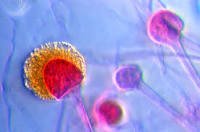
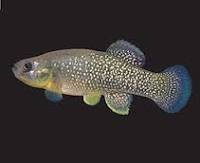
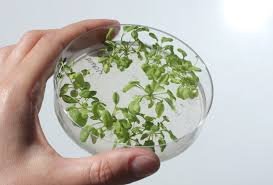
Early studies using model organisms such as Drosophila melanogaster (fruit fly), Fundulus heteroclitus (killifish), certain mold species, and Arabidopsis thaliana (thale cress) helped elucidate the relationship between genes and proteins.
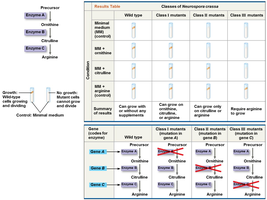
Beadle and Tatum Experiment: Exposed bread mold (Neurospora crassa) to X-rays, creating mutants unable to grow on minimal medium. Each mutant had a defect in a different enzyme required for arginine synthesis.
One Gene–One Enzyme Hypothesis: Each gene dictates the production of a specific enzyme. This was later refined to the one gene–one polypeptide hypothesis.

Evidence from Metabolic Defects
Inherited diseases often reflect the inability to synthesize a particular enzyme, supporting the gene-protein connection.
Nutritional Mutants in Neurospora
Mutants unable to synthesize arginine were used to demonstrate that specific genes encode specific enzymes in a metabolic pathway.
Transcription: DNA to RNA
Mechanism of Transcription
Transcription is the DNA-directed synthesis of RNA, catalyzed by RNA polymerase.
Promoter: DNA sequence where RNA polymerase binds to initiate transcription (e.g., TATA box in eukaryotes).
Transcription Factors: Proteins that help RNA polymerase bind to the promoter and initiate transcription.
Elongation: RNA polymerase adds nucleotides to the 3′ end of the growing RNA strand.
Termination: In prokaryotes, transcription stops at a terminator sequence; in eukaryotes, a polyadenylation signal is transcribed, and the RNA is released.
RNA Processing in Eukaryotes
5′ Cap: Modified guanine nucleotide added to the 5′ end.
Poly-A Tail: Series of adenine nucleotides added to the 3′ end.
RNA Splicing: Removal of noncoding introns and joining of coding exons by spliceosomes (complexes of proteins and snRNPs).
Ribozymes: RNA molecules with catalytic activity, such as those in spliceosomes.
Alternative Splicing: Allows a single gene to code for multiple proteins by varying exon inclusion.
Translation: RNA to Protein
The Genetic Code
The genetic code is a set of rules by which information encoded in mRNA is translated into proteins.
Codon: A sequence of three nucleotides that codes for a specific amino acid.
There are 64 possible codons: 61 code for amino acids, 3 are stop codons.
Start Codon: AUG (codes for methionine) signals the start of translation.
Reading Frame: Codons must be read in the correct sequence to produce the correct protein.
tRNA and Ribosomes
tRNA: Transfer RNA molecules bring amino acids to the ribosome and match them to the mRNA codon via their anticodon.
Aminoacyl-tRNA Synthetase: Enzyme that attaches the correct amino acid to its tRNA.
Wobble: Flexible base pairing at the third codon position allows some tRNAs to recognize more than one codon.
Ribosome: Composed of rRNA and proteins, it coordinates the pairing of tRNA anticodons with mRNA codons and catalyzes peptide bond formation.
Steps of Translation
Initiation: Small ribosomal subunit binds mRNA and initiator tRNA, then the large subunit joins to form the initiation complex.
Elongation: Amino acids are added one by one to the growing polypeptide chain through codon recognition, peptide bond formation, and translocation.
Termination: When a stop codon is reached, a release factor binds, causing the polypeptide to be released.
Post-Translational Modifications
Proteolysis: Cutting the polypeptide chain by proteases.
Glycosylation: Addition of sugars to form glycoproteins.
Phosphorylation: Addition of phosphate groups by kinases.
Protein Targeting
Proteins synthesized by free ribosomes remain in the cytosol.
Proteins destined for secretion or for the endomembrane system are marked by a signal peptide and directed to the endoplasmic reticulum (ER) by a signal-recognition particle (SRP).
Mutations and Their Effects
Types of Mutations
Mutations are changes in the genetic material that can affect protein structure and function.
Point Mutations: Changes in a single nucleotide pair.
Silent Mutation: No effect on the amino acid sequence.
Missense Mutation: Changes one amino acid to another.
Nonsense Mutation: Changes an amino acid codon to a stop codon, leading to a truncated protein.
Insertions/Deletions: Addition or loss of nucleotide pairs, which may cause frameshift mutations, altering the reading frame.
Causes of Mutations
Spontaneous Mutations: Occur naturally during DNA replication, recombination, or repair.
Induced Mutations: Caused by external agents (mutagens) such as chemicals or radiation.
Examples of Mutation Effects
Sickle Cell Anemia: Caused by a missense mutation in the hemoglobin gene, resulting in abnormal red blood cell shape.
Lactase Persistence/Intolerance: Mutations in regulatory regions of the lactase gene affect enzyme production in adults.
What Is a Gene?
Modern Definition
A gene is a region of DNA that can be expressed to produce a final functional product, either a polypeptide or an RNA molecule. This definition encompasses both protein-coding genes and genes that produce functional RNAs (such as rRNA, tRNA, and regulatory RNAs).
