 Back
Gene Expression: From DNA to Protein
Study Guide - Smart Notes
 Tailored notes based on your materials, expanded with key definitions, examples, and context.
Gene Expression: The Flow of Genetic Information
Overview of Gene Expression
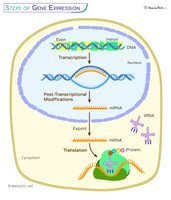
Gene expression is the process by which information encoded in DNA is used to direct the synthesis of proteins, which are essential for cellular structure and function. This process involves two main stages: transcription and translation.
Transcription: The synthesis of RNA from a DNA template.
Translation: The synthesis of a polypeptide (protein) from an mRNA template.
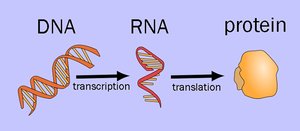
Central Dogma: The concept that genetic information flows from DNA to RNA to protein.
Genotype and Phenotype: The Link
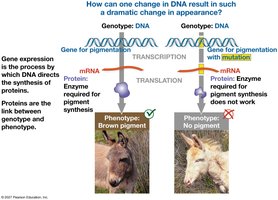
Proteins are the link between genotype (genetic makeup) and phenotype (observable traits). Changes in DNA can result in changes in protein structure and function, leading to variations in phenotype.
Gene Expression: Determines the traits by dictating protein synthesis.
Mutations: Changes in DNA sequence can alter protein function and phenotype.
Transcription and Translation: Basic Principles
Transcription and Translation in Prokaryotes vs. Eukaryotes
Transcription and translation differ between prokaryotic and eukaryotic cells.
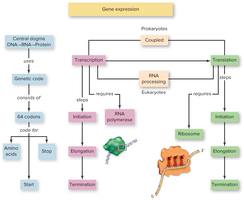
Prokaryotes: Transcription and translation occur in the cytoplasm and can be coupled.
Eukaryotes: Transcription occurs in the nucleus; translation occurs in the cytoplasm. RNA processing modifies the transcript before translation.
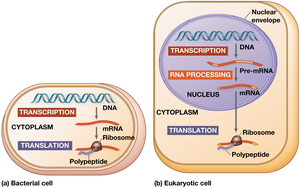
The Central Dogma of Molecular Biology
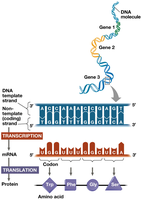
The central dogma describes the directional flow of genetic information:
DNA → RNA → Protein
Transcription produces mRNA, which is translated into protein.

The Genetic Code and Codons
Triplet Code and Codons
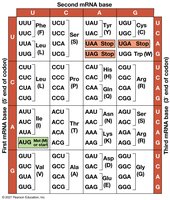
The genetic code is based on triplets of nucleotides called codons, each specifying an amino acid.
Codon: A sequence of three nucleotides in mRNA that corresponds to a specific amino acid.
There are 64 codons; 61 code for amino acids, 3 are stop signals.
The start codon (AUG) codes for methionine, which initiates translation.
The reading frame is crucial for correct translation.
Transcription: DNA-Directed RNA Synthesis
Stages of Transcription
Transcription occurs in three main stages:
Initiation: RNA polymerase binds to the promoter region of DNA.
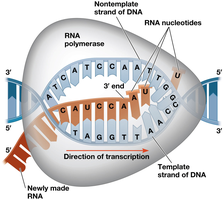
Elongation: RNA polymerase synthesizes the RNA strand by adding nucleotides to the 3' end.
Termination: Transcription ends when RNA polymerase reaches a terminator sequence.
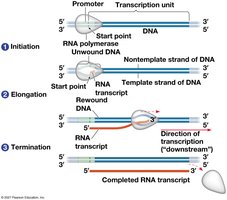
Promoters and Transcription Initiation Complex
Promoter: DNA sequence where RNA polymerase attaches.
TATA Box: A promoter element important in eukaryotes.
Transcription Factors: Proteins that help RNA polymerase bind to the promoter.
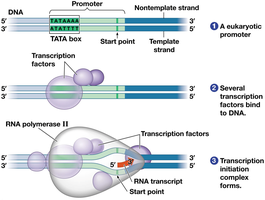
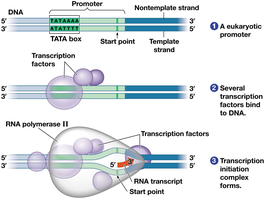
Elongation and Termination
RNA polymerase moves along DNA, untwisting the helix and synthesizing RNA.
Termination differs in prokaryotes and eukaryotes.
RNA Processing in Eukaryotes
Modification of mRNA Ends
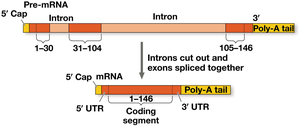
Eukaryotic pre-mRNA undergoes modifications:
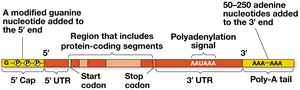
5' Cap: Modified guanine nucleotide added to the 5' end.
Poly-A Tail: 50–250 adenine nucleotides added to the 3' end.
These modifications facilitate export, protect mRNA, and help ribosome binding.
RNA Splicing: Introns and Exons
Introns: Noncoding regions removed from pre-mRNA.
Exons: Coding regions joined together to form mature mRNA.
Spliceosomes: Complexes that catalyze splicing.
Alternative Splicing: Allows production of multiple proteins from one gene.
Translation: Protein Synthesis
Components and Process of Translation
Translation converts mRNA into a polypeptide chain using ribosomes and tRNA.
tRNA: Transfers amino acids to the ribosome; has an anticodon that pairs with mRNA codon.
Ribosome: Site of protein synthesis; has three binding sites for tRNA (A, P, E).
Stages: Initiation, elongation, termination.
Wobble: Flexible pairing at the third base of a codon allows tRNA to bind to multiple codons.
Mutations and Their Effects
Types of Mutations
Mutations are changes in the genetic material that can affect protein structure and function.
Point Mutations: Changes in a single nucleotide pair.
Substitutions: Replace one nucleotide pair with another; can be silent, missense, or nonsense.
Insertions/Deletions: Add or remove nucleotide pairs; often cause frameshift mutations.
Mutagens: Physical or chemical agents that cause mutations.
Mutation Type | Description | Effect |
|---|---|---|
Silent | Substitution, no change in amino acid | No effect on protein |
Missense | Substitution, changes amino acid | May alter protein function |
Nonsense | Substitution, creates stop codon | Protein truncated, usually nonfunctional |
Frameshift | Insertion/deletion, alters reading frame | Disastrous effect on protein |
Gene Editing: CRISPR-Cas9
CRISPR-Cas9 Technology
CRISPR-Cas9 is a powerful tool for gene editing, allowing targeted modifications to correct disease-causing mutations. It uses a guide RNA and the Cas9 protein to cut DNA at specific sites.
Used in research and potential therapies for genetic disorders.
Concerns about off-target effects and ethical considerations.
Additional info: The notes above expand on the original content by providing definitions, examples, and context for each step of gene expression, as well as a summary table for mutation types.
