 Back
Gene Expression: From DNA to Protein
Study Guide - Smart Notes
 Tailored notes based on your materials, expanded with key definitions, examples, and context.
Gene Expression: DNA, RNA, and Proteins
Overview of Gene Expression
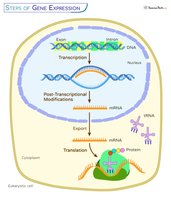
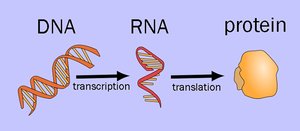
Gene expression is the process by which information encoded in DNA is used to direct the synthesis of proteins, which are essential for cellular structure and function. This process involves two main stages: transcription and translation.
Transcription: The synthesis of RNA from a DNA template.
Translation: The synthesis of a polypeptide (protein) from an mRNA template.
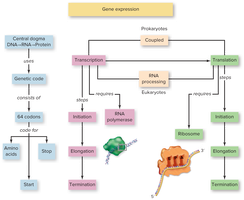
Central Dogma: The flow of genetic information is typically DNA → RNA → Protein.
Genotype to Phenotype
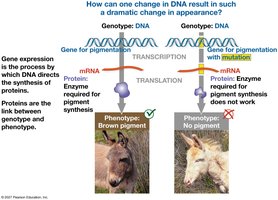
The DNA inherited by an organism determines specific traits by dictating the synthesis of proteins. Proteins are the link between genotype (genetic makeup) and phenotype (observable traits).
Gene Expression: DNA directs protein synthesis, which in turn affects phenotype.
Mutations: Changes in DNA can lead to changes in protein structure and function, resulting in altered phenotypes.
Transcription and Translation: Basic Principles
Transcription and Translation in Prokaryotes vs. Eukaryotes
Transcription and translation differ between prokaryotic and eukaryotic cells.
Prokaryotes: Transcription and translation occur in the cytoplasm, often simultaneously.
Eukaryotes: Transcription occurs in the nucleus; translation occurs in the cytoplasm. RNA processing modifies the transcript before translation.
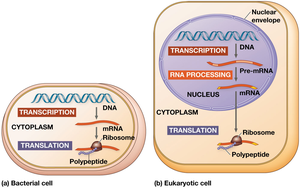
The Central Dogma of Molecular Biology
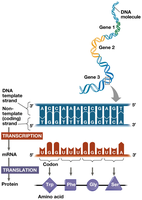
The central dogma describes the directional flow of genetic information:
DNA → RNA → Protein
Transcription produces mRNA, which is then translated into protein.

The Genetic Code and Codons
Triplet Code and Codons
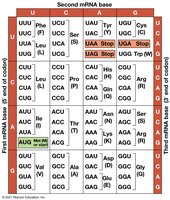
The genetic code is based on a triplet code, where three nucleotide bases (codon) specify one amino acid.
Codon: A sequence of three nucleotides in mRNA that specifies an amino acid.
Reading Frame: The correct grouping of codons is essential for accurate translation.
Start Codon: AUG (methionine) signals the start of translation.
Stop Codons: UAA, UAG, UGA signal the end of translation.
Transcription: DNA-Directed RNA Synthesis
Stages of Transcription
Transcription occurs in three main stages:
Initiation: RNA polymerase binds to the promoter region of DNA.
Elongation: RNA polymerase synthesizes the RNA strand by adding nucleotides to the 3' end.
Termination: Transcription ends when RNA polymerase reaches a terminator sequence.
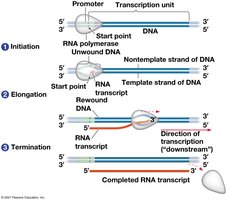
Promoters and Transcription Initiation Complex
Promoter: DNA sequence where RNA polymerase attaches and transcription begins.
TATA Box: A promoter element crucial for forming the initiation complex in eukaryotes.
Transcription Factors: Proteins that help RNA polymerase bind to the promoter.
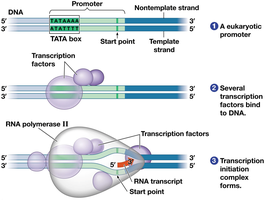
Elongation and Termination
RNA polymerase moves along DNA, untwisting the helix and synthesizing RNA.
Termination differs in prokaryotes and eukaryotes; in eukaryotes, a polyadenylation signal is involved.
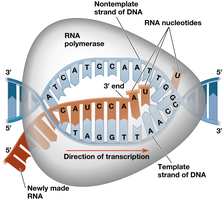
RNA Processing in Eukaryotes
Modification of mRNA Ends
Eukaryotic pre-mRNA undergoes modifications:
5' Cap: Modified guanine nucleotide added to the 5' end.
Poly-A Tail: 50-250 adenine nucleotides added to the 3' end.
These modifications facilitate export, protect mRNA, and help ribosome binding.
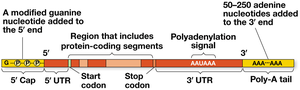
RNA Splicing: Introns and Exons
Introns: Noncoding regions removed from pre-mRNA.
Exons: Coding regions joined together to form mature mRNA.
Spliceosomes: Complexes that catalyze the removal of introns.
Alternative Splicing: Allows production of multiple proteins from one gene.
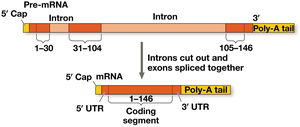
Translation: mRNA to Protein
Components and Process of Translation
Translation is the process by which ribosomes synthesize proteins using mRNA as a template.
tRNA: Transfers amino acids to the ribosome; each tRNA has an anticodon complementary to an mRNA codon.
Ribosome: Site of protein synthesis; has three binding sites for tRNA (A, P, E).
Stages: Initiation, elongation, and termination.
Wobble: Flexible pairing at the third base of a codon allows tRNA to bind to multiple codons.
Mutations and Their Effects
Types of Mutations
Mutations are changes in the genetic information of a cell and can affect protein structure and function.
Point Mutations: Changes in a single nucleotide pair.
Substitutions: Replace one nucleotide pair with another; can be silent, missense, or nonsense.
Insertions/Deletions: Add or remove nucleotide pairs; often cause frameshift mutations.
Mutagens: Physical or chemical agents that cause mutations.
Examples and Significance
Sickle-cell Disease: Caused by a point mutation leading to abnormal hemoglobin.
CRISPR-Cas9: A gene-editing technique used to correct disease-causing mutations.
Summary Table: Comparison of Transcription and Translation in Prokaryotes and Eukaryotes
Feature | Prokaryotes | Eukaryotes |
|---|---|---|
Location of Transcription | Cytoplasm | Nucleus |
Location of Translation | Cytoplasm | Cytoplasm |
RNA Processing | None | 5' cap, poly-A tail, splicing |
Coupling of Processes | Often simultaneous | Separated by nuclear envelope |
Key Equations and Concepts
Central Dogma Equation:
Codon-Amino Acid Relationship:
Transcription Direction:
Translation Direction:
