 Back
Gene Expression: From Gene to Protein (Chapter 17 Study Notes)
Study Guide - Smart Notes
 Tailored notes based on your materials, expanded with key definitions, examples, and context.
Gene Expression: From Gene to Protein
Overview of Gene Expression
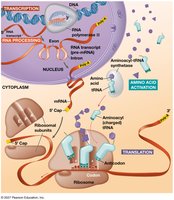
Gene expression is the process by which information encoded in DNA directs the synthesis of proteins, which are responsible for an organism's traits. This process involves two main stages: transcription and translation. Proteins serve as the link between genotype and phenotype, translating genetic information into observable characteristics.
Transcription: The synthesis of RNA from a DNA template.
Translation: The synthesis of a polypeptide (protein) from the information in messenger RNA (mRNA).
Ribosomes: Cellular structures where translation occurs.
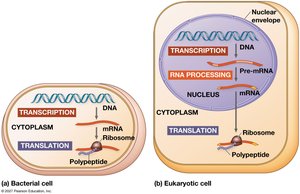

Basic Principles of Transcription and Translation
RNA acts as the bridge between genes and protein synthesis. Transcription produces mRNA, which carries genetic information from DNA to the ribosome, where translation occurs.
Transcription: Occurs in the nucleus (eukaryotes) or cytoplasm (prokaryotes).
Translation: Occurs in the cytoplasm at ribosomes.
The Triplet Code and Codons
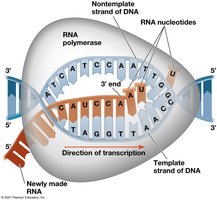
The genetic code is based on triplets of nucleotides called codons. Each codon specifies a particular amino acid or a stop signal. The template strand of DNA is used to order the sequence of complementary nucleotides in an RNA transcript.
Template strand: The DNA strand used for RNA synthesis.
Coding strand: The DNA strand whose sequence matches the mRNA (except T is replaced by U).
Redundancy: Multiple codons can code for the same amino acid.
Reading frame: Codons must be read in the correct groupings.
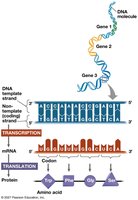
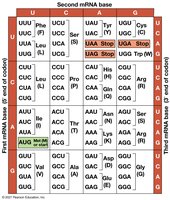
Molecular Components of Transcription
RNA Polymerase and Promoters
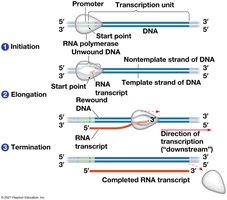
RNA synthesis is catalyzed by RNA polymerase, which separates DNA strands and joins RNA nucleotides. The DNA sequence where RNA polymerase attaches is called the promoter. In bacteria, the sequence signaling the end of transcription is the terminator.
RNA polymerase: Enzyme that synthesizes RNA.
Promoter: DNA sequence where transcription begins.
Terminator: Sequence signaling transcription end (in bacteria).
Transcription unit: Stretch of DNA transcribed into RNA.
RNA Processing in Eukaryotes
Modification of Pre-mRNA
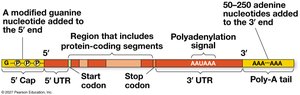
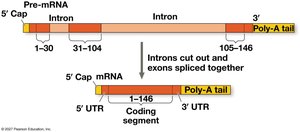
In eukaryotic cells, the primary RNA transcript (pre-mRNA) undergoes processing before leaving the nucleus. Both ends of the transcript are modified, and certain interior sections (introns) are removed, while exons are spliced together.
5' Cap: Modified guanine nucleotide added to the 5' end.
Poly-A tail: 50–250 adenine nucleotides added to the 3' end.
RNA splicing: Removal of introns and joining of exons.
Alternative RNA Splicing
Some genes can encode more than one kind of polypeptide, depending on which segments are treated as exons during splicing. This process is called alternative RNA splicing, increasing protein diversity.
Introns: Non-coding regions removed during splicing.
Exons: Coding regions joined together.
Regulation: Some introns regulate gene expression.
Translation: From mRNA to Protein
Transfer RNA (tRNA) and Ribosomes
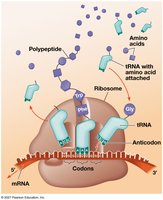
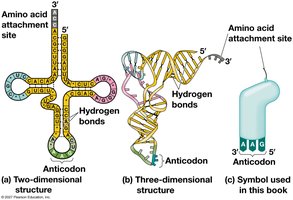
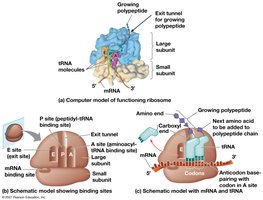
Each tRNA molecule carries a specific amino acid and has an anticodon that base-pairs with a complementary codon on mRNA. Ribosomes facilitate the matching of tRNA anticodons with mRNA codons and catalyze peptide bond formation.
tRNA: Adapter molecule in translation.
Anticodon: Sequence on tRNA complementary to mRNA codon.
Ribosome: Site of protein synthesis.
Stages of Translation
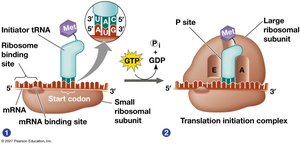
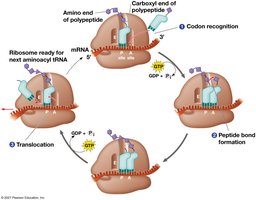
Translation occurs in three stages: initiation, elongation, and termination. Each stage involves specific molecular interactions and energy requirements.
Initiation: Assembly of the translation initiation complex.
Elongation: Addition of amino acids to the growing polypeptide chain.
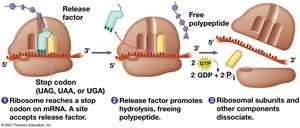
Termination: Release of the completed polypeptide when a stop codon is reached.
Protein Folding and Post-Translational Modifications
Protein Structure and Targeting
After translation, polypeptides fold into their functional three-dimensional shapes. Some proteins undergo post-translational modifications or are targeted to specific cellular locations, such as the endoplasmic reticulum (ER).
Primary structure: Sequence of amino acids determined by the gene.
Secondary and tertiary structure: Folding and coiling of the polypeptide.
Post-translational modifications: Chemical changes required for function.
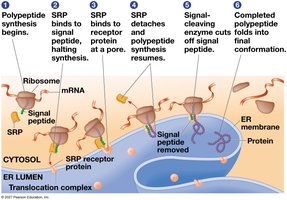
Signal peptide: Directs proteins to the ER.
Mutations and Their Effects on Protein Structure
Types of Mutations
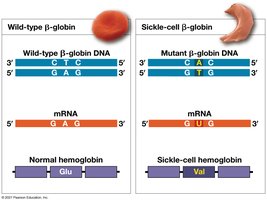
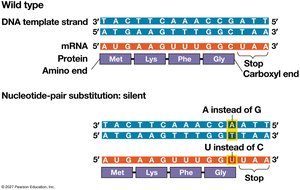
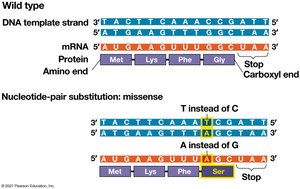
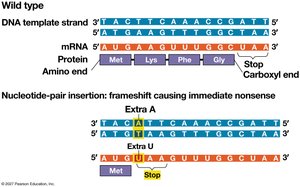
Mutations are changes in the genetic information of a cell. Point mutations affect a single nucleotide pair, while insertions and deletions can alter the reading frame, often resulting in more severe effects.
Point mutations: Single nucleotide changes.
Silent mutations: No effect on protein due to genetic code redundancy.
Missense mutations: Change one amino acid to another.
Nonsense mutations: Change an amino acid codon to a stop codon.
Frameshift mutations: Insertions or deletions that alter the reading frame.
Mutagens and Gene Editing
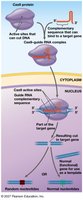
Mutations can occur spontaneously or be induced by mutagens, which are physical or chemical agents. The CRISPR-Cas9 system is a powerful tool for gene editing, allowing targeted modifications to correct disease-causing mutations.
Mutagens: Agents that cause mutations (often carcinogenic).
CRISPR-Cas9: Gene editing technology using a guide RNA and Cas9 protein.
Defining a Gene
Modern Definition
A gene is defined as a region of DNA that can be expressed to produce a final functional product, either a polypeptide or an RNA molecule. This definition reflects the complexity and diversity of gene products in modern molecular biology.
Gene: DNA region encoding a functional product.
Polypeptide: Protein product of gene expression.
RNA molecule: Functional RNA (e.g., tRNA, rRNA, regulatory RNA).
----------------------------------------
