 Back
Gene Expression: From Gene to Protein – Study Notes
Study Guide - Smart Notes
 Tailored notes based on your materials, expanded with key definitions, examples, and context.
Gene Expression: From Gene to Protein
Introduction to Gene Expression
Gene expression is the process by which information encoded in DNA is used to direct the synthesis of proteins, which are responsible for an organism's traits. This process involves two main stages: transcription and translation. Proteins serve as the link between genotype (genetic makeup) and phenotype (observable traits).
Gene Expression: The process by which DNA directs protein synthesis.
Transcription: The synthesis of RNA from a DNA template.
Translation: The synthesis of a polypeptide using information from mRNA.
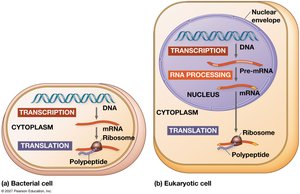
Central Dogma of Molecular Biology
The central dogma describes the flow of genetic information: DNA is transcribed into RNA, which is then translated into protein.
DNA → RNA → Protein: This sequence is fundamental to all living organisms.
Ribosomes: The cellular structures where translation occurs.

Transcription: Basic Principles
Transcription Mechanism
Transcription is catalyzed by RNA polymerase, which separates DNA strands and assembles RNA nucleotides complementary to the DNA template strand.
RNA Polymerase: Enzyme responsible for RNA synthesis; does not require a primer.
Promoter: DNA sequence where RNA polymerase binds to initiate transcription.
Terminator: Sequence signaling the end of transcription in bacteria.
Transcription Unit: The stretch of DNA transcribed into RNA.
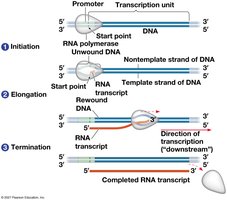
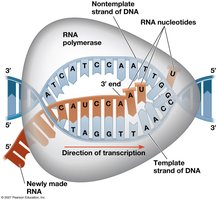
Transcription Stages
Initiation: RNA polymerase binds to the promoter and unwinds DNA.
Elongation: RNA polymerase moves along the template strand, synthesizing RNA.
Termination: RNA polymerase releases the completed RNA transcript.
Translation: Basic Principles
The Genetic Code and Codons
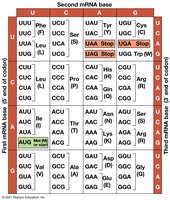
The genetic code consists of triplets of nucleotides called codons, each specifying an amino acid.
Codon: A sequence of three nucleotides in mRNA that specifies an amino acid.
Redundancy: Multiple codons can code for the same amino acid.
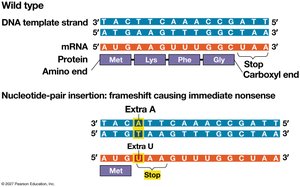
Reading Frame: Codons must be read in the correct grouping for proper protein synthesis.
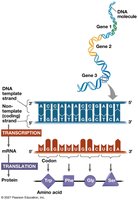
Translation Mechanism
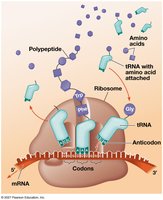
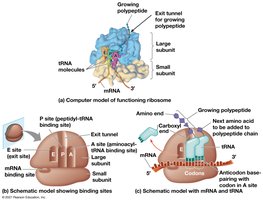
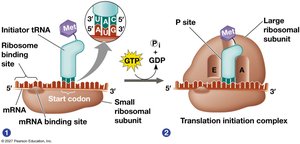
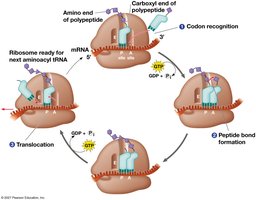
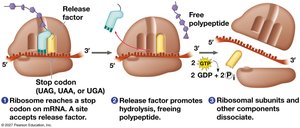
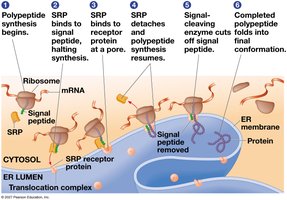
Translation occurs at the ribosome, where mRNA is decoded to build a polypeptide.
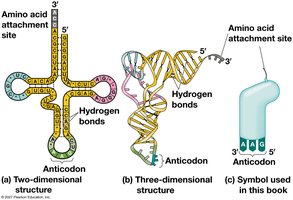
tRNA: Transfer RNA molecules carry specific amino acids and have anticodons that pair with mRNA codons.
Ribosome: Facilitates the pairing of tRNA anticodons with mRNA codons and catalyzes peptide bond formation.
RNA Processing in Eukaryotes
Modifications of Pre-mRNA
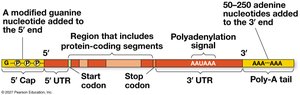
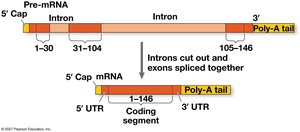
Eukaryotic cells modify RNA after transcription. These modifications are essential for mRNA stability and translation.
5' Cap: A modified guanine nucleotide added to the 5' end.
Poly-A Tail: 50–250 adenine nucleotides added to the 3' end.
RNA Splicing: Removal of introns and joining of exons.
Alternative RNA Splicing
Some genes can encode multiple polypeptides depending on which segments are treated as exons during splicing. This increases protein diversity.
Introns: Non-coding regions removed during splicing.
Exons: Coding regions joined together to form mature mRNA.
Alternative Splicing: Allows a single gene to produce multiple proteins.
Protein Folding and Post-Translational Modifications
Protein Structure and Function
After translation, polypeptides fold into specific three-dimensional shapes, which are critical for their function.
Primary Structure: Sequence of amino acids determined by the gene.
Secondary and Tertiary Structure: Folding and coiling of the polypeptide chain.
Post-Translational Modifications: Chemical changes to the protein after synthesis, necessary for function.
Mutations and Their Effects
Types of Mutations
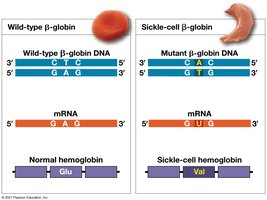
Mutations are changes in the genetic information of a cell and can affect protein structure and function.
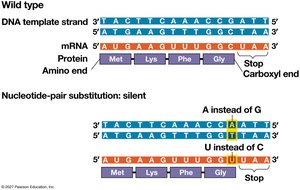
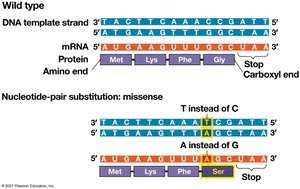
Point Mutations: Changes in a single nucleotide pair.
Silent Mutations: No effect on the amino acid sequence.
Missense Mutations: Change one amino acid to another.
Nonsense Mutations: Change an amino acid codon to a stop codon.
Insertions and Deletions: Addition or loss of nucleotide pairs, often causing frameshift mutations.
Mutagens and Gene Editing
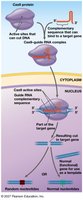
Mutagens are physical or chemical agents that cause mutations. CRISPR-Cas9 is a modern technique used to edit genes and correct disease-causing mutations.
Mutagens: Agents that induce mutations; most carcinogens are mutagens.
CRISPR-Cas9: A gene-editing tool that allows precise modifications of DNA.
Summary Table: Types of Mutations
Type | Description | Effect |
|---|---|---|
Silent | Change in nucleotide, no change in amino acid | No effect |
Missense | Change in nucleotide, changes amino acid | May alter protein function |
Nonsense | Change in nucleotide, creates stop codon | Usually nonfunctional protein |
Insertion/Deletion | Addition or loss of nucleotides | Frameshift, often disastrous |
What Is a Gene?
Modern Definition
A gene is a region of DNA that can be expressed to produce a final functional product, either a polypeptide or an RNA molecule.
Gene: Functional unit of heredity; sequence of DNA encoding a product.
Additional info:
Gene expression is tightly regulated and can be influenced by environmental and cellular signals.
Mutations outside coding regions can affect gene regulation and expression.
