 Back
Gene Expression: From Gene to Protein
Study Guide - Smart Notes
 Tailored notes based on your materials, expanded with key definitions, examples, and context.
Gene Expression: From Gene to Protein
Overview of Gene Expression
Gene expression is the process by which information encoded in DNA is used to direct the synthesis of proteins, which are responsible for an organism's traits. This process involves two main stages: transcription and translation.
Transcription: The synthesis of RNA from a DNA template.
Translation: The synthesis of a polypeptide (protein) fro m an mRNA template.
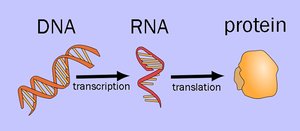
Central Dogma: The flow of genetic information is generally from DNA → RNA → Protein.

Differences Between DNA and RNA
DNA and RNA are both nucleic acids, but they differ in structure and function.
DNA: Double-stranded, contains deoxyribose sugar, uses thymine (T).
RNA: Single-stranded, contains ribose sugar, uses uracil (U) instead of thymine.
Transcription vs. Translation
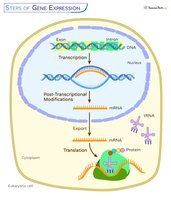
Transcription: Occurs in the nucleus (eukaryotes) or cytoplasm (prokaryotes). DNA is used as a template to make mRNA.
Translation: Occurs in the cytoplasm. Ribosomes use mRNA to assemble amino acids into a polypeptide.
Location of Transcription and Translation
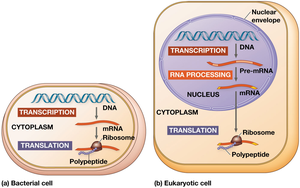
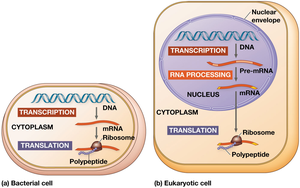
Bacteria: Both processes occur in the cytoplasm; translation can begin before transcription is finished.
Eukaryotes: Transcription occurs in the nucleus; translation occurs in the cytoplasm. RNA processing occurs between these steps.
The Genetic Code
Codons and the Triplet Code
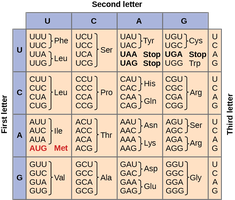
The genetic code is based on codons, which are sequences of three nucleotides in mRNA. Each codon specifies a particular amino acid.
Codon: A three-nucleotide sequence in mRNA that specifies an amino acid.
Reading Frame: The correct grouping of nucleotides into codons is essential for proper translation.
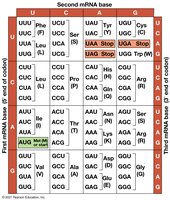
Start Codon: AUG (methionine) signals the start of translation.
Stop Codons: UAA, UAG, UGA signal the end of translation.
Redundancy: Multiple codons can code for the same amino acid, but each codon specifies only one amino acid.
Template and Coding Strands
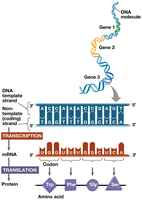
Template Strand: The DNA strand used to synthesize RNA.
Coding Strand: The DNA strand whose sequence matches the mRNA (except T is replaced by U).
Transcription: DNA-Directed Synthesis of RNA
Molecular Components of Transcription
Transcription is catalyzed by RNA polymerase, which synthesizes RNA by reading the DNA template strand.
Promoter: DNA sequence where RNA polymerase binds to start transcription.
Terminator: Sequence signaling the end of transcription (in bacteria).
Transcription Unit: The stretch of DNA that is transcribed.
Stages of Transcription
Initiation: RNA polymerase binds to the promoter, aided by transcription factors in eukaryotes.
Elongation: RNA polymerase moves along DNA, synthesizing RNA in the 5′ → 3′ direction.
Termination: Transcription ends at the terminator (bacteria) or after the polyadenylation signal (eukaryotes).
RNA Processing in Eukaryotes
Modification of RNA After Transcription
Eukaryotic cells modify pre-mRNA before it becomes mature mRNA.
5′ Cap: Added to the 5′ end for stability and ribosome binding.
Poly-A Tail: Added to the 3′ end for stability and export.
RNA Splicing: Removal of introns (noncoding regions) and joining of exons (coding regions).
Alternative Splicing: Allows a single gene to code for multiple proteins.
Translation: RNA-Directed Synthesis of Polypeptides
Components and Process of Translation
Translation uses mRNA, tRNA, ribosomes, and various protein factors.
tRNA: Transfers specific amino acids to the ribosome; contains an anticodon that pairs with mRNA codons.
Wobble: Flexible pairing at the third base of a codon allows some tRNAs to bind to multiple codons.
Aminoacyl-tRNA Synthetase: Enzyme that attaches the correct amino acid to tRNA.
Ribosome: Facilitates the pairing of tRNA anticodons with mRNA codons; has three binding sites (A, P, E).
Stages of Translation
Initiation: Small ribosomal subunit binds mRNA and initiator tRNA (methionine); large subunit joins.
Elongation: Amino acids are added one by one; involves codon recognition, peptide bond formation, and translocation.
Termination: Stop codon is reached; release factor causes polypeptide release.
Protein Folding and Post-Translational Modifications
Polypeptides fold into specific shapes (secondary, tertiary structure).
Post-translational modifications may be required for functionality.
Mutations and Their Effects
Types of Mutations
Mutations are changes in the genetic information of a cell.
Point Mutations: Changes in a single nucleotide pair.
Substitutions: Replace one nucleotide pair with another.
Insertions/Deletions: Add or remove nucleotide pairs; can cause frameshift mutations.
Missense Mutation: Changes one amino acid to another.
Nonsense Mutation: Changes an amino acid codon to a stop codon.
Silent Mutation: No effect on the amino acid sequence.
Mutagens
Physical Mutagens: e.g., radiation.
Chemical Mutagens: e.g., carcinogens.
Summary Table: Genetic Code
Codon | Amino Acid | Function |
|---|---|---|
AUG | Methionine | Start codon |
UAA, UAG, UGA | None | Stop codons |
UUU, UUC | Phenylalanine | Standard codons |
CUU, CUC, CUA, CUG | Leucine | Standard codons |
... (see genetic code table for full list) | ... | ... |
Summary Table: Mutation Types
Mutation Type | Description | Effect |
|---|---|---|
Substitution | One nucleotide replaced | Silent, missense, or nonsense |
Insertion | Extra nucleotide added | Frameshift, often deleterious |
Deletion | Nucleotide removed | Frameshift, often deleterious |
Key Terms
Gene Expression
Transcription
Translation
Codon
Mutation
tRNA
Ribosome
Promoter
Introns/Exons
Additional info:
Alternative RNA splicing increases protein diversity.
Polyribosomes allow rapid protein synthesis.
Mutations outside coding regions can affect gene regulation.
