 Back
Gene Expression: From Gene to Protein (Chapter 17 Study Notes)
Study Guide - Smart Notes
 Tailored notes based on your materials, expanded with key definitions, examples, and context.
Gene Expression: From Gene to Protein
Introduction to Gene Expression
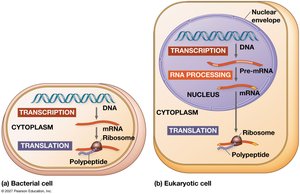
Gene expression is the process by which information encoded in DNA directs the synthesis of proteins, ultimately determining an organism's traits. Proteins serve as the link between genotype and phenotype, and gene expression involves two main stages: transcription and translation.
Transcription: The synthesis of RNA from a DNA template.
Translation: The synthesis of a polypeptide using information in the mRNA.
Proteins: The functional products that result from gene expression.

Basic Principles of Transcription and Translation
The flow of genetic information follows the central dogma: DNA → RNA → Protein. RNA acts as the bridge between genes and protein synthesis, with ribosomes serving as the sites of translation.
Messenger RNA (mRNA): Carries genetic information from DNA to the ribosome.
Ribosomes: Facilitate the translation of mRNA into polypeptides.

Transcription: The Triplet Code and Codons
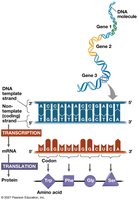
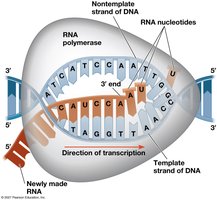
The genetic code is based on triplets of nucleotides called codons. One DNA strand (the template strand) is used to order the sequence of complementary nucleotides in an RNA transcript. The coding strand is identical to the RNA sequence except for thymine (T) in DNA and uracil (U) in RNA.
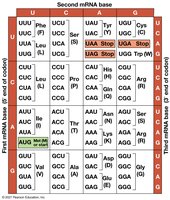
Codon: A sequence of three nucleotides that specifies an amino acid.
Reading Frame: The correct grouping of nucleotides to produce the intended polypeptide.
Redundancy: Multiple codons can specify the same amino acid.
Stop Codons: Three codons signal the end of translation.
Molecular Components of Transcription
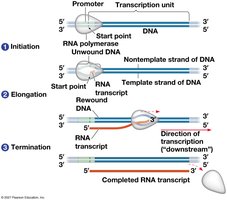
RNA synthesis is catalyzed by RNA polymerase, which separates DNA strands and assembles RNA nucleotides. The promoter is the DNA sequence where RNA polymerase attaches, and the terminator signals the end of transcription in bacteria. The transcribed stretch of DNA is called the transcription unit.
RNA Polymerase: Enzyme that synthesizes RNA from DNA.
Promoter: DNA sequence initiating transcription.
Terminator: Sequence signaling transcription termination.
RNA Processing in Eukaryotes
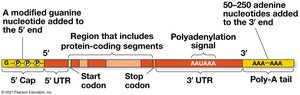
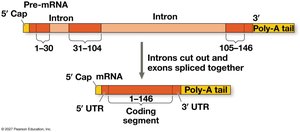
Eukaryotic cells modify pre-mRNA before it is exported to the cytoplasm. This includes the addition of a 5' cap and a poly-A tail, as well as RNA splicing, where introns are removed and exons are joined.
5' Cap: Modified guanine nucleotide added to the 5' end.
Poly-A Tail: String of adenine nucleotides added to the 3' end.
RNA Splicing: Removal of introns and joining of exons.
Alternative RNA Splicing and Introns
Some introns regulate gene expression, and alternative RNA splicing allows a single gene to encode multiple polypeptides, increasing protein diversity.
Introns: Non-coding regions removed during RNA processing.
Exons: Coding regions retained in mature mRNA.
Alternative Splicing: Different combinations of exons produce different proteins.
Translation: The Basic Concept
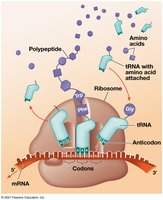
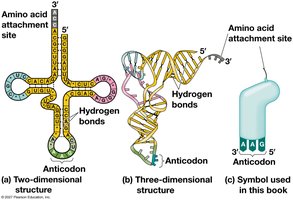
Translation is the process by which mRNA is decoded to produce a polypeptide. Transfer RNA (tRNA) molecules carry specific amino acids and have anticodons that pair with mRNA codons.
tRNA: Adapter molecule that brings amino acids to the ribosome.
Anticodon: Three-nucleotide sequence on tRNA complementary to mRNA codon.
Ribosome Structure and Function
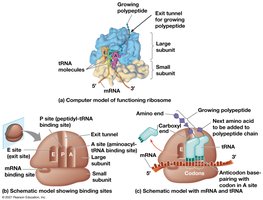
Ribosomes are composed of a large and small subunit and have binding sites for tRNA and mRNA. They facilitate the assembly of amino acids into polypeptides.
Ribosome: Molecular machine for protein synthesis.
Binding Sites: E (exit), P (peptidyl), and A (aminoacyl) sites for tRNA.
Stages of Translation
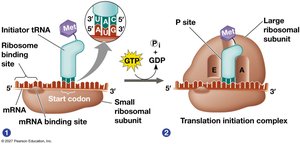
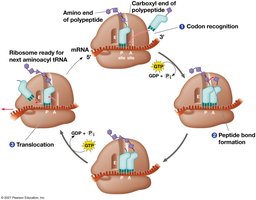
Translation occurs in three stages: initiation, elongation, and termination.
Initiation: Assembly of the translation initiation complex.
Elongation: Addition of amino acids to the growing polypeptide chain.
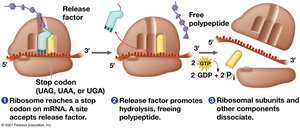
Termination: Release of the completed polypeptide when a stop codon is reached.
Protein Folding and Post-Translational Modifications
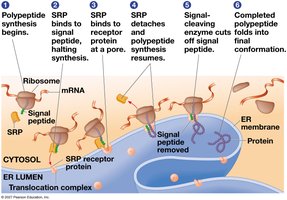
After translation, polypeptides fold into their functional three-dimensional shapes. Some proteins undergo post-translational modifications, such as cleavage or addition of chemical groups, to become fully functional.
Primary Structure: Sequence of amino acids determined by the gene.
Secondary/Tertiary Structure: Folding and coiling of the polypeptide.
Post-Translational Modifications: Chemical changes required for protein function.
Summary of Transcription and Translation in Eukaryotic Cells
The process of gene expression in eukaryotes involves transcription in the nucleus, RNA processing, and translation in the cytoplasm. 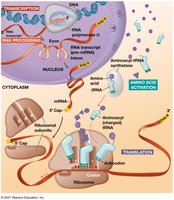
Mutations and Their Effects on Protein Structure and Function
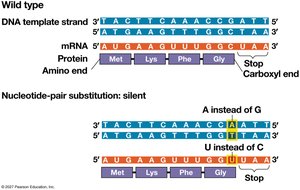
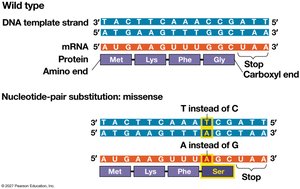
Mutations are changes in genetic information that can affect protein structure and function. Point mutations involve changes in a single nucleotide pair and can result in silent, missense, or nonsense mutations.
Silent Mutation: No effect on protein due to redundancy in the genetic code.
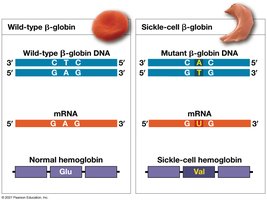
Missense Mutation: Changes one amino acid in the protein.
Nonsense Mutation: Converts a codon to a stop codon, leading to a truncated protein.
Insertions, Deletions, and Frameshift Mutations
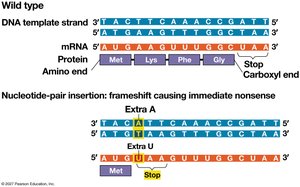
Insertions and deletions add or remove nucleotide pairs, often causing frameshift mutations that alter the reading frame and usually result in nonfunctional proteins.
Frameshift Mutation: Shifts the reading frame, changing all downstream codons.
Mutagens and Gene Editing
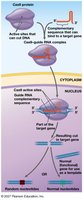
Mutations can occur spontaneously or be induced by mutagens, which are physical or chemical agents. CRISPR-Cas9 is a powerful gene-editing tool used to correct disease-causing mutations.
Mutagen: Agent that causes mutations.
CRISPR-Cas9: Gene-editing system derived from bacterial defense mechanisms.
Defining a Gene
A gene is a region of DNA that can be expressed to produce a final functional product, either a polypeptide or an RNA molecule.
Gene: Fundamental unit of heredity, encoding functional products.
Key Terms and Concepts Table
Term | Definition |
|---|---|
Transcription | Synthesis of RNA from DNA template |
Translation | Synthesis of polypeptide from mRNA |
Codon | Three-nucleotide sequence specifying an amino acid |
Mutation | Change in genetic information |
RNA Polymerase | Enzyme catalyzing RNA synthesis |
CRISPR-Cas9 | Gene-editing system |
Important Equations and Concepts
Central Dogma:
Genetic Code:
Example: Sickle-Cell Disease
A single nucleotide substitution in the β-globin gene leads to sickle-cell disease, demonstrating how mutations can affect protein structure and function.
Summary
Gene expression is a fundamental biological process involving transcription and translation, with multiple regulatory steps and potential for mutation. Understanding these mechanisms is essential for studying genetics, molecular biology, and biotechnology.
