 Back
Gene Expression: From Gene to Protein (Transcription, Translation, and Mutations)
Study Guide - Smart Notes
 Tailored notes based on your materials, expanded with key definitions, examples, and context.
Gene Expression: From Gene to Protein
Basic Principles of Transcription and Translation
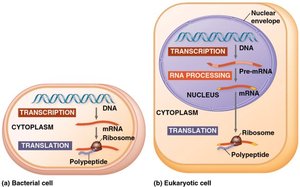
Gene expression is the process by which information from a gene is used to synthesize a functional gene product, typically a protein. This process involves two main stages: transcription and translation. In prokaryotes, translation can begin before transcription is finished, while in eukaryotes, the nuclear envelope separates these processes, and RNA transcripts undergo processing before translation.
Transcription: The synthesis of RNA from a DNA template.
Translation: The synthesis of a polypeptide (protein) from an mRNA template.
RNA Processing (Eukaryotes): Modifies RNA transcripts to produce mature mRNA.
The Central Dogma and Genetic Code
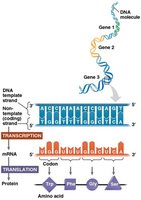
The central dogma of molecular biology describes the flow of genetic information: DNA → RNA → Protein. The genetic code is composed of codons, which are triplets of nucleotides in mRNA that specify amino acids.
Template Strand: The DNA strand used to synthesize RNA.
Coding Strand: The DNA strand with the same sequence as the mRNA (except T for U).
Codons: Each codon specifies one of 20 amino acids or a stop signal.
Redundancy: Multiple codons can code for the same amino acid.
Reading Frame: Codons must be read in the correct grouping for proper protein synthesis.
Transcription: Molecular Components and Process
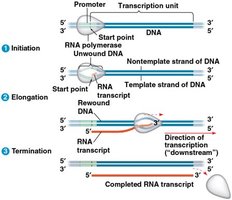
Transcription is the first stage of gene expression, where RNA polymerase synthesizes RNA from a DNA template. The process consists of three stages: initiation, elongation, and termination.
Promoter: DNA sequence where RNA polymerase binds to start transcription.
Transcription Factors: Proteins that help RNA polymerase bind and initiate transcription.
TATA Box: A promoter element crucial for initiation in eukaryotes.
Transcription Unit: The stretch of DNA transcribed into RNA.
Termination: Different mechanisms in prokaryotes and eukaryotes.
RNA Processing in Eukaryotes
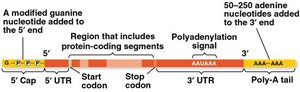
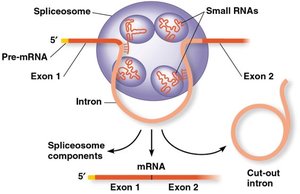
Before mRNA leaves the nucleus, it undergoes processing. Both ends of the primary transcript are modified, and noncoding regions (introns) are removed through splicing.
5′ Cap: Modified guanine nucleotide added to the 5′ end.
Poly-A Tail: 50–250 adenine nucleotides added to the 3′ end.
Functions: Facilitate export, protect mRNA, and help ribosome binding.
Split Genes and RNA Splicing
Most eukaryotic genes contain introns (noncoding regions) and exons (coding regions). Introns are removed by spliceosomes, and exons are joined to form mature mRNA.
Introns: Intervening sequences removed from pre-mRNA.
Exons: Expressed sequences translated into protein.
Spliceosome: Complex of proteins and small RNAs that catalyze splicing.
Functional and Evolutionary Importance of Introns
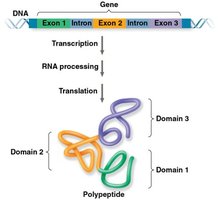
Introns can regulate gene expression and allow for alternative RNA splicing, increasing protein diversity. Exon shuffling can lead to new proteins by mixing exons from different genes.
Alternative Splicing: Produces different proteins from the same gene.
Protein Domains: Exons often code for distinct functional regions of proteins.
Translation: RNA-Directed Synthesis of Polypeptides
Translation is the process by which mRNA is decoded to synthesize a polypeptide. Transfer RNA (tRNA) and ribosomes play key roles in this process.
tRNA: Transfers specific amino acids to the growing polypeptide chain.
Anticodon: tRNA region that base-pairs with mRNA codon.
Aminoacyl-tRNA Synthetase: Enzyme that attaches amino acids to tRNA.
Wobble: Flexible pairing at the third base of a codon.
Ribosome Structure and Function
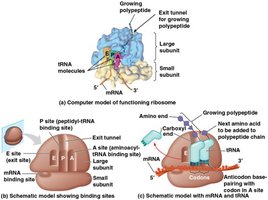
Ribosome: Facilitates coupling of tRNA anticodons with mRNA codons.
Binding Sites: P site (polypeptide), A site (amino acid), E site (exit).
Stages of Translation
Initiation: Small ribosomal subunit binds mRNA and initiator tRNA (methionine).
Elongation: Amino acids added to the growing chain via codon recognition, peptide bond formation, and translocation.
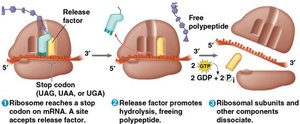
Termination: Stop codon triggers release factor, freeing the polypeptide.
Protein Folding and Targeting
After translation, polypeptides fold into their functional shapes and may undergo post-translational modifications. Proteins are targeted to specific cellular locations based on signal peptides.
Free Ribosomes: Synthesize proteins for cytosol.
Bound Ribosomes: Synthesize proteins for secretion or endomembrane system.
Signal Peptide: Directs ribosome to ER for protein targeting.
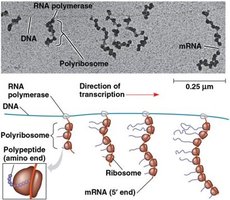
Polyribosomes
Multiple ribosomes can translate a single mRNA simultaneously, forming a polyribosome for efficient protein synthesis.
Mutations and Their Effects on Protein Structure and Function
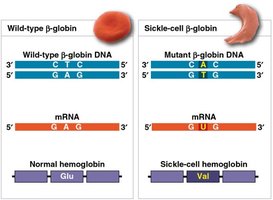
Mutations are changes in genetic information that can affect protein structure and function. Point mutations alter a single nucleotide pair, while insertions and deletions can cause frameshift mutations.
Point Mutations: Single nucleotide changes (silent, missense, nonsense).
Insertions/Deletions: Addition or loss of nucleotides, often causing frameshift mutations.
Mutagens: Physical or chemical agents that cause mutations.
Gene Editing: CRISPR-Cas9
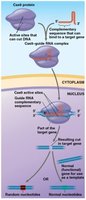
CRISPR-Cas9 is a powerful gene editing tool used to alter genes and correct disease-causing mutations. Cas9 protein, guided by RNA, cuts DNA at specific sites, enabling researchers to disable or correct genes.
Cas9: Bacterial protein used for gene editing.
Guide RNA: Directs Cas9 to target DNA sequence.
Gene Knockout: Disabling a gene to study its function.
Gene Correction: Introducing a template to repair defective genes.
What Is a Gene?
A gene is a region of DNA that can be expressed to produce a final functional product, either a polypeptide or an RNA molecule.
----------------------------------------
