 Back
Gene Expression: From Gene to Protein
Study Guide - Smart Notes
 Tailored notes based on your materials, expanded with key definitions, examples, and context.
Gene Expression and the Central Dogma
Overview of Gene Expression
Gene expression is the process by which information encoded in DNA is used to produce a functional product, either RNA or protein. This process is fundamental to all living organisms and is governed by the central dogma of molecular biology.
Central Dogma: Describes the flow of genetic information from DNA to RNA to protein.
Gene Expression: Involves transcription (DNA to RNA) and translation (RNA to protein).
Functional Products: Can be RNA molecules (such as rRNA or tRNA) or proteins (enzymes, structural proteins, etc.).
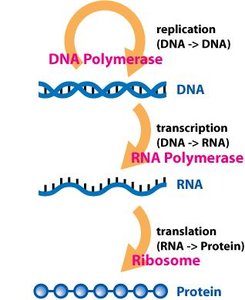
Genes Specify Proteins via Transcription and Translation
Beadle and Tatum’s Experiment
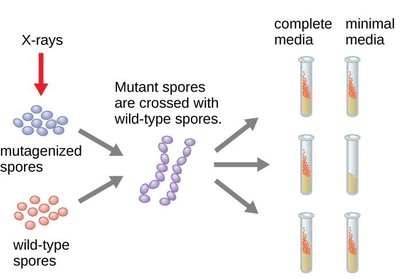
Beadle and Tatum used the mold Neurospora crassa to demonstrate that genes control metabolic pathways by encoding specific enzymes. Their experiments led to the 'one gene, one enzyme' hypothesis, later refined to 'one gene, one protein.'
Knockout Mutations: Mutations that cause a loss of function in a gene.
Experimental Setup: Mutated haploid spores with X-rays, crossed with wild-type spores, grown on minimal and complete media.
Minimal Media: Contains only sugar, salt, and biotin; wild-type spores grow, mutants do not.
Complete Media: Minimal media plus amino acids; all spores grow.
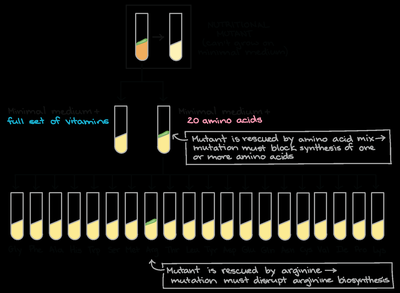
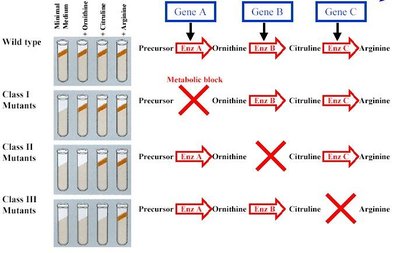
Rescue Experiment and Arginine Pathway
Mutants unable to grow on minimal media could be 'rescued' by supplementing with specific amino acids, revealing the steps in the arginine biosynthesis pathway.
Rescue: Mutant receives the necessary amino acid from the environment and can grow.
Arginine Pathway: Three different mutants grow on different supplemented media, showing the pathway of arginine synthesis.
One Gene, One Protein Hypothesis: Each gene encodes a single protein (enzyme) in a metabolic pathway.
Flow of Genetic Information: Central Dogma
DNA, RNA, and Protein
The central dogma describes the directional flow of genetic information: DNA is transcribed into RNA, which is then translated into protein. Each step involves specific enzymes and cellular structures.
Replication: DNA is copied by DNA polymerase.
Transcription: DNA is transcribed into RNA by RNA polymerase.
Translation: RNA is translated into protein by ribosomes.
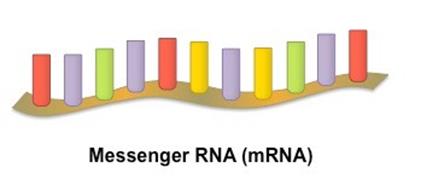
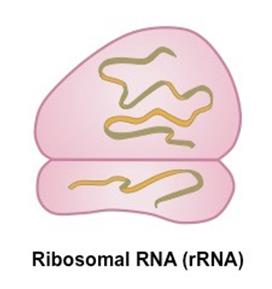
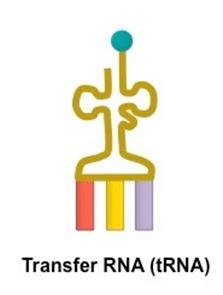
Main Types of RNA
Messenger RNA (mRNA), Ribosomal RNA (rRNA), and Transfer RNA (tRNA)
Three main types of RNA are involved in gene expression, each with a distinct function.
mRNA: Carries genetic information from DNA to the cytoplasm for translation.
rRNA: Forms the structural and functional core of the ribosome.
tRNA: Brings amino acids to the ribosome during translation.
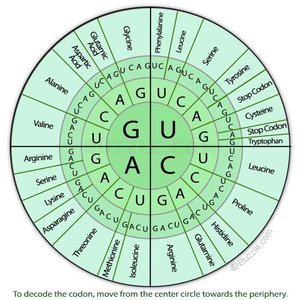
The Triplet Code and Codons
Genetic Code Structure
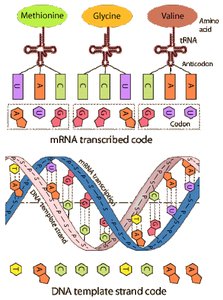
The genetic code is composed of codons, which are sequences of three nucleotides that specify amino acids. The template strand of DNA is used to synthesize mRNA, which has the same sequence as the coding strand (except U replaces T).
Codons: Three-base sequences in mRNA that specify amino acids.
Start Codon: AUG (methionine) signals the start of translation.
Stop Codons: UGA, UAA, UAG signal the end of translation.
Reading Frame: The grouping of codons that produces a functional polypeptide sequence.
Transcription: DNA-Directed Synthesis of RNA
Stages of Transcription
Transcription is the process by which an RNA copy of a gene is made. It occurs in three stages: initiation, elongation, and termination.
Initiation: Promoter binds to the start point on DNA; transcription factors assemble.
Elongation: RNA polymerase separates DNA strands and synthesizes the RNA transcript.
Termination: RNA polymerase releases the mRNA at the end of the transcription unit.
RNA Processing in Eukaryotes
Modifications to pre-mRNA
Before mRNA can be translated, it undergoes several modifications to ensure stability and proper function.
5' Cap: Modified guanine added to the 5' end.
Poly-A Tail: 50-250 adenine nucleotides added to the 3' end.
Introns Removed: Non-coding regions (introns) are spliced out, leaving only exons.
RNA Splicing
Spliceosomes remove introns from pre-mRNA, allowing exons to be joined together. This process can produce multiple protein variants from a single gene (alternative splicing).
Introns: Non-coding segments between coding regions.
Exons: Coding regions expressed as protein.
Spliceosome: Complex of proteins and small RNAs that remove introns.
Ribozymes: RNA molecules with enzymatic activity.
Translation: RNA-Directed Synthesis of Polypeptides
Stages of Translation
Translation is the process by which mRNA is decoded to build a polypeptide chain. It occurs in three stages: initiation, elongation, and termination.
Initiation: Ribosome assembles at the start codon.
Elongation: Polypeptide chain grows as tRNA brings amino acids.
Termination: Ribosome disassembles at the stop codon.
Transfer RNA and the Reading Frame
tRNA molecules carry amino acids to the ribosome and match their anticodon to the codon on mRNA. The reading frame is critical for correct translation.
Anticodon: Portion of tRNA that pairs with the mRNA codon.
Aminoacyl tRNA Synthetase: Enzyme that attaches amino acids to tRNA.
Wobble: Flexibility in the third base of the codon, allowing multiple codons to code for the same amino acid.
Ribosome Structure and Function
Ribosomes are composed of two subunits (large and small) made of rRNA. They facilitate the assembly of amino acids into polypeptides.
P Site: Holds the tRNA with the growing polypeptide chain.
A Site: Binds new tRNA bringing the next amino acid.
E Site: Where tRNA exits the ribosome.
Mutations and Their Effects on Protein Structure and Function
Types of Mutations
Mutations are changes to the genetic code that can affect protein structure and function. They may involve substitution, insertion, or deletion of nucleotides.
Point Mutation: Substitution of one nucleotide for another.
Silent Mutation: No effect on protein.
Missense Mutation: Changes one amino acid.
Nonsense Mutation: Creates a stop codon, resulting in a truncated protein.
Insertion/Deletion: Addition or removal of nucleotides, potentially causing a frameshift.
Frameshift Mutation: Alters the reading frame, affecting all downstream codons.
Causes of Mutations
Mutagens: Physical or chemical agents that damage DNA.
Carcinogens: Cancer-causing agents that lead to unregulated cell growth.
Gene Editing: CRISPR-Cas9
CRISPR-Cas9 System
CRISPR-Cas9 is a revolutionary gene editing tool derived from the bacterial immune system. It allows targeted modification of DNA sequences.
Cas9: Protein that cuts DNA at a targeted sequence.
gRNA: Guide RNA that directs Cas9 to the specific DNA sequence.
Knockout: Removes gene function.
Correction: Provides a correct template to repair DNA.
Green Fluorescent Protein (GFP) and Gene Expression
GFP Applications
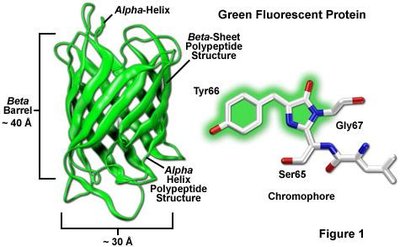
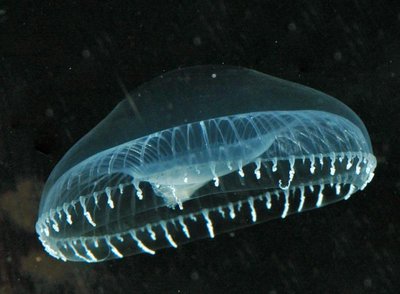
GFP is a small protein that fluoresces green under UV light. It is used as a marker to study gene expression and protein localization in cells.
Produced by: Sea jelly Aequorea victoria.
Function: Can be linked to target proteins to visualize their location in cells.
Variants: Different fluorescent proteins emit at different wavelengths, allowing multi-color labeling.
Summary Table: Types of Mutations and Their Effects
Mutation Type | Description | Effect on Protein |
|---|---|---|
Point Mutation | Substitution of one nucleotide | Silent, missense, or nonsense |
Insertion | Addition of nucleotide(s) | Frameshift, altered protein |
Deletion | Removal of nucleotide(s) | Frameshift, altered protein |
Frameshift | Change in reading frame | All downstream codons affected |
Additional info: The notes have been expanded to provide academic context and explanations suitable for General Biology college students, including definitions, examples, and relevant images.
