 Back
Gene Expression: From Gene to Protein (Chapter 17) - Study Notes
Study Guide - Smart Notes
 Tailored notes based on your materials, expanded with key definitions, examples, and context.
Gene Expression: From Gene to Protein
Overview of Gene Expression
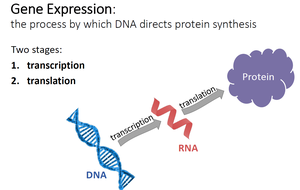
Gene expression is the process by which genetic information encoded in DNA is used to synthesize proteins, which determine cellular structure and function. This process is fundamental to all living organisms and occurs in two main stages: transcription and translation.
Transcription: DNA is used as a template to synthesize messenger RNA (mRNA).
Translation: mRNA is decoded to build a polypeptide (protein).
What is a Gene?
A gene is a unit of hereditary information consisting of a specific DNA sequence that codes for a particular polypeptide or functional RNA molecule. Genes are located on chromosomes and are responsible for the transmission of traits from one generation to the next.
Gene: Section of DNA coding for a specific polypeptide.
Polypeptide: A chain of amino acids that forms a protein.
One Gene–One Enzyme Hypothesis
Beadle and Tatum's Experiment
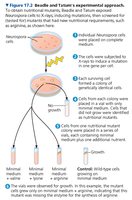
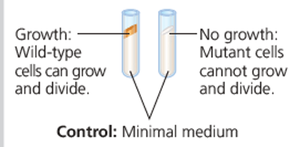
George Beadle and Edward Tatum's experiments with Neurospora crassa (bread mold) in the 1930s led to the formulation of the one gene–one enzyme hypothesis. They exposed the mold to X-rays, creating mutants that could not grow on minimal medium due to the inability to synthesize certain nutrients.
Nutritional Mutants: Cells unable to grow on minimal medium because they lack enzymes for synthesizing essential molecules.
Mutants grew only when the medium was supplemented with the missing nutrient (e.g., arginine).
Biochemical Pathways and Mutant Analysis
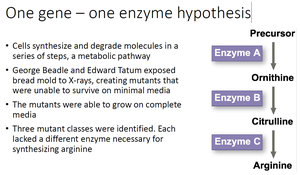
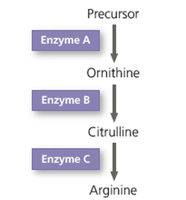
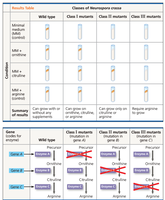
Beadle and Tatum showed that each class of mutant was unable to carry out one step in the pathway for synthesizing arginine because it lacked the necessary enzyme. This demonstrated that each gene dictates the production of one enzyme.
Enzyme A: Converts precursor to ornithine.
Enzyme B: Converts ornithine to citrulline.
Enzyme C: Converts citrulline to arginine.
The Products of Gene Expression: A Developing Story
Researchers later revised the hypothesis to one gene–one protein and then to one gene–one polypeptide, as not all proteins are enzymes and many proteins are composed of several polypeptides, each encoded by its own gene.
Not all proteins are enzymes.
Many proteins are made of multiple polypeptides.
Current hypothesis: one gene–one polypeptide.
Central Dogma of Molecular Biology
Flow of Genetic Information
The central dogma describes the directional flow of genetic information: DNA → RNA → Protein. DNA strands unwind, and RNA is synthesized using one DNA strand as a template. This flow is fundamental to all living organisms.
Transcription: DNA is transcribed to RNA.
Translation: RNA is translated to protein.
Role of RNA
RNA acts as the bridge between genes and the proteins for which they code. There are three main types of RNA:
Messenger RNA (mRNA): Encodes information to make proteins.
Ribosomal RNA (rRNA): Forms part of the ribosome structure.
Transfer RNA (tRNA): Brings specific amino acids to the ribosome during translation.
Triplet Genetic Code and Transcription
Genetic Code
The flow of information from gene to protein is based on the Triplet Genetic Code, a series of nonoverlapping three-nucleotide 'words' called codons. Each codon specifies a particular amino acid.
Triplet Code: Three bases code for one amino acid.
Universal: Same code used by almost all organisms.
Nonoverlapping: Codons are read one after another.
Degenerate: Some amino acids are coded by more than one codon.
Start Codon: AUG (methionine).
Stop Codons: UAA, UAG, UGA (signal termination).
Transcription Process
Transcription is the synthesis of RNA from a DNA template. RNA polymerase binds to the promoter region and synthesizes mRNA in the 5'→3' direction. In prokaryotes, the mRNA transcript is immediately usable, while in eukaryotes, it undergoes further processing.
Initiation: RNA polymerase binds to promoter.
Elongation: RNA strand is synthesized.
Termination: RNA polymerase stops at a termination sequence.
Translation: RNA-Directed Synthesis of Polypeptides
Translation Process
Translation occurs in the cytoplasm on ribosomes. mRNA provides the codon, tRNA provides the anticodon and brings specific amino acids to the ribosome, matching each codon to a growing polypeptide.
Initiation: Small ribosomal subunit binds to mRNA at start codon; initiator tRNA binds.
Elongation: tRNA brings amino acids; polypeptide chain grows.
Termination: Ribosome reaches stop codon; polypeptide released.
Structure and Function of tRNA and Ribosomes
tRNA has a cloverleaf shape and carries specific amino acids to the ribosome. Ribosomes are made in the nucleolus and consist of a small and large subunit. mRNA binds to the small subunit, and translation occurs as tRNA matches codons with anticodons.
Mutations and Gene Editing
Types of Mutations
A mutation is a change in the nucleotide sequence of DNA. Mutations can be beneficial, harmful, or neutral. Types include:
Point Mutation: Single nucleotide change.
Frameshift Mutation: Insertion or deletion alters the reading frame.
Mutagens: Physical, chemical, or biological agents causing mutations (e.g., UV, X-rays, chemicals, viruses).
Gene Editing Using CRISPR-Cas9
CRISPR-Cas9 is a gene editing tool used to correct disease-causing mutations. Cas9 is a bacterial protein guided by RNA to target specific DNA sequences.
Summary and Context
Gene expression involves transcription and translation, tightly regulated to maintain cell function and efficiency. The definition of a gene has evolved from a unit of inheritance to a DNA sequence coding for a polypeptide or functional RNA.
Table: Mutant Classes and Growth Conditions
This table summarizes the growth of different classes of Neurospora crassa mutants on various media and the corresponding enzyme deficiencies.
Condition | Wild type | Class I mutants (enzyme A) | Class II mutants (enzyme B) | Class III mutants (enzyme C) |
|---|---|---|---|---|
Minimal medium | Growth | No growth | No growth | No growth |
Minimal + ornithine | Growth | Growth | No growth | No growth |
Minimal + citrulline | Growth | Growth | Growth | No growth |
Minimal + arginine | Growth | Growth | Growth | Growth |
Summary of results: Wild type can grow on all media; Class I mutants require ornithine, citrulline, or arginine; Class II mutants require citrulline or arginine; Class III mutants require arginine.
Additional info: The table illustrates the relationship between gene mutations, enzyme deficiencies, and nutrient requirements in metabolic pathways.
