 Back
Chapter 17, Parts 1 & 2 Gene Expression: From Gene to Protein – General Biology Study Notes
Study Guide - Smart Notes
 Tailored notes based on your materials, expanded with key definitions, examples, and context.
Gene Expression: From Gene to Protein
Introduction to Gene Expression
Gene expression is the process by which the information encoded in a gene is used to direct the synthesis of a functional product, typically a protein. This process is fundamental to cell specialization and the manifestation of traits (phenotypes) from genetic information (genotype).
Gene Expression: The process by which DNA directs protein synthesis.
Central Dogma: The flow of genetic information follows the path: DNA → RNA → Protein.
Genotype vs. Phenotype: Genotype refers to the genetic makeup, while phenotype is the observable trait.
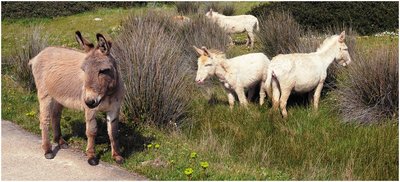
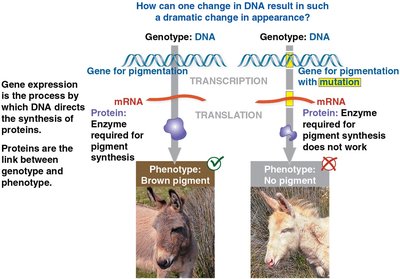
Role of Gene Expression in Cell Specialization
Although all cells in a multicellular organism contain the same genome, different cell types express different subsets of genes, leading to cell specialization. This selective gene expression results in the production of specific proteins that determine a cell's structure and function.
Liver cells express genes for albumin and detoxifying enzymes.
Nerve cells express genes for ion channels and neurotransmitter enzymes.
Red blood cell precursors express hemoglobin genes.
Cell specialization is achieved through differential gene expression.
The Flow of Genetic Information: The Central Dogma
Overview of the Central Dogma
The central dogma of molecular biology describes the two-step process by which the information in genes flows into proteins: transcription and translation.
Transcription: DNA is used as a template to synthesize messenger RNA (mRNA).
Translation: mRNA is decoded by ribosomes to build a polypeptide (protein).
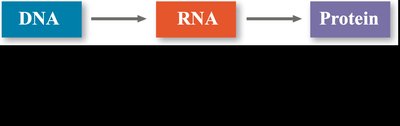
Transcription and Translation: Steps and Locations
The processes of transcription and translation occur in different locations in prokaryotic and eukaryotic cells.
Bacteria: Both transcription and translation occur in the cytoplasm, often simultaneously.
Eukaryotes: Transcription occurs in the nucleus, and translation occurs in the cytoplasm. Pre-mRNA undergoes processing before translation.
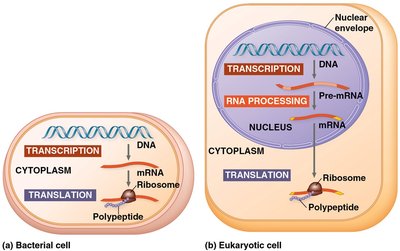
Coupling of Transcription and Translation in Bacteria
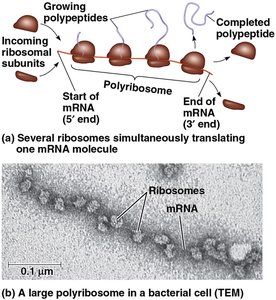
In bacteria, the absence of a nuclear envelope allows ribosomes to begin translating mRNA while it is still being synthesized by RNA polymerase. This results in the formation of polyribosomes, where multiple ribosomes translate a single mRNA simultaneously.
Polyribosome: Several ribosomes translating one mRNA at the same time.
Efficiency: Allows rapid protein synthesis from a single mRNA.
Gene Expression in Eukaryotes: Full Pathway
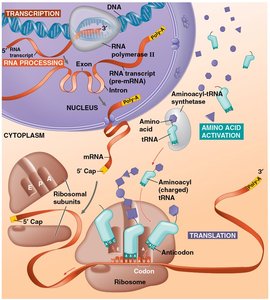
In eukaryotic cells, gene expression involves several steps, including transcription, RNA processing, export of mRNA, and translation.
Transcription: Occurs in the nucleus, producing pre-mRNA.
RNA Processing: Pre-mRNA is modified (5′ cap, poly-A tail, splicing) to become mature mRNA.
Export: Mature mRNA exits the nucleus via nuclear pores.
Translation: Occurs in the cytoplasm at ribosomes.
Mutation: The Source of Genetic Variation
Definition and Importance of Mutation
Mutations are changes in the genetic material and are the ultimate source of new alleles and genetic diversity. They can have various effects on protein structure and function, and their occurrence is random with respect to fitness.
Spontaneous mutations: Result from errors in DNA replication, recombination, or repair.
Mutagens: Physical or chemical agents (e.g., X-rays, UV light) that cause mutations.
Randomness: Mutations arise by chance; natural selection acts on their effects after they occur.
Transcription: Copying DNA into RNA
Template and Coding Strands
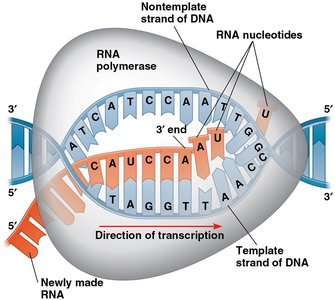
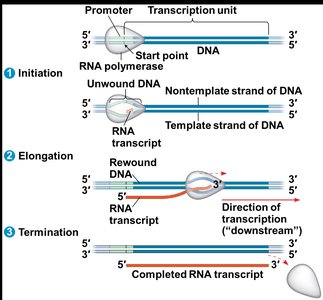
During transcription, only one strand of DNA (the template strand) is used to synthesize a complementary RNA molecule. The coding strand has the same sequence as the mRNA (except T is replaced by U in RNA).
Template strand: Read by RNA polymerase in the 3′→5′ direction.
mRNA: Synthesized in the 5′→3′ direction, complementary to the template strand.
Coding strand: Same sequence as mRNA (except T/U).
Stages of Transcription
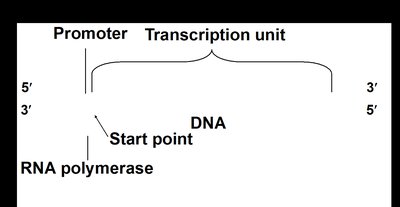
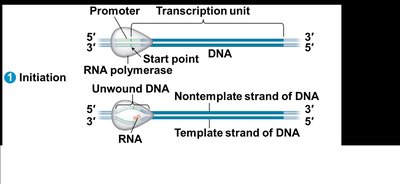
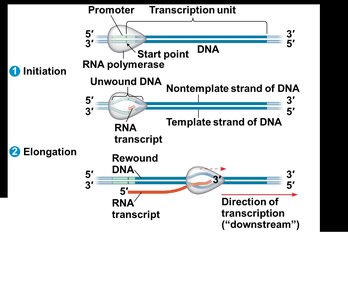
Transcription occurs in three main stages: initiation, elongation, and termination.
Initiation: RNA polymerase binds to the promoter and unwinds the DNA.
Elongation: RNA polymerase moves along the template strand, synthesizing RNA.
Termination: Transcription ends when RNA polymerase reaches a terminator sequence (bacteria) or polyadenylation signal (eukaryotes).
Structure of a Eukaryotic Gene
Key Elements and Their Roles
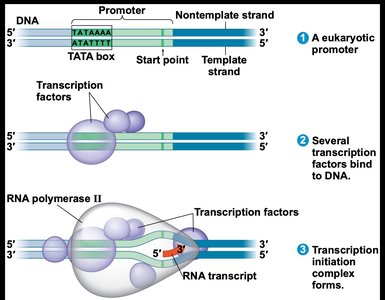
Eukaryotic genes contain several regulatory and coding elements that control transcription and RNA processing.
Promoter (TATA box): Site where transcription factors and RNA polymerase assemble to start transcription.
Enhancer: Binds activators to increase transcription.
Silencer: Binds repressors to decrease transcription.
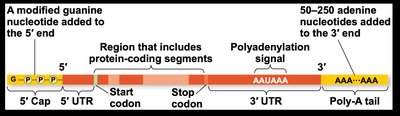
Poly-A signal sequence: Signals the end of transcription and addition of the poly-A tail.
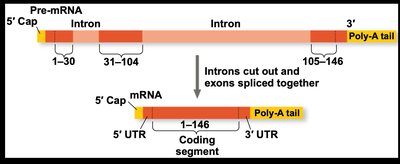
Exons: Coding regions retained in mature mRNA.
Introns: Noncoding regions removed during RNA splicing.
Start/Stop codons: Define the coding region for translation.
RNA Processing in Eukaryotes
Pre-mRNA Processing Steps
Before eukaryotic mRNA can be translated, it undergoes several modifications in the nucleus:
5′ Cap: A modified guanine nucleotide added to the 5′ end for protection and ribosome binding.
Poly-A Tail: A stretch of adenine nucleotides added to the 3′ end for stability and export.
Splicing: Removal of introns and joining of exons to form mature mRNA.
Functions of mRNA Modifications
Export: Facilitate export of mRNA from the nucleus.
Protection: Protect mRNA from degradation by hydrolytic enzymes.
Translation: Help ribosomes recognize and bind to the mRNA.
Summary Table: Locations of Key Processes
Process | Bacteria | Eukaryotes |
|---|---|---|
DNA Replication | Cytoplasm (nucleoid region) | Nucleus |
Transcription | Cytoplasm | Nucleus |
RNA Processing | None needed | Nucleus (5′ cap, poly-A tail, splicing) |
Translation | Cytoplasm (can start before transcription ends) | Cytoplasm (free ribosomes or rough ER) |
