 Back
Gene Expression: From Gene to Protein
Study Guide - Smart Notes
 Tailored notes based on your materials, expanded with key definitions, examples, and context.
Gene Expression: From Gene to Protein
Overview of Gene Expression
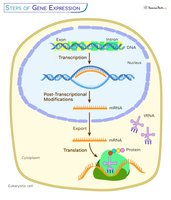
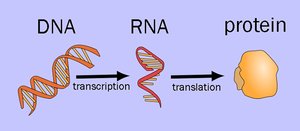
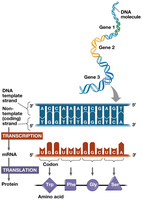
Gene expression is the process by which information encoded in DNA is used to direct the synthesis of proteins, which are responsible for an organism's traits. This process involves two main stages: transcription and translation. Proteins serve as the link between genotype and phenotype, and gene expression is tightly regulated to ensure proper cellular function.
Transcription: The synthesis of RNA from a DNA template.
Translation: The synthesis of a polypeptide (protein) from an mRNA template.
Central Dogma: The flow of genetic information is generally from DNA → RNA → Protein.

Differences Between RNA and DNA
RNA and DNA are both nucleic acids, but they differ in structure and function:
DNA: Double-stranded, contains deoxyribose sugar, uses thymine (T) as a base.
RNA: Single-stranded, contains ribose sugar, uses uracil (U) instead of thymine.
Transcription and Translation: Locations and Processes
Transcription and translation occur in different locations in prokaryotes and eukaryotes:
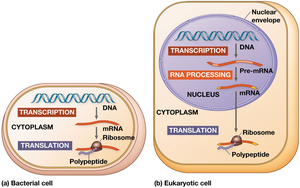
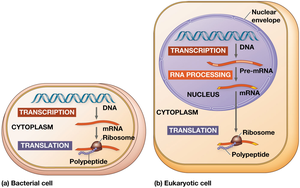
Prokaryotes: Both processes occur in the cytoplasm; translation can begin before transcription is finished.
Eukaryotes: Transcription occurs in the nucleus; translation occurs in the cytoplasm. RNA processing modifies the transcript before translation.
The Genetic Code and Codons
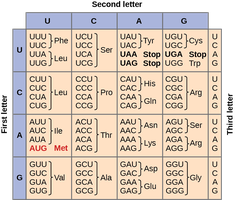
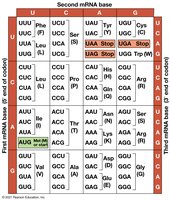
The genetic code is the set of rules by which information in mRNA is translated into proteins. Each three-nucleotide sequence (codon) in mRNA specifies an amino acid.
Codon: A sequence of three nucleotides in mRNA that corresponds to a specific amino acid.
Reading Frame: The correct grouping of codons is essential for proper translation.
Start Codon: AUG (methionine) signals the start of translation.
Stop Codons: UAA, UAG, UGA signal the end of translation.
Redundancy: Multiple codons can code for the same amino acid, but each codon specifies only one amino acid.
Transcription: DNA-Directed Synthesis of RNA
Transcription is catalyzed by RNA polymerase, which binds to a specific DNA sequence called the promoter. The process consists of three stages:
Initiation: RNA polymerase binds to the promoter, aided by transcription factors in eukaryotes.
Elongation: RNA polymerase moves along the DNA, synthesizing RNA in the 5′ → 3′ direction.
Termination: Transcription ends at a terminator sequence (bacteria) or after a polyadenylation signal (eukaryotes).
RNA Processing in Eukaryotes
After transcription, eukaryotic pre-mRNA undergoes several modifications:
5′ Cap: A modified guanine nucleotide added to the 5′ end.
Poly-A Tail: A string of adenine nucleotides added to the 3′ end.
Splicing: Removal of introns (noncoding regions) and joining of exons (coding regions).
Alternative Splicing: Allows a single gene to code for multiple proteins by varying exon combinations.
Translation: RNA-Directed Synthesis of Polypeptides
Translation occurs at ribosomes and involves several key molecules:
tRNA: Transfers specific amino acids to the growing polypeptide chain; contains an anticodon complementary to mRNA codons.
Ribosome: Facilitates the pairing of tRNA anticodons with mRNA codons; consists of large and small subunits.
Stages: Initiation (start codon recognition), elongation (amino acid addition), termination (stop codon recognition).
Wobble: Flexible pairing at the third base of a codon allows some tRNAs to bind to multiple codons.
Protein Folding and Post-Translational Modifications
After translation, polypeptides fold into their functional three-dimensional shapes. Some proteins undergo further modifications, such as cleavage or addition of functional groups, before becoming fully functional.
Mutations and Their Effects
Mutations are changes in the genetic sequence that can affect protein structure and function. Types of mutations include:
Point Mutations: Changes in a single nucleotide pair.
Substitutions: Replace one nucleotide pair with another; can be silent, missense, or nonsense.
Insertions/Deletions: Add or remove nucleotide pairs; often cause frameshift mutations, which are usually more harmful than substitutions.
Mutagens: Physical or chemical agents that cause mutations (e.g., radiation, carcinogens).
Summary Table: Types of Mutations
Type | Description | Effect | Example |
|---|---|---|---|
Point Mutation | Change in a single nucleotide pair | Can be silent, missense, or nonsense | Sickle cell anemia (missense) |
Substitution | Replacement of one nucleotide pair | May alter amino acid sequence | Silent mutation (no effect) |
Insertion/Deletion | Addition or removal of nucleotide pairs | Frameshift mutation; often deleterious | Cystic fibrosis (deletion) |
Key Equations and Concepts
Central Dogma:
Transcription:
Translation:
Example: The codon AUG codes for methionine and serves as the start signal for translation.
Additional info: Alternative RNA splicing increases protein diversity, and mutations outside coding regions can affect gene regulation.
