 Back
Gene Expression: From Gene to Protein (Chapter 17 Study Notes)
Study Guide - Smart Notes
 Tailored notes based on your materials, expanded with key definitions, examples, and context.
Gene Expression: From Gene to Protein
Overview of Gene Expression
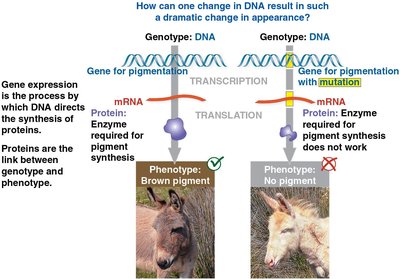
Gene expression is the process by which information encoded in DNA directs the synthesis of proteins, linking genotype to phenotype. This process involves two main stages: transcription and translation.
Genotype: The genetic makeup of an organism (DNA sequence).
Phenotype: Observable traits, determined by proteins synthesized from genetic instructions.
Proteins: The functional molecules that mediate traits.
Gene Expression: Includes transcription (DNA to RNA) and translation (RNA to protein).
Historical Evidence: Metabolic Defects and Nutritional Mutants
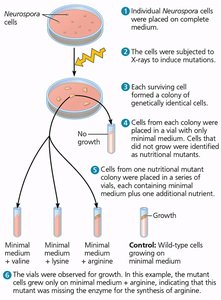
Early studies showed that genes dictate phenotypes through enzymes that catalyze specific reactions. Archibald Garrod proposed that inherited diseases result from the inability to synthesize certain enzymes. Beadle and Tatum's experiments with Neurospora bread mold established the one gene–one enzyme hypothesis.
Metabolic Pathway: Series of steps in molecule synthesis/degradation.
One Gene–One Enzyme Hypothesis: Each gene dictates production of a specific enzyme.
One Gene–One Polypeptide Hypothesis: Updated to reflect that not all proteins are enzymes and many proteins are made of multiple polypeptides.
Basic Principles of Transcription and Translation
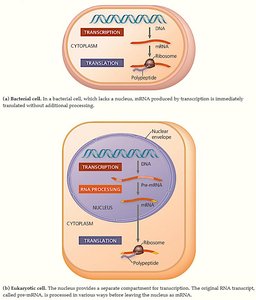
RNA acts as a bridge between DNA and protein synthesis. Transcription produces messenger RNA (mRNA), which is then translated into a polypeptide by ribosomes.
Transcription: Synthesis of RNA from DNA template.
Translation: Synthesis of polypeptide from mRNA template.
Ribosomes: Sites of translation.
Central Dogma: Information flows from DNA → RNA → Protein.

The Genetic Code
Triplet Code and Codons
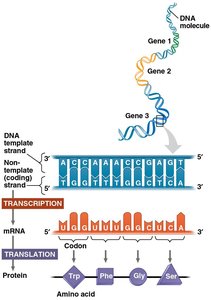
The genetic code is based on a triplet code, where three nucleotides (codon) specify one amino acid. The mRNA is read in the 5′ → 3′ direction during translation.
Codon: Three-nucleotide sequence in mRNA that specifies an amino acid.
Template Strand: DNA strand used for mRNA synthesis.
Coding Strand: DNA strand with sequence identical to mRNA (except T/U).
Cracking the Genetic Code
There are 64 codons: 61 code for amino acids, 3 are stop signals. The code is redundant but not ambiguous. Codons must be read in the correct frame.
Start Codon: AUG (methionine).
Stop Codons: UAA, UAG, UGA.
Redundancy: Multiple codons for some amino acids.
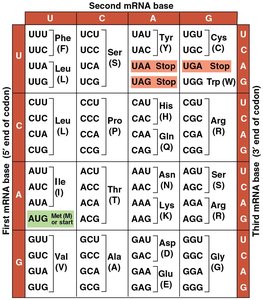
Universality and Evolution of the Genetic Code
The genetic code is nearly universal, shared by all organisms, supporting the common ancestry of life.
Transcription: DNA-Directed Synthesis of RNA
Molecular Components of Transcription
Transcription is catalyzed by RNA polymerase, which synthesizes RNA complementary to the DNA template strand. No primer is needed.
Promoter: DNA sequence where RNA polymerase binds.
Terminator: Sequence signaling end of transcription (in bacteria).
Transcription Unit: DNA stretch transcribed into RNA.
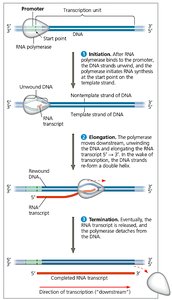
Initiation of Transcription
Promoters signal the start point. In eukaryotes, transcription factors and a TATA box are crucial for forming the initiation complex.
Transcription Factors: Proteins guiding RNA polymerase binding.
TATA Box: Promoter element in eukaryotes.
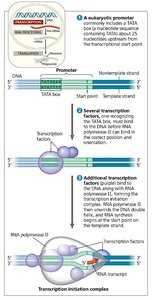
Elongation and Termination
RNA polymerase moves along DNA, untwisting the helix and adding nucleotides to the 3′ end. Termination differs between bacteria and eukaryotes.
Elongation: Addition of nucleotides to growing RNA.
Termination: Release of RNA transcript.
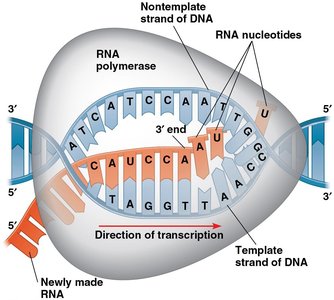
RNA Processing in Eukaryotes
Modification of mRNA Ends
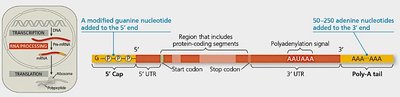
Pre-mRNA is modified at both ends: a 5′ cap and a 3′ poly-A tail. These modifications facilitate export, protect mRNA, and aid ribosome attachment.
5′ Cap: Modified guanine nucleotide added to 5′ end.
Poly-A Tail: 50–250 adenine nucleotides added to 3′ end.
RNA Splicing: Introns and Exons
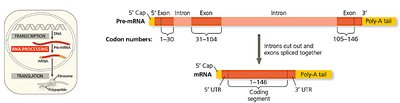
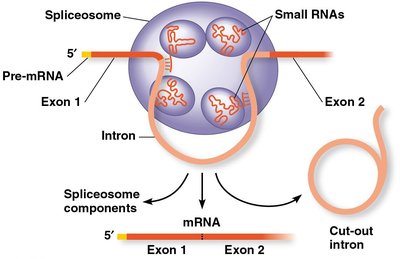
Most eukaryotic genes contain introns (noncoding regions) and exons (coding regions). Introns are removed, and exons are spliced together by spliceosomes.
Introns: Noncoding segments removed during splicing.
Exons: Coding segments expressed as protein.
Spliceosome: Complex of proteins and RNAs that catalyze splicing.
Alternative RNA Splicing and Protein Domains
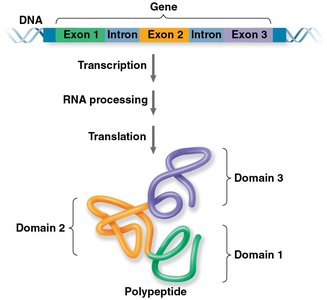
Alternative splicing allows a single gene to code for multiple polypeptides. Exons often correspond to functional domains in proteins.
Alternative Splicing: Different combinations of exons produce different proteins.
Protein Domains: Discrete functional regions of proteins.
Translation: RNA-Directed Synthesis of Polypeptides
Molecular Components of Translation
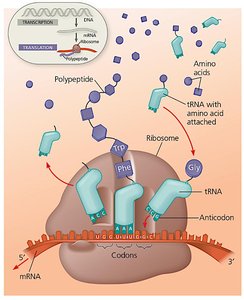
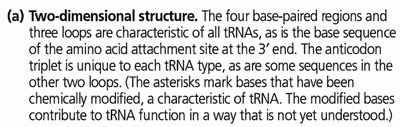
Translation converts mRNA sequence into a polypeptide with the help of tRNA and ribosomes. tRNA carries amino acids and matches codons via its anticodon.
tRNA: Transfer RNA, adapter molecule for translation.
Anticodon: tRNA sequence complementary to mRNA codon.
Aminoacyl-tRNA Synthetase: Enzyme attaching amino acid to tRNA.
Ribosome Structure and Function
Ribosomes have three tRNA binding sites: A (aminoacyl), P (peptidyl), and E (exit). They facilitate the correct pairing of tRNA anticodons with mRNA codons.
P Site: Holds tRNA with growing polypeptide.
A Site: Holds tRNA with next amino acid.
E Site: Exit site for discharged tRNA.
Stages of Translation
Translation occurs in three stages: initiation, elongation, and termination. Each stage requires protein factors and energy.
Initiation: Small ribosomal subunit binds mRNA and initiator tRNA (methionine).
Elongation: Amino acids added to chain; involves codon recognition, peptide bond formation, and translocation.
Termination: Stop codon reached; release factor causes polypeptide release.
Protein Folding and Targeting
Polypeptides fold into functional proteins and may undergo post-translational modifications. Signal peptides direct proteins to specific cellular locations.
Signal Peptide: Directs ribosome to ER for secreted/endoplasmic proteins.
SRP: Signal-recognition particle, escorts ribosome to ER.
Polyribosomes and Coupled Transcription/Translation
Multiple ribosomes can translate a single mRNA simultaneously (polyribosome). In bacteria, transcription and translation are coupled; in eukaryotes, they are separated by the nuclear envelope.
Mutations and Their Effects
Point Mutations
Mutations are changes in genetic information. Point mutations affect a single nucleotide pair and can lead to abnormal proteins.
Silent Mutation: No effect on protein.
Missense Mutation: Changes one amino acid.
Nonsense Mutation: Changes codon to stop codon.
Insertions and Deletions
Insertions or deletions can cause frameshift mutations, often resulting in nonfunctional proteins.
Mutagens and CRISPR Gene Editing
Mutagens are agents causing mutations. CRISPR-Cas9 is a powerful gene-editing tool used to correct disease-causing mutations.
Mutagen: Physical or chemical agent causing mutation.
CRISPR-Cas9: Gene-editing system for targeted DNA modification.
Defining a Gene
The concept of a gene has evolved: it is now defined as a region of DNA that can be expressed to produce a functional product, either a polypeptide or an RNA molecule.
Type of Mutation | Effect |
|---|---|
Silent | No change in amino acid sequence |
Missense | Change in one amino acid |
Nonsense | Premature stop codon |
Frameshift | Altered reading frame, often nonfunctional protein |
Additional info: These notes expand on the original lecture slides by providing definitions, examples, and context for each concept, ensuring a comprehensive and self-contained study guide for exam preparation.
