 Back
BackGene Expression: From Gene to Protein
Study Guide - Smart Notes
 Tailored notes based on your materials, expanded with key definitions, examples, and context.
Gene Expression: From Gene to Protein
Introduction to Gene Expression
Gene expression is the process by which the information encoded in DNA is used to direct the synthesis of proteins, which are essential for cellular structure and function. This process involves two main stages: transcription and translation. Proteins serve as the link between genotype and phenotype, determining the traits of an organism.

Evidence Linking Genes and Proteins
Early studies, such as those by Archibald Garrod and later by Beadle and Tatum, established that genes dictate phenotypes through enzymes that catalyze specific biochemical reactions. Their experiments with Neurospora crassa mutants led to the formulation of the "one gene–one enzyme" hypothesis, which was later refined to "one gene–one polypeptide" as not all proteins are enzymes and many proteins are composed of multiple polypeptides.
Basic Principles of Transcription and Translation
Overview of the Central Dogma
The central dogma of molecular biology describes the flow of genetic information within a biological system: DNA → RNA → Protein. In this process, DNA is transcribed into RNA, which is then translated into protein.

Transcription and Translation in Prokaryotes vs. Eukaryotes
In prokaryotes, transcription and translation occur simultaneously in the cytoplasm. In eukaryotes, transcription occurs in the nucleus, and the resulting pre-mRNA undergoes processing before being exported to the cytoplasm for translation.
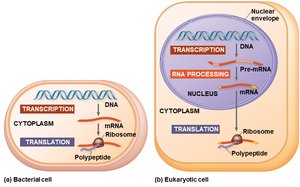
The Genetic Code
Codons and the Triplet Code
The genetic code is composed of codons, which are sequences of three nucleotides that specify particular amino acids. There are 64 possible codons, 61 of which code for amino acids and 3 serve as stop signals. The code is redundant but not ambiguous, and it is nearly universal among organisms.
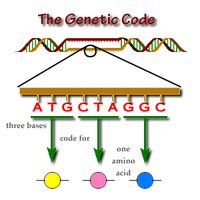
Transcription: DNA to RNA
During transcription, one strand of DNA (the template strand) is used to synthesize a complementary RNA strand. The coding strand of DNA has the same sequence as the RNA (except T is replaced by U in RNA).
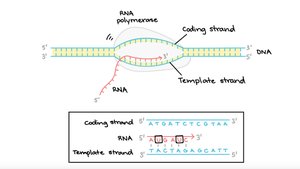
Transcription: DNA-Directed Synthesis of RNA
Stages of Transcription
Transcription occurs in three main stages:
Initiation: RNA polymerase binds to the promoter region of the gene, aided by transcription factors in eukaryotes.
Elongation: RNA polymerase moves along the DNA, synthesizing the RNA transcript by adding nucleotides to the 3' end.
Termination: Transcription ends when RNA polymerase reaches a terminator sequence (in prokaryotes) or after the polyadenylation signal (in eukaryotes).
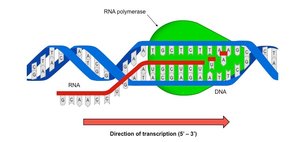
RNA Processing in Eukaryotes
Modification of mRNA Ends
Before mRNA leaves the nucleus, it undergoes processing:
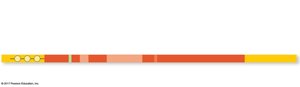
A 5' cap (modified guanine nucleotide) is added to the 5' end.
A poly-A tail (50–250 adenine nucleotides) is added to the 3' end.
These modifications protect mRNA from degradation and help in export and translation.
RNA Splicing
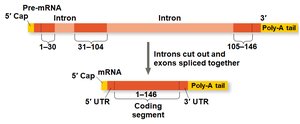
Most eukaryotic genes contain introns (noncoding regions) and exons (coding regions). RNA splicing removes introns and joins exons to produce a continuous coding sequence. This process is often carried out by spliceosomes, which are complexes of proteins and small RNAs.
Alternative Splicing and Protein Diversity
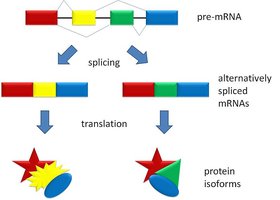
Alternative RNA splicing allows a single gene to code for multiple proteins by including or excluding different exons. This increases the diversity of proteins that can be produced from a single gene.
Translation: RNA-Directed Synthesis of a Polypeptide
Role of tRNA and Ribosomes
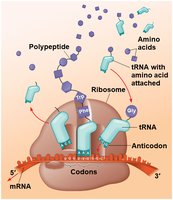
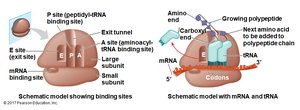
Translation is the process by which the sequence of an mRNA is decoded to build a polypeptide. Transfer RNA (tRNA) molecules bring amino acids to the ribosome, matching their anticodon with codons on the mRNA. Ribosomes facilitate the coupling of tRNA anticodons with mRNA codons and catalyze peptide bond formation.
Stages of Translation
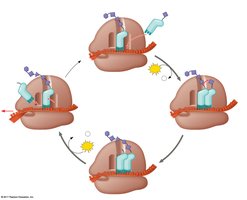
Initiation: The small ribosomal subunit binds to mRNA and the initiator tRNA, followed by the large subunit.
Elongation: Amino acids are added one by one to the growing polypeptide chain.
Termination: When a stop codon is reached, a release factor binds, causing the polypeptide to be released.
Protein Folding and Post-Translational Modifications
Levels of Protein Structure
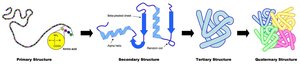
After translation, the polypeptide chain folds into its functional three-dimensional shape. Proteins have four levels of structure:
Primary structure: Sequence of amino acids
Secondary structure: Alpha helices and beta sheets formed by hydrogen bonding
Tertiary structure: Overall 3D shape formed by interactions among side chains
Quaternary structure: Association of multiple polypeptide chains
Post-Translational Modifications
Proteins may undergo further modifications, such as cleavage, phosphorylation, or glycosylation, to become fully functional or to be targeted to specific locations within the cell.
Mutations and Their Effects on Protein Structure
Types of Mutations
Mutations are changes in the genetic material that can affect protein structure and function. Types include:
Point mutations: Change a single nucleotide pair (can be silent, missense, or nonsense mutations)
Insertions and deletions: Add or remove nucleotide pairs, often causing frameshift mutations
Consequences of Mutations
Mutations can lead to nonfunctional proteins or altered traits, and some are associated with genetic disorders or diseases.
Summary Table: Types of RNA and Their Functions
Type of RNA | Functions |
|---|---|
Messenger RNA (mRNA) | Conveys genetic information from DNA to ribosome |
Transfer RNA (tRNA) | Brings amino acids to ribosome during translation |
Ribosomal RNA (rRNA) | Plays catalytic (ribozyme) and structural roles in ribosomes |
Primary transcript | Initial RNA transcript before processing |
Small RNAs in the spliceosome | Involved in RNA splicing |
