 Back
Gene Expression: From Gene to Protein (Chapter 17) – Study Notes
Study Guide - Smart Notes
 Tailored notes based on your materials, expanded with key definitions, examples, and context.
Gene Expression: From Gene to Protein
Introduction to Gene Expression
Gene expression is the process by which the information encoded in a gene is used to direct the synthesis of a functional product, typically a protein. This process is central to the relationship between an organism's genotype (genetic makeup) and its phenotype (observable traits). Proteins are the molecules that carry out most cellular functions and determine traits.
Central Dogma of Molecular Biology: Information flows from DNA to RNA to protein.
Mutation Impact: A single change in DNA can alter the resulting protein and thus the phenotype (e.g., a flower changing color due to a non-functional pigment protein).
The Central Dogma: DNA to mRNA to Protein
Stages of Gene Expression
Gene expression occurs in two main stages: transcription and translation.
Transcription: The process of copying a segment of DNA into messenger RNA (mRNA).
Translation: The process where the mRNA is read by a ribosome to synthesize a protein.
Prokaryotes vs. Eukaryotes: In prokaryotes, transcription and translation are coupled; in eukaryotes, they are separated by the nuclear envelope.
DNA Strands and the Triplet Code
Template Strand: The DNA strand used as a template for mRNA synthesis; the mRNA is complementary to this strand.
Coding Strand: The non-template DNA strand; its sequence matches the mRNA (except T is replaced by U in RNA).
Codons: mRNA is read in groups of three nucleotides (codons), each specifying an amino acid.
Genetic Code Redundancy: Multiple codons can code for the same amino acid, but each codon specifies only one amino acid.
Start Codon: AUG (codes for Methionine) is the only start codon.
Stop Codons: UAA, UAG, and UGA signal the end of translation.
Universality: The genetic code is nearly universal across all organisms.
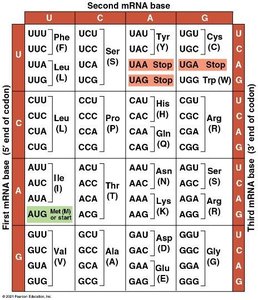
Example: Transcription of a DNA Template Strand
DNA Template Strand: 5'-ATGCAGTAG-3'
mRNA Strand: 5'-CUGAUGUAC-3'
Explanation: RNA polymerase reads the DNA template strand (3' to 5') and synthesizes mRNA in the 5' to 3' direction, adding complementary bases (A-U, T-A, C-G, G-C).
Transcription: Synthesis of RNA from DNA
The Three Stages of Transcription
Initiation: RNA polymerase binds to the promoter region (including the TATA box in eukaryotes) with the help of transcription factors, forming the transcription initiation complex.
Elongation: RNA polymerase unwinds DNA and adds RNA nucleotides to the 3' end of the growing RNA strand.
Termination: In bacteria, a terminator sequence ends transcription; in eukaryotes, a polyadenylation signal triggers release of the RNA transcript.
Eukaryotic RNA Processing
Modifications of Pre-mRNA
In eukaryotes, the primary RNA transcript (pre-mRNA) undergoes several modifications before becoming mature mRNA:
5' Cap: Addition of a modified guanine nucleotide to the 5' end.
Poly-A Tail: Addition of 50–250 adenine nucleotides to the 3' end.
RNA Splicing: Removal of noncoding regions (introns) and joining of coding regions (exons) by the spliceosome.
Alternative Splicing: Different combinations of exons can be joined to produce multiple proteins from one gene.
Additional info: There is no equivalent RNA processing in prokaryotes; their mRNA is immediately ready for translation.
Translation: Synthesis of Protein from mRNA
The Three Stages of Translation
Initiation: The small ribosomal subunit binds to mRNA and the initiator tRNA (carrying methionine) pairs with the start codon (AUG). The large subunit then joins.
Elongation: Amino acids are added one by one to the growing polypeptide chain. This involves codon recognition, peptide bond formation, and translocation.
Termination: When a stop codon is reached, a release factor binds, causing the polypeptide to be released and the ribosome to disassemble.
tRNA: Transfer RNA molecules carry specific amino acids and have anticodons complementary to mRNA codons.
Ribosomes: Composed of rRNA and proteins, ribosomes have three binding sites: A (aminoacyl), P (peptidyl), and E (exit).
Example: Translating an mRNA Sequence
mRNA: 5'-AUGGUACUAUGAG-3'
Codons: AUG, GUA, CUA, UGA
Amino Acid Sequence: Met-Val-Leu (translation stops at UGA)
Post-Translational Modifications and Protein Targeting
Protein Modifications
Glycosylation: Addition of sugars to proteins.
Methylation: Addition of methyl groups (CH3).
Protein Targeting
Free Ribosomes: Synthesize proteins for use in the cytosol.
Bound Ribosomes: Synthesize proteins for the endomembrane system or secretion; these ribosomes are directed to the ER by a signal peptide and a signal recognition particle (SRP).
Mutations and Their Effects
Types of Mutations
Point Mutations: Change in a single nucleotide pair.
Silent Mutation: No change in amino acid due to redundancy.
Missense Mutation: Changes one amino acid (e.g., sickle cell anemia).
Nonsense Mutation: Converts an amino acid codon to a stop codon, truncating the protein.
Frameshift Mutations: Insertions or deletions that alter the reading frame, often causing widespread changes in the protein sequence.
Mutagens: Physical or chemical agents (e.g., radiation, carcinogens) that cause mutations.
Example: Analyzing a Point Mutation
Original DNA Template: 3'-TACATTCGAGAC-5'
Original mRNA: 5'-AUGUAAGCUCUG-3'
Original Amino Acid Chain: Met-Stop
Mutated DNA Template: 3'-TACATACGAGAC-5'
Mutated mRNA: 5'-AUGUAUGCUCUG-3'
Mutated Amino Acid Chain: Met-Tyr-Ala-Leu
Explanation: The mutation changes a stop codon to a sense codon, resulting in a longer protein.
