 Back
BackGene Expression: From Gene to Protein – Transcription, Translation, and the Genetic Code
Study Guide - Smart Notes
 Tailored notes based on your materials, expanded with key definitions, examples, and context.
Gene Expression: From Gene to Protein
Introduction to Gene Expression
Gene expression is the process by which the information encoded in a gene is used to direct the synthesis of a protein or, in some cases, functional RNAs. This process is fundamental to the manifestation of inherited traits and the functioning of all living cells. The two main stages of gene expression are transcription and translation.
Genotype refers to the genetic makeup of an organism, while phenotype refers to the observable traits.
Proteins are the link between genotype and phenotype, as they carry out the instructions encoded by genes.
Gene expression involves the flow of genetic information from DNA to RNA to protein.
Historical Foundations: Genes and Enzymes
Evidence from Metabolic Defects
Early studies of inherited diseases, such as alkaptonuria, led Archibald Garrod to propose that genes dictate phenotypes through enzymes. He suggested that symptoms of inherited diseases reflect an inability to synthesize a particular enzyme, resulting in metabolic blocks.
Each step in a metabolic pathway is catalyzed by a specific enzyme.
Mutations in genes can lead to the absence or malfunction of these enzymes, causing metabolic disorders.
Beadle and Tatum’s Experiments with Neurospora
George Beadle and Edward Tatum used the bread mold Neurospora crassa to demonstrate the relationship between genes and enzymes. By inducing mutations and analyzing nutritional requirements, they established the one gene–one enzyme hypothesis.
Mutant strains unable to synthesize specific nutrients were identified as nutritional mutants.
Each mutant was defective in a single step of a metabolic pathway, corresponding to a specific enzyme.
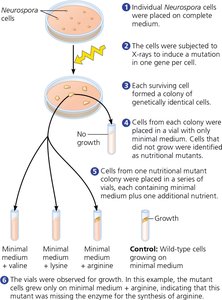
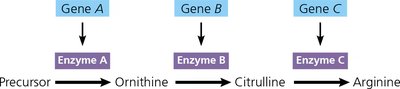
Example: Mutants requiring arginine were grouped based on which step in the arginine synthesis pathway was blocked, supporting the idea that each gene encodes a specific enzyme.
Refinements to the One Gene–One Enzyme Hypothesis
Further research revealed that not all proteins are enzymes and that some proteins are composed of multiple polypeptides, each encoded by a separate gene. The hypothesis was refined to the one gene–one polypeptide concept. Additionally, some genes code for functional RNAs rather than proteins.
Alternative splicing allows a single gene to code for multiple related polypeptides.
Some genes produce RNAs (e.g., tRNA, rRNA) that are not translated into proteins.
Basic Principles of Transcription and Translation
Overview of the Flow of Genetic Information
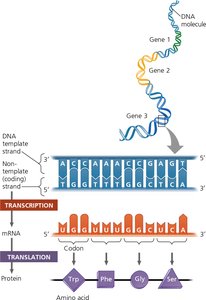
The central dogma of molecular biology describes the directional flow of genetic information: DNA → RNA → Protein. This process involves two main stages:
Transcription: Synthesis of RNA from a DNA template.
Translation: Synthesis of a polypeptide using the information in mRNA.

Transcription
During transcription, a gene's DNA sequence is copied to produce a complementary RNA strand. In protein-coding genes, this RNA is called messenger RNA (mRNA).
RNA differs from DNA by having ribose sugar and uracil (U) instead of thymine (T).
Only one DNA strand (the template strand) is transcribed for each gene.
Translation
Translation is the process by which the sequence of an mRNA is decoded to build a polypeptide, with the help of ribosomes. The mRNA sequence is read in sets of three nucleotides, called codons, each specifying an amino acid.
Translation occurs in the cytoplasm at ribosomes.
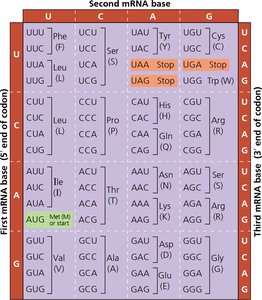
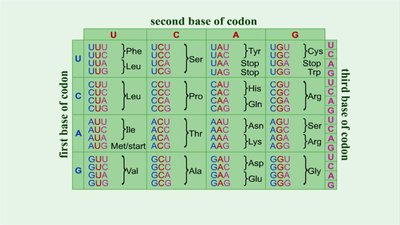
Each codon corresponds to a specific amino acid or a stop signal.
Differences Between Prokaryotic and Eukaryotic Gene Expression
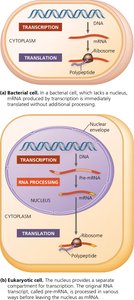
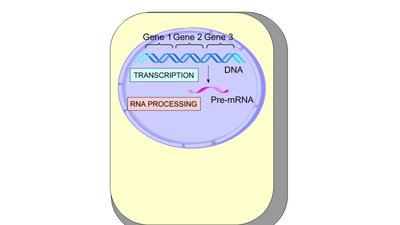
In bacteria (prokaryotes), transcription and translation are coupled, as there is no nucleus. In eukaryotes, transcription occurs in the nucleus, and the resulting pre-mRNA undergoes processing before being exported to the cytoplasm for translation.
The Genetic Code
Codons: Triplets of Nucleotides
The genetic code is based on triplets of nucleotides called codons. Each codon specifies one amino acid. With four nucleotide bases, there are 64 possible codons, more than enough to code for the 20 amino acids.
The code is redundant (more than one codon may specify the same amino acid) but not ambiguous (no codon specifies more than one amino acid).
The reading frame (grouping of codons) is crucial for correct translation.
Cracking the Genetic Code
Experiments in the 1960s, such as those by Marshall Nirenberg, deciphered which codons correspond to which amino acids. The codon table is now a fundamental tool in molecular biology.
Universality and Evolution of the Genetic Code
The genetic code is nearly universal among all organisms, indicating a common evolutionary origin. Genes from one species can often be expressed in another, a principle used in genetic engineering.
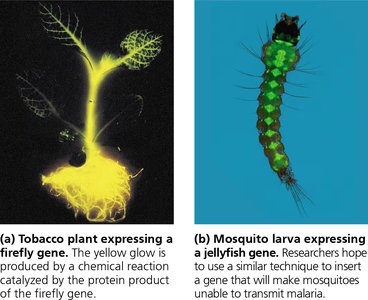
Example: Bacteria can be engineered to produce human proteins, such as insulin, by introducing human genes.
Summary Table: Key Concepts in Gene Expression
Concept | Description |
|---|---|
Gene Expression | Process by which genetic information is used to synthesize proteins or functional RNAs |
Transcription | Synthesis of RNA from a DNA template |
Translation | Synthesis of a polypeptide from an mRNA template |
Codon | Three-nucleotide sequence in mRNA that specifies an amino acid |
Redundancy | Multiple codons can code for the same amino acid |
Universality | Genetic code is shared by almost all organisms |
Key Equations and Concepts
Central Dogma:
Codon Calculation: possible codons (4 bases, 3 positions)
Conclusion
Gene expression is a central concept in biology, linking genetic information to cellular function and phenotype. The processes of transcription and translation, governed by the nearly universal genetic code, are fundamental to life and have profound implications for biotechnology and medicine.
