 Back
BackGene Expression: From Gene to Protein – Transcription, Translation, and the Genetic Code
Study Guide - Smart Notes
 Tailored notes based on your materials, expanded with key definitions, examples, and context.
Gene Expression: From Gene to Protein
Introduction to Gene Expression
Gene expression is the process by which the information encoded in a gene is used to direct the synthesis of a protein or functional RNA. This process is fundamental to the manifestation of inherited traits and involves two main stages: transcription and translation. Proteins are the primary link between genotype and phenotype, as they carry out most cellular functions and determine observable characteristics.
Historical Foundations: Genes and Enzymes
Evidence from Metabolic Defects
Archibald Garrod (1902) first proposed that genes dictate phenotypes through enzymes, suggesting that inherited diseases result from the inability to synthesize specific enzymes.
Example: Alkaptonuria – Individuals with this disorder cannot break down alkapton due to a missing enzyme, leading to black urine.
Biochemists later confirmed that metabolic pathways are composed of sequential steps, each catalyzed by a specific enzyme.
Beadle and Tatum's Experiments with Neurospora
George Beadle and Edward Tatum used the bread mold Neurospora crassa to demonstrate the relationship between genes and enzymes. Their experiments led to the formulation of the "one gene–one enzyme" hypothesis, later refined to "one gene–one polypeptide." They generated nutritional mutants by exposing cells to X-rays and identified mutants that required specific nutrients for growth.
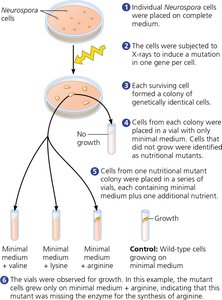
One Gene–One Enzyme/Polypeptide Hypothesis
Each gene encodes a specific enzyme (or polypeptide) that catalyzes a step in a metabolic pathway.
Mutations in genes result in the absence or malfunction of the corresponding enzyme, blocking the pathway at a specific step.
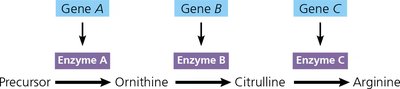
Modern View of Gene Products
Not all proteins are enzymes (e.g., keratin, insulin).
Many proteins consist of multiple polypeptides, each encoded by a separate gene (e.g., hemoglobin).
Some genes code for functional RNAs that are not translated into proteins.
Alternative splicing allows a single gene to produce multiple related polypeptides.
Basic Principles of Transcription and Translation
Overview of the Central Dogma
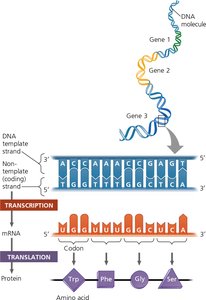
The central dogma of molecular biology describes the directional flow of genetic information: DNA → RNA → Protein. Genes provide instructions for making proteins, but do not build proteins directly. The process involves two main stages:
Transcription: Synthesis of RNA from a DNA template.
Translation: Synthesis of a polypeptide using the information in mRNA.

Transcription
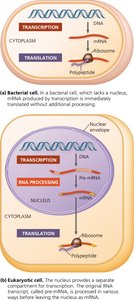
Occurs in the nucleus (eukaryotes) or cytoplasm (prokaryotes).
Produces messenger RNA (mRNA), which carries genetic information from DNA to the ribosome.
RNA differs from DNA by having ribose sugar and uracil (U) instead of thymine (T).
Translation
Occurs at ribosomes in the cytoplasm.
mRNA sequence is read in sets of three nucleotides (codons), each specifying an amino acid.
tRNA molecules bring amino acids to the ribosome, where they are joined to form a polypeptide.
Differences Between Prokaryotic and Eukaryotic Gene Expression
In bacteria, transcription and translation are coupled; translation can begin before transcription is finished.
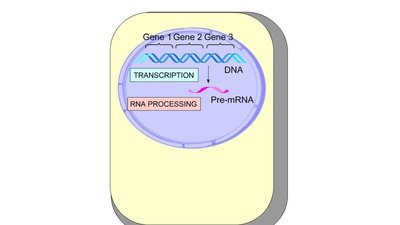
In eukaryotes, transcription occurs in the nucleus, and mRNA is processed (capping, polyadenylation, splicing) before being exported to the cytoplasm for translation.
The Genetic Code
Codons: Triplets of Nucleotides
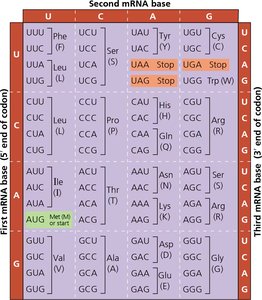
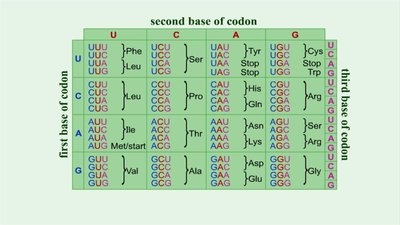
The genetic code is based on triplets of nucleotides called codons. Each codon specifies one amino acid. With four nucleotide bases, there are 64 possible codons, more than enough to code for the 20 amino acids used in proteins.
Properties of the Genetic Code
Redundancy: Multiple codons can specify the same amino acid (e.g., GAA and GAG both code for glutamic acid).
No ambiguity: Each codon specifies only one amino acid.
Reading frame: The correct grouping of nucleotides is essential for accurate translation.
Nearly universal: The genetic code is shared by almost all organisms, providing evidence for common ancestry.
Experimental Deciphering of the Code
Marshall Nirenberg and colleagues deciphered the first codon (UUU codes for phenylalanine) using artificial mRNA in cell-free systems.
Subsequent experiments revealed the amino acid specified by each codon.
Evolutionary Significance of the Genetic Code
The near universality of the genetic code suggests it arose early in the evolution of life.
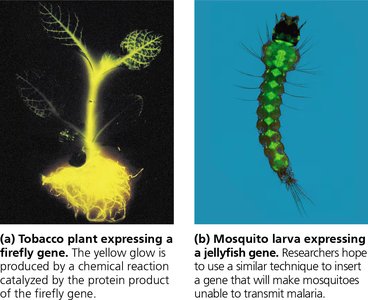
Genes from one species can be expressed in another, enabling genetic engineering (e.g., bacteria producing human insulin).
Summary Table: Key Steps in Gene Expression
Stage | Location (Eukaryotes) | Main Events |
|---|---|---|
Transcription | Nucleus | DNA is used as a template to synthesize pre-mRNA; RNA processing produces mature mRNA |
Translation | Cytoplasm (ribosome) | mRNA codons are read to assemble amino acids into a polypeptide chain |
Key Terms and Concepts
Gene expression: The process by which information from a gene is used to synthesize a functional gene product (protein or RNA).
Transcription: The synthesis of RNA from a DNA template.
Translation: The synthesis of a polypeptide using the information in mRNA.
Codon: A sequence of three nucleotides in mRNA that specifies an amino acid.
mRNA: Messenger RNA, carries genetic information from DNA to the ribosome.
tRNA: Transfer RNA, brings amino acids to the ribosome during translation.
Ribosome: The molecular machine that synthesizes proteins by translating mRNA.
Key Equations
Central Dogma:
Example Application
Genetic Engineering: Inserting a gene from one species into another can result in the expression of new traits, such as bacteria producing human insulin or plants expressing bioluminescent proteins.
Additional info: The above notes integrate foundational experiments, the molecular mechanisms of gene expression, and the universality of the genetic code, providing a comprehensive overview suitable for college-level biology students.
