 Back
BackGene Expression: From Gene to Protein (Chapter 17 Study Notes)
Study Guide - Smart Notes
 Tailored notes based on your materials, expanded with key definitions, examples, and context.
Gene Expression: From Gene to Protein
Introduction
Gene expression is the process by which information encoded in DNA directs the synthesis of proteins, which are essential for cellular structure and function. This chapter explores the experimental foundations of the one gene-one enzyme hypothesis, the mechanisms of transcription and translation, RNA processing, and the impact of mutations on gene expression.
The One Gene-One Enzyme Hypothesis
Historical Experiments and Alkaptonuria
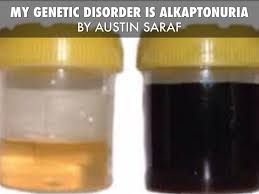
Alkaptonuria is a genetic disorder that provided early evidence linking genes to metabolic pathways. Individuals with this disorder cannot produce a specific enzyme, leading to the accumulation of homogentisic acid, which darkens urine upon exposure to air.
Archibald Garrod first suggested that genes dictate phenotypes through enzymes that catalyze specific chemical reactions in the cell.
"Inborn errors of metabolism" refer to genetic diseases resulting from the absence of particular enzymes.
Beadle and Tatum's Neurospora Experiments
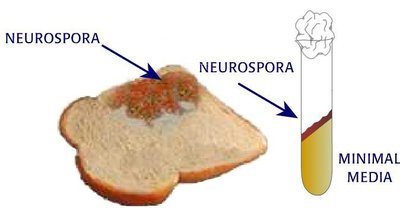
Beadle and Tatum used the bread mold Neurospora crassa to demonstrate that genes act by regulating specific chemical events.
Wild-type Neurospora can grow on minimal medium (salts, glucose, biotin) because it can synthesize all necessary molecules.
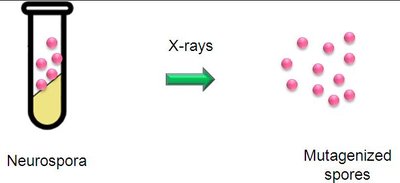
X-rays were used to induce mutations in Neurospora spores, creating mutants unable to grow on minimal medium unless supplemented with specific nutrients.
These experiments led to the formulation of the "one gene-one enzyme" hypothesis, later refined to "one gene-one polypeptide" as not all proteins are enzymes and some proteins are composed of multiple polypeptides.
Metabolic Pathways and Mutant Analysis
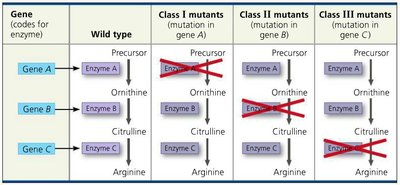
Genes encode enzymes that catalyze steps in metabolic pathways. Mutations in specific genes block the corresponding enzymatic step, resulting in characteristic growth requirements.
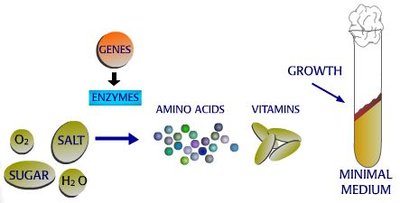
Mutants defective in a particular enzyme cannot grow on minimal medium unless the medium is supplemented with the product of the blocked step.
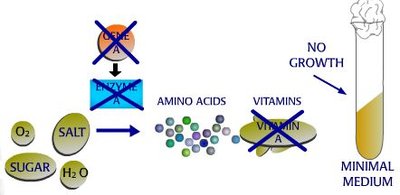
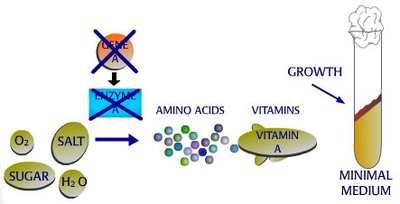
Auxotrophs are mutants that require additional nutrients for growth due to a metabolic block.
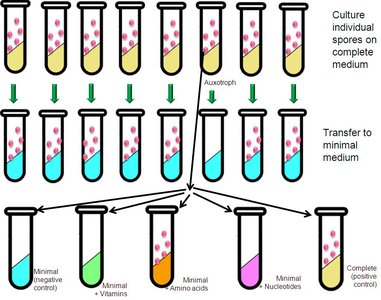
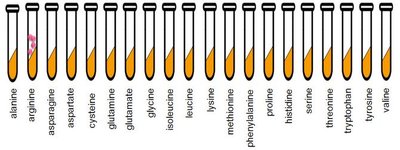
By supplementing minimal medium with different amino acids, researchers identified mutants defective in arginine synthesis.
Arginine Pathway and Mutant Classes
The arginine biosynthetic pathway involves several steps, each catalyzed by a specific enzyme.
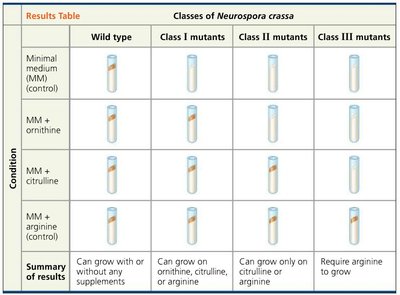
Three classes of arginine-requiring mutants were identified, each defective in a different step of the pathway.
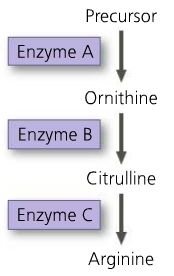
Class I mutants can grow with ornithine, citrulline, or arginine; Class II with citrulline or arginine; Class III only with arginine.
From Gene to Protein: The Central Dogma
DNA vs. RNA
DNA is double-stranded, contains deoxyribose sugar, and uses the bases A, T, C, and G.
RNA is single-stranded, contains ribose sugar, and uses the bases A, U, C, and G.
Gene Expression Overview
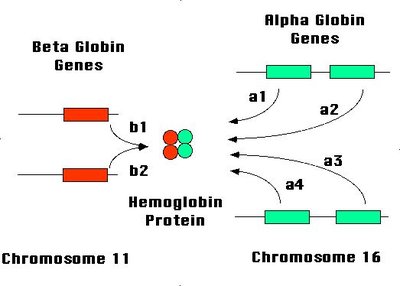
Gene expression involves two main processes: transcription (DNA to RNA) and translation (RNA to protein).
The flow of genetic information is described by the central dogma: DNA → RNA → Protein.
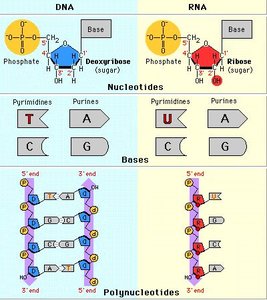
Transcription: DNA to RNA
Mechanism of Transcription
Transcription is the synthesis of RNA from a DNA template by RNA polymerase.
Occurs in three stages: initiation, elongation, and termination.
In eukaryotes, transcription factors are required for RNA polymerase to bind to the promoter region (often containing a TATA box).
During elongation, RNA polymerase moves along the template strand (3' to 5'), synthesizing RNA in the 5' to 3' direction.
Termination differs between prokaryotes (DNA sequence) and eukaryotes (AAUAAA signal in mRNA).
RNA Processing in Eukaryotes
Modifications and Splicing
Primary transcripts (pre-mRNA) undergo processing before translation:
5' cap (modified guanine nucleotide) is added early during transcription.
3' poly-A tail (50-250 adenines) is added after transcription.
These modifications protect mRNA from degradation, aid export from the nucleus, and facilitate ribosome binding.
RNA splicing removes noncoding regions (introns) and joins coding regions (exons) via the spliceosome complex.
Alternative splicing allows a single gene to code for multiple polypeptides.
The Genetic Code and Translation
Codons and the Universal Code
The genetic code is read in triplets (codons), each specifying an amino acid.
There are 64 possible codons, with redundancy (multiple codons for one amino acid) but no ambiguity.
The code is nearly universal among all organisms.
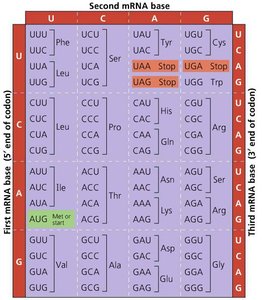
Translation: mRNA to Protein
Translation occurs at the ribosome and involves three main players:
mRNA: carries the genetic message.
tRNA: brings amino acids to the ribosome, matching codons with anticodons.
Ribosome: catalyzes peptide bond formation and ensures correct tRNA-mRNA pairing.
Translation proceeds in three stages: initiation, elongation, and termination, all requiring energy (GTP).
Translation Steps
Initiation: Small ribosomal subunit binds mRNA and initiator tRNA; large subunit joins to form the initiation complex.
Elongation: tRNAs bring amino acids to the ribosome, peptide bonds form, and the ribosome translocates along the mRNA.
Termination: A stop codon is reached, a release factor binds, and the completed polypeptide is released.
Protein Folding and Post-Translational Modifications
Proteins fold into specific 3D structures, sometimes with the help of chaperone proteins.
Post-translational modifications include addition of sugars, lipids, phosphates, removal of amino acids, or cleavage/combination of polypeptides.
Proteins are targeted to specific cellular locations by signal peptides or target peptides.
Mutations and Their Effects
Types of Mutations
Point mutations (nucleotide-pair substitutions):
Silent mutation: No effect on amino acid sequence.
Missense mutation: Changes one amino acid; effect varies.
Nonsense mutation: Changes an amino acid codon to a stop codon, leading to premature termination.
Insertions and deletions: Addition or loss of nucleotides, often causing frameshift mutations that alter the reading frame and usually result in nonfunctional proteins.
Examples and Applications
Some mutations cause genetic diseases (e.g., sickle cell anemia, cystic fibrosis).
CRISPR-Cas9 technology can introduce targeted mutations for gene editing.
Summary Table: Classes of Neurospora Mutants
Condition | Wild type | Class I mutants | Class II mutants | Class III mutants |
|---|---|---|---|---|
Minimal medium (MM) | Can grow | No growth | No growth | No growth |
MM + ornithine | Can grow | Can grow | No growth | No growth |
MM + citrulline | Can grow | Can grow | Can grow | No growth |
MM + arginine | Can grow | Can grow | Can grow | Can grow |
Conclusion
Gene expression is a fundamental process in biology, linking genotype to phenotype through the production of proteins. Understanding the mechanisms of transcription, RNA processing, translation, and the effects of mutations provides insight into both normal cellular function and the molecular basis of genetic diseases.
