 Back
BackGene Expression: From Gene to Protein (Chapter 17) – Study Notes
Study Guide - Smart Notes
 Tailored notes based on your materials, expanded with key definitions, examples, and context.
Gene Expression: From Gene to Protein
Introduction to Gene Expression
Gene expression is the process by which information from a gene is used to synthesize functional gene products, typically proteins. This process is fundamental to all living organisms and underlies the diversity of cell types and functions.
Gene Expression involves two main stages: transcription (DNA to RNA) and translation (RNA to protein).
Proteins produced through gene expression determine the phenotype of an organism.
The One Gene-One Enzyme Hypothesis
Historical Experiments and the Neurospora Model
The "one gene-one enzyme" hypothesis was a foundational concept in molecular biology, proposing that each gene encodes a specific enzyme. This idea was developed through experiments with the bread mold Neurospora crassa, which helped clarify the relationship between genes and metabolic pathways.
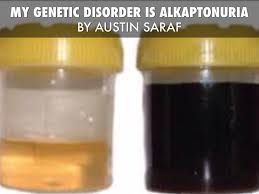
Alkaptonuria: An early example of a genetic disorder linked to enzyme deficiency, supporting the idea that genes control metabolic pathways.
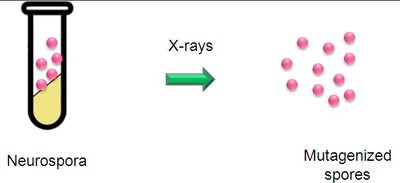
Beadle and Tatum's Experiment: Used X-rays to induce mutations in Neurospora, then identified mutants unable to grow on minimal medium, indicating a block in a specific metabolic pathway.
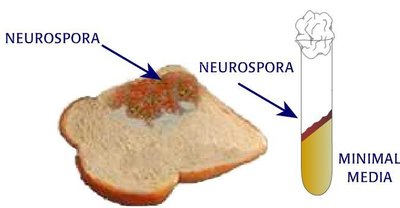
Mutants that could not grow on minimal medium but survived on complete medium were defective in synthesizing certain amino acids, such as arginine.
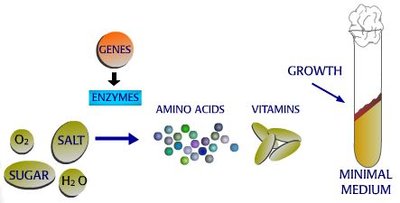
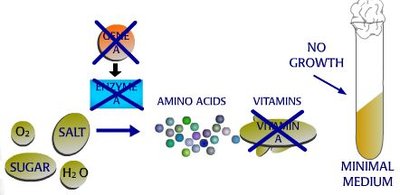
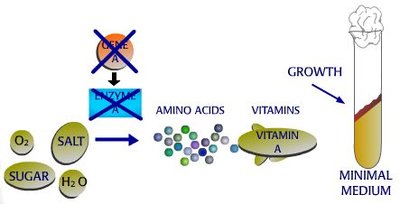
By supplementing minimal medium with specific nutrients, researchers pinpointed the metabolic step affected by each mutation.
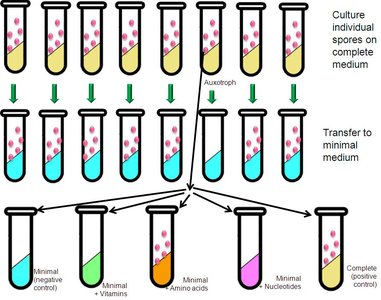
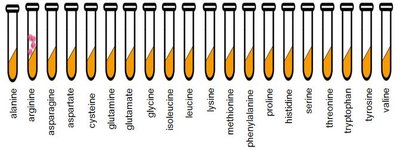
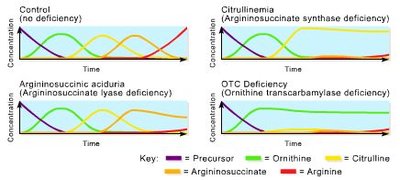
Three classes of arginine-requiring mutants were identified, each defective in a different enzyme in the arginine biosynthesis pathway.
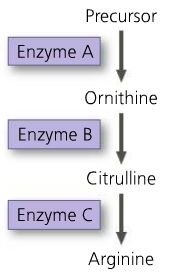
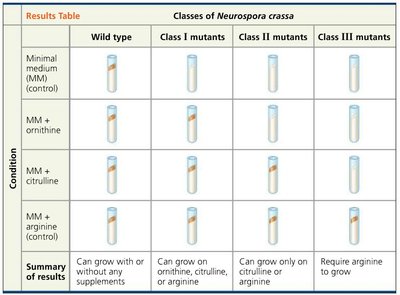
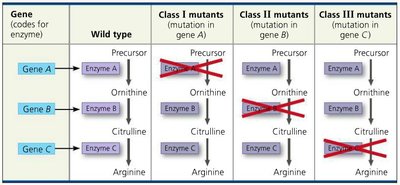
This supported the "one gene-one enzyme" hypothesis, later refined to "one gene-one polypeptide" as not all proteins are enzymes and some proteins are made of multiple polypeptides.
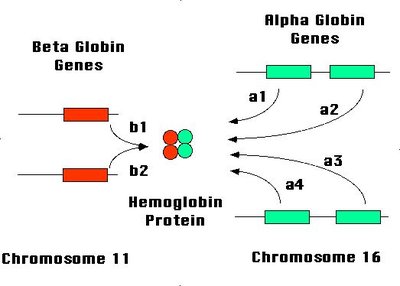
Example: Hemoglobin consists of two alpha and two beta polypeptides, each encoded by a different gene.
Gene Expression: DNA to Protein
DNA vs. RNA
DNA and RNA are nucleic acids with distinct structures and functions in gene expression.
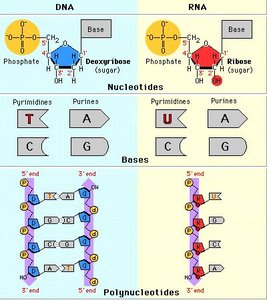
DNA: Double-stranded, contains deoxyribose sugar, bases A, T, C, G.
RNA: Single-stranded, contains ribose sugar, bases A, U, C, G.
Central Dogma of Molecular Biology
The central dogma describes the flow of genetic information: DNA is transcribed into RNA, which is then translated into protein.
Transcription: Synthesis of RNA from a DNA template.
Translation: Synthesis of a polypeptide using the information in mRNA.
Genetic Code
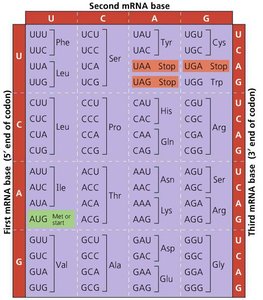
The genetic code is a set of rules by which information encoded in mRNA is translated into proteins. Each three-nucleotide sequence (codon) specifies an amino acid.
There are 64 possible codons, with redundancy (multiple codons for most amino acids).
Start codon: AUG (methionine); Stop codons: UAA, UAG, UGA.
The code is nearly universal among all organisms.
Transcription: DNA to mRNA
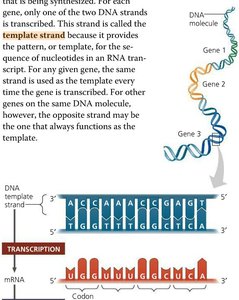
Transcription is the process by which RNA is synthesized from a DNA template. It occurs in three main stages: initiation, elongation, and termination.
Initiation: RNA polymerase binds to the promoter region (often containing a TATA box in eukaryotes).
Elongation: RNA polymerase moves along the template strand, synthesizing RNA in the 5' to 3' direction.
Termination: In prokaryotes, a termination sequence in DNA ends transcription; in eukaryotes, a polyadenylation signal (AAUAAA) is involved.
RNA Processing in Eukaryotes
In eukaryotes, the primary RNA transcript (pre-mRNA) undergoes several modifications before becoming mature mRNA.
5' Cap: Modified guanine nucleotide added to the 5' end.
3' Poly-A Tail: 50-250 adenine nucleotides added to the 3' end.
RNA Splicing: Removal of noncoding regions (introns) and joining of coding regions (exons) by the spliceosome.
Alternative Splicing: Allows a single gene to code for multiple polypeptides.
Translation: mRNA to Protein
Mechanism of Translation
Translation is the process by which ribosomes synthesize proteins using the sequence of codons in mRNA.
tRNA: Transfers specific amino acids to the ribosome; contains an anticodon complementary to the mRNA codon.
Ribosome: Composed of rRNA and proteins; has three binding sites for tRNA (A, P, E sites).
Translation occurs in three stages: initiation, elongation, and termination, all requiring energy (GTP).
Initiation: Small ribosomal subunit binds mRNA and initiator tRNA; large subunit completes the initiation complex.
Elongation: Amino acids are added one by one to the growing polypeptide chain.
Termination: Stop codon is reached; release factor promotes release of the polypeptide.
Protein Folding and Post-Translational Modifications
After translation, proteins may undergo folding (often assisted by chaperone proteins) and various modifications, such as addition of sugars, lipids, or phosphates, or cleavage into smaller polypeptides.
Proteins may be targeted to specific cellular locations by signal peptides.
Mutations and Their Effects
Types of Mutations
Mutations are changes in the genetic information of a cell. They can affect gene expression and protein function in various ways.
Nucleotide-Pair Substitution: Replacement of one nucleotide pair with another.
Silent Mutation: No effect on amino acid sequence.
Missense Mutation: Changes one amino acid; effect varies.
Nonsense Mutation: Changes an amino acid codon to a stop codon, leading to premature termination.
Insertions and Deletions: Addition or loss of nucleotides; may cause frameshift mutations, altering the reading frame.
Example: The genetic disorder Leber Congenital Amaurosis is caused by a missense mutation in the CEP290 gene.
Summary Table: Classes of Neurospora Mutants
Condition | Wild type | Class I mutants | Class II mutants | Class III mutants |
|---|---|---|---|---|
Minimal medium (MM) | Grows | No growth | No growth | No growth |
MM + ornithine | Grows | Grows | No growth | No growth |
MM + citrulline | Grows | Grows | Grows | No growth |
MM + arginine | Grows | Grows | Grows | Grows |
Summary | Can grow with or without supplements | Can grow on ornithine, citrulline, or arginine | Can grow on citrulline or arginine | Require arginine to grow |
Conclusion
Gene expression is a multi-step process involving transcription, RNA processing, and translation. The one gene-one enzyme hypothesis, supported by classic experiments with Neurospora, laid the foundation for our understanding of how genes control cellular functions. Mutations can disrupt gene expression, leading to a variety of genetic disorders and phenotypic changes.
