 Back
BackGene Expression: From Gene to Protein (Central Dogma and Molecular Mechanisms)
Study Guide - Smart Notes
 Tailored notes based on your materials, expanded with key definitions, examples, and context.
Gene Expression and the Central Dogma
Genes, Alleles, and Phenotype
Genes are segments of DNA that code for specific proteins, which in turn determine an organism's traits. Alleles are different versions of a gene, and variation in alleles leads to observable differences in phenotype. For example, a gene may code for an enzyme required for pigment synthesis in deer; a functional allele results in brown pigmentation, while a faulty allele (as in albino deer) leads to a lack of pigment due to a nonfunctional enzyme.
Gene: DNA sequence coding for a functional product (protein or RNA).
Allele: Variant form of a gene.
Phenotype: Observable traits resulting from gene expression.
Genotype: Genetic makeup of an organism.
Example: The albino phenotype in deer is caused by a mutation in the gene encoding a pigment-producing enzyme.

The Central Dogma of Molecular Biology
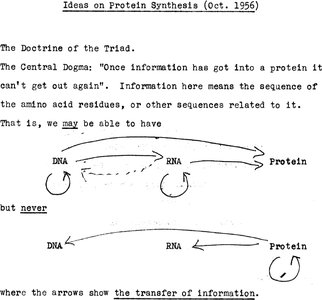
The central dogma describes the flow of genetic information within a biological system: DNA is transcribed into RNA, which is then translated into protein. This principle, proposed by Francis Crick in 1956, establishes that information flows from nucleic acids to proteins, but not in reverse.
Central Dogma: DNA → RNA → Protein
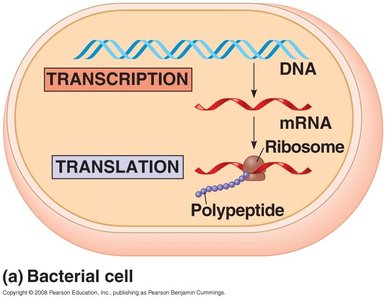
Transcription: Synthesis of RNA from a DNA template.
Translation: Synthesis of protein from an mRNA template.
Key Point: Proteins are the link between genotype and phenotype.
Transcription and Translation: Cellular Context
Prokaryotic vs. Eukaryotic Gene Expression
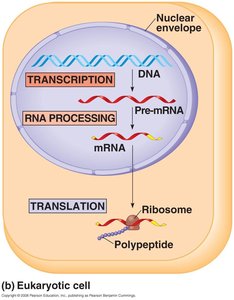
In prokaryotes (e.g., bacteria), transcription and translation occur in the cytoplasm, often simultaneously. In eukaryotes, transcription occurs in the nucleus, and the resulting pre-mRNA undergoes processing before being exported to the cytoplasm for translation.
Prokaryotes: No nucleus; mRNA is translated as soon as it is transcribed.
Eukaryotes: Transcription in nucleus; pre-mRNA processed to mature mRNA before translation in cytoplasm.
DNA and RNA: Structure and Function
Nucleic Acid Structure
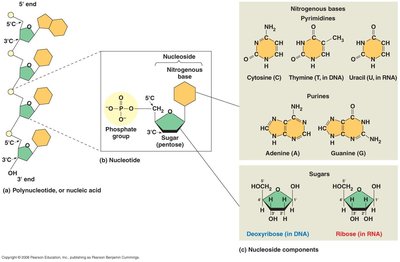
DNA and RNA are polymers of nucleotides, each consisting of a phosphate group, a five-carbon sugar, and a nitrogenous base. DNA contains deoxyribose and the bases A, T, G, and C; RNA contains ribose and the bases A, U, G, and C.
DNA: Deoxyribose sugar; bases A, T, G, C.
RNA: Ribose sugar; bases A, U, G, C.
Function: DNA stores genetic information; RNA acts as a messenger and functional molecule in protein synthesis.
The Genetic Code
Codons and the Triplet Code
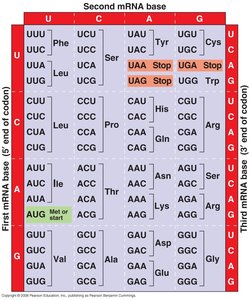
The genetic code is read in sets of three nucleotides (codons), each specifying an amino acid. With four nucleotides, there are 64 possible codons, more than enough to code for the 20 amino acids. The code is redundant (more than one codon per amino acid) but not ambiguous (each codon specifies only one amino acid).
Codon: Sequence of three mRNA bases that codes for an amino acid.
Start Codon: AUG (codes for methionine; signals start of translation).
Stop Codons: UAA, UAG, UGA (signal termination of translation).
Redundancy: Multiple codons can code for the same amino acid.
No ambiguity: Each codon codes for only one amino acid.
Transcription: From DNA to RNA
Stages of Transcription
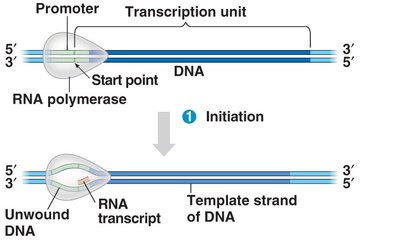
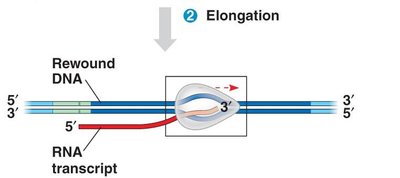
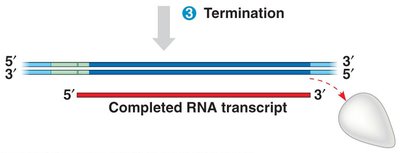
Transcription involves three main stages: initiation, elongation, and termination. RNA polymerase binds to the promoter, unwinds the DNA, and synthesizes an RNA transcript complementary to the DNA template strand.
Initiation: RNA polymerase binds to promoter; DNA unwinds.
Elongation: RNA polymerase synthesizes RNA in the 5' to 3' direction.
Termination: RNA polymerase releases the completed RNA transcript.
Promoters and the TATA Box
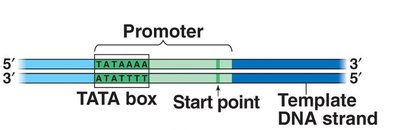
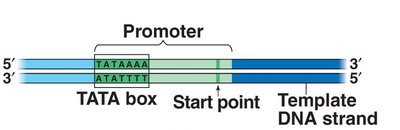
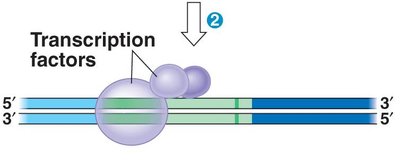
In eukaryotes, promoters often contain a TATA box, a conserved DNA sequence that helps position RNA polymerase II for transcription initiation. Transcription factors are required for the assembly of the transcription initiation complex.
Promoter: DNA sequence where RNA polymerase binds to initiate transcription.
TATA Box: Conserved sequence (TATAAA) about 25 bases upstream of the start site.
Transcription Factors: Proteins that help RNA polymerase bind and initiate transcription.
RNA Processing in Eukaryotes
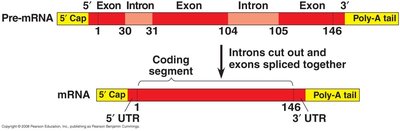
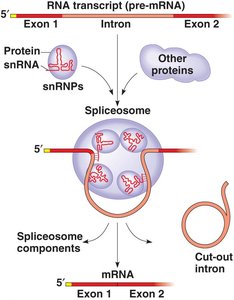
Before mRNA can be translated, eukaryotic pre-mRNA undergoes processing: addition of a 5' cap, a poly-A tail, and splicing to remove introns. These modifications stabilize mRNA, facilitate export from the nucleus, and aid in translation.
5' Cap: Modified guanine nucleotide added to the 5' end.
Poly-A Tail: String of adenine nucleotides added to the 3' end.
Splicing: Removal of non-coding introns; joining of coding exons.
UTRs: Untranslated regions at 5' and 3' ends; important for regulation.

Translation: From mRNA to Protein
tRNA and the Ribosome
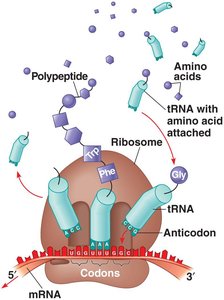
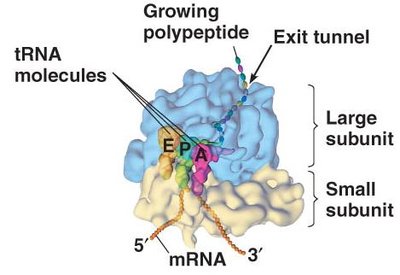
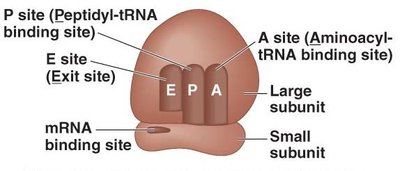
Translation is the process by which ribosomes synthesize proteins using mRNA as a template. Transfer RNAs (tRNAs) bring amino acids to the ribosome, matching their anticodon with codons on the mRNA. Ribosomes have three binding sites for tRNA: A (aminoacyl), P (peptidyl), and E (exit).
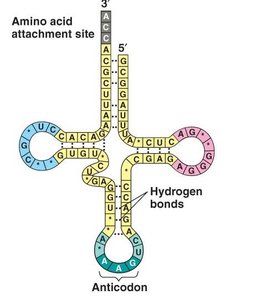
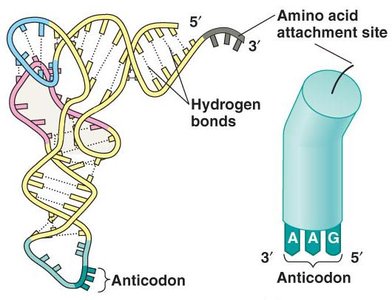
tRNA: Adapter molecule with an anticodon and an amino acid attachment site.
Anticodon: Three-nucleotide sequence on tRNA complementary to mRNA codon.
Ribosome: Molecular machine composed of rRNA and proteins; catalyzes peptide bond formation.
Translation: Initiation, Elongation, and Termination
Translation proceeds in three stages:
Initiation: Small ribosomal subunit binds mRNA; initiator tRNA pairs with start codon; large subunit completes the initiation complex.
Elongation: tRNAs bring amino acids to the ribosome; peptide bonds form; ribosome moves along mRNA.
Termination: Stop codon is reached; release factor binds; polypeptide is released.
Polyribosomes: Multiple ribosomes can translate a single mRNA simultaneously, increasing efficiency.
Mutations and Their Effects
Types of Mutations
Mutations are changes in the DNA sequence that can affect protein structure and function. Point mutations involve a single nucleotide change, while insertions and deletions can cause frameshift mutations, altering the reading frame and potentially leading to nonfunctional proteins.
Point Mutation: Change in a single nucleotide pair.
Base-pair Substitution: Replacement of one nucleotide and its partner.
Insertion/Deletion: Addition or loss of nucleotides; may cause frameshift.
Frameshift Mutation: Insertion/deletion not in multiples of three; shifts reading frame.
Silent Mutation: No effect on amino acid sequence.
Missense Mutation: Changes one amino acid.
Nonsense Mutation: Creates a premature stop codon.
Summary Table: Key Terms and Concepts
Term | Definition |
|---|---|
Gene | DNA sequence coding for a functional product |
Allele | Variant form of a gene |
Transcription | Synthesis of RNA from DNA |
Translation | Synthesis of protein from mRNA |
Codon | Three-nucleotide sequence on mRNA |
Anticodon | Three-nucleotide sequence on tRNA |
Mutation | Change in DNA sequence |
Introns | Non-coding regions removed from pre-mRNA |
Exons | Coding regions joined in mature mRNA |
Additional info: This guide covers the molecular mechanisms of gene expression, including the central dogma, transcription, RNA processing, translation, and the impact of mutations. It is suitable for exam preparation in introductory college biology courses.
