 Back
BackGene Expression: From Gene to Protein & Regulation of Gene Expression
Study Guide - Smart Notes
 Tailored notes based on your materials, expanded with key definitions, examples, and context.
Gene Expression: From Gene to Protein
One Gene, One Polypeptide Hypothesis
The "one gene, one polypeptide hypothesis" states that each gene within DNA codes for a single polypeptide chain, which may function alone or as part of a larger protein complex. This concept evolved from the earlier "one gene, one enzyme" hypothesis, reflecting the discovery that not all proteins are enzymes and that some proteins are composed of multiple polypeptides.
Gene: A segment of DNA that encodes information for building a functional product, typically a polypeptide.
Polypeptide: A chain of amino acids linked by peptide bonds; may constitute a whole protein or a subunit.
Example: Hemoglobin is composed of four polypeptide subunits, each encoded by a separate gene.
Key Terminology in Gene Expression
Transcription: The synthesis of RNA from a DNA template.
Translation: The synthesis of a polypeptide using the information in mRNA.
mRNA (messenger RNA): The RNA copy of a gene that is translated into protein.
Ribosomes: Molecular machines that facilitate the translation of mRNA into polypeptides.
Primary transcript: The initial RNA product synthesized from a gene, prior to processing.
Codon: A sequence of three nucleotides in mRNA that specifies an amino acid or stop signal.
Template strand: The DNA strand used as a template for RNA synthesis.
Coding strand: The DNA strand whose sequence matches the RNA transcript (except T/U).
Promoter: DNA sequence where RNA polymerase binds to initiate transcription.
RNA polymerase: Enzyme that synthesizes RNA from a DNA template.
5’ cap: Modified guanine nucleotide added to the 5’ end of eukaryotic mRNA for stability and ribosome binding.
Poly-A tail: String of adenine nucleotides added to the 3’ end of eukaryotic mRNA for stability and export.
RNA splicing: Removal of introns and joining of exons in eukaryotic mRNA.
Exons: Coding regions of a gene that remain in mature mRNA.
Introns: Non-coding regions removed during RNA processing.
Mutagen: An agent that causes changes in DNA sequence.
Steps of Transcription and Translation
Gene expression involves two main processes: transcription and translation.
Transcription:
Initiation: RNA polymerase binds to the promoter region (often containing a TATA box in eukaryotes).
Elongation: RNA polymerase synthesizes RNA in the 5’ to 3’ direction, using the DNA template strand.
Termination: Transcription ends when RNA polymerase reaches a terminator sequence.
Translation:
Initiation: The small ribosomal subunit binds to the mRNA, and the initiator tRNA pairs with the start codon (AUG).
Elongation: tRNAs bring amino acids to the ribosome, matching codons in mRNA with anticodons in tRNA.
Termination: When a stop codon is reached, the polypeptide is released.
Locations of Transcription and Translation
Transcription: Occurs in the nucleus of eukaryotic cells.
Translation: Occurs in the cytoplasm, at ribosomes.
The Central Dogma of Molecular Biology
The central dogma describes the flow of genetic information: DNA → RNA → Protein. While this model is foundational, it is now known that one gene can produce multiple polypeptides (via alternative splicing) or sometimes no polypeptide at all.
Key Equation:
Codons and the Genetic Code
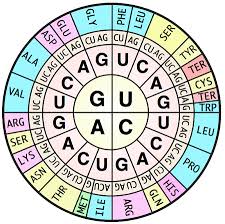
Codons are triplets of nucleotides in mRNA that specify amino acids. The genetic code is redundant, meaning multiple codons can code for the same amino acid, but it is not ambiguous (each codon specifies only one amino acid).
Start Codon: AUG (codes for methionine, Met)
Stop Codons: UAA, UAG, UGA (signal termination of translation)
Redundancy: 64 possible codons, but only 20 amino acids; some amino acids are specified by more than one codon.
Promoters and RNA Polymerase
Promoter: Essential DNA sequence for initiating transcription; in eukaryotes, often contains a TATA box.
RNA Polymerase: Synthesizes RNA from DNA; unlike DNA polymerase, it does not require a primer and can initiate synthesis de novo.
RNA Splicing and Its Importance
Splicing: Removes introns and joins exons, allowing for alternative splicing and increased protein diversity.
Alternative Splicing: Enables a single gene to code for multiple polypeptides.
Role of Ribosome and tRNA in Translation
Ribosome: Coordinates the pairing of tRNA anticodons with mRNA codons and catalyzes peptide bond formation.
tRNA: Transfers specific amino acids to the growing polypeptide chain by matching its anticodon to the mRNA codon.
Targeting Polypeptides to the ER
Some polypeptides contain signal sequences that direct them to the endoplasmic reticulum (ER) for further processing or secretion.
Types of Mutations
Point Mutations: Single nucleotide changes (e.g., silent, missense, nonsense mutations).
Insertions/Deletions: Addition or loss of nucleotides, potentially causing frameshifts.
Effect: Mutations can alter gene expression and protein function, sometimes causing disease.
Regulation of Gene Expression
Importance of Gene Control
Gene regulation allows cells to respond to environmental changes and differentiate into specialized cell types. Both prokaryotes and eukaryotes tightly control gene expression to conserve energy and resources.
Operons in Prokaryotes
Operon: A cluster of genes under the control of a single promoter and operator, allowing coordinated regulation (e.g., lac operon).
Benefit: Efficient regulation of genes with related functions.
Repression vs. Induction
Repressible Operon: Usually on; can be turned off by a repressor (e.g., trp operon).
Inducible Operon: Usually off; can be turned on by an inducer (e.g., lac operon).
The lac Operon
Operator: DNA segment where a repressor binds to block transcription.
Promoter: Site where RNA polymerase binds to initiate transcription.
Repressor gene: Encodes a protein that can bind the operator to inhibit transcription.
RNA polymerase: Transcribes the operon when not blocked by the repressor.
Effect of Glucose: High glucose inhibits lac operon even if lactose is present, prioritizing energy-efficient metabolism (catabolite repression).
Points of Gene Regulation
Gene expression can be regulated at multiple stages: chromatin structure, transcription, RNA processing, mRNA stability, translation, and protein modification/degradation.
Chromatin Structure and Nucleosomes
Nucleosome: DNA wrapped around histone proteins; basic unit of chromatin.
Methylation: Addition of methyl groups to DNA or histones, often repressing gene expression by condensing chromatin.
Eukaryotic Transcription Factors
General transcription factors: Required for transcription of all genes; include TATA-binding protein (TBP), which binds the TATA box in promoters.
Specific transcription factors: Regulate expression of particular genes in response to signals.
Alternative Splicing
Allows a single gene to produce multiple mRNA variants and thus different proteins, increasing proteomic diversity.
Translational Control and mRNA Longevity
Translation can be regulated by factors affecting ribosome binding or mRNA stability; mRNA longevity influences how much protein is produced.
Protein Degradation: Ubiquitination and the Proteasome
Ubiquitination: Tagging of proteins with ubiquitin molecules, marking them for degradation.
Proteasome: Large protein complex that degrades and recycles ubiquitinated proteins.
