 Back
Gene Expression: From Gene to Protein – Transcription and Translation
Study Guide - Smart Notes
 Tailored notes based on your materials, expanded with key definitions, examples, and context.
Gene Expression: From Gene to Protein
Basic Principles of Transcription and Translation
Gene expression is the process by which information encoded in DNA directs the synthesis of proteins, which are essential for cellular structure and function. This process involves two main stages: transcription and translation.
Transcription: The synthesis of RNA using DNA as a template. The resulting RNA is called messenger RNA (mRNA).
Translation: The synthesis of a polypeptide (protein) using the information in mRNA. This occurs at the ribosome.
Ribosomes: Molecular machines that facilitate the translation of mRNA into protein.
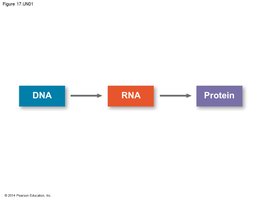
The Central Dogma: The flow of genetic information in cells is described as DNA → RNA → Protein.
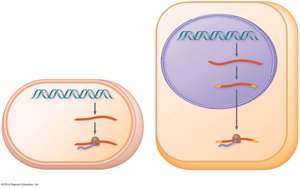
Prokaryotic vs. Eukaryotic Gene Expression
There are key differences in how gene expression occurs in prokaryotes and eukaryotes:
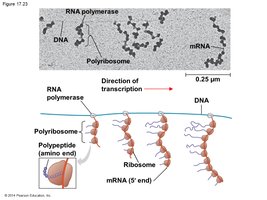
In prokaryotes, translation of mRNA can begin before transcription has finished because there is no nuclear envelope.
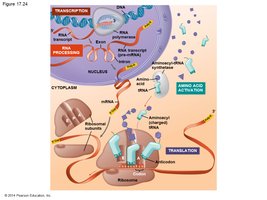
In eukaryotes, the nuclear envelope separates transcription (in the nucleus) from translation (in the cytoplasm). Eukaryotic RNA transcripts are modified through RNA processing before becoming mature mRNA.
The Genetic Code
Codons and the Reading Frame
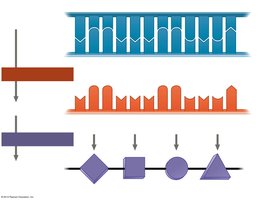
The genetic code consists of triplets of nucleotides called codons, each of which specifies a particular amino acid or a stop signal during translation.
There are 64 codons: 61 code for amino acids, and 3 are stop signals.
The code is redundant (more than one codon may specify the same amino acid) but not ambiguous (no codon specifies more than one amino acid).
Codons must be read in the correct reading frame for the correct protein to be produced.
Example: The codon AUG codes for methionine and also serves as the start signal for translation.
Transcription: DNA-Directed Synthesis of RNA
Mechanism of Transcription
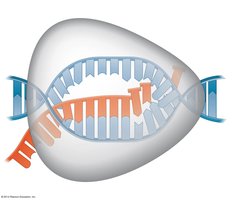
Transcription is catalyzed by the enzyme RNA polymerase, which synthesizes RNA complementary to the DNA template strand. Unlike DNA polymerase, RNA polymerase does not require a primer.
RNA synthesis follows base-pairing rules, except uracil (U) replaces thymine (T).
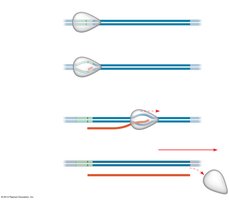
Transcription Initiation
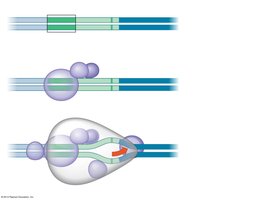
The DNA sequence where RNA polymerase attaches is called the promoter. In bacteria, the sequence signaling the end of transcription is called the terminator. The stretch of DNA transcribed is the transcription unit.
Transcription Elongation and Termination
During elongation, RNA polymerase moves along the DNA, unwinding the double helix and synthesizing RNA. Termination differs between prokaryotes and eukaryotes:
In bacteria, transcription ends at the terminator sequence, and mRNA is ready for translation.
In eukaryotes, RNA polymerase II transcribes a polyadenylation signal sequence; the RNA transcript is released 10–35 nucleotides past this sequence.
RNA Processing in Eukaryotes
Modification of mRNA Ends
Before leaving the nucleus, eukaryotic pre-mRNA undergoes processing:
The 5′ end receives a modified nucleotide 5′ cap.
The 3′ end receives a poly-A tail (50–250 adenine nucleotides).
These modifications facilitate export, protect mRNA from degradation, and help ribosomes attach for translation.
RNA Splicing
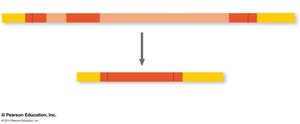
Most eukaryotic genes contain introns (noncoding regions) and exons (coding regions). Introns are removed, and exons are joined together by a process called RNA splicing, often carried out by spliceosomes (complexes of proteins and small nuclear RNAs).
Ribozymes
Ribozymes are RNA molecules with catalytic activity, capable of self-splicing and other enzymatic functions. Their discovery showed that not all enzymes are proteins.
Translation: RNA-Directed Synthesis of a Polypeptide
The Role of tRNA and Ribosomes
Translation converts the genetic information in mRNA into a specific sequence of amino acids in a polypeptide. This process requires:
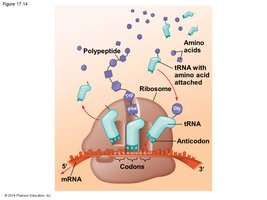
Transfer RNA (tRNA): Brings amino acids to the ribosome and matches them to the mRNA codon via its anticodon.
Ribosomes: Facilitate the coupling of tRNA anticodons with mRNA codons and catalyze peptide bond formation.
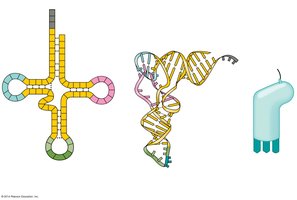
Ribosome Structure and Function
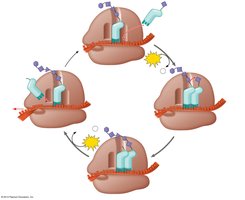
Ribosomes have three binding sites for tRNA:
P site: Holds the tRNA with the growing polypeptide chain.
A site: Holds the tRNA with the next amino acid to be added.
E site: Exit site for discharged tRNAs.
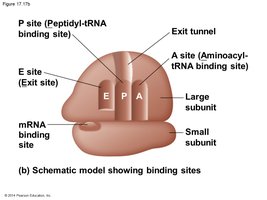
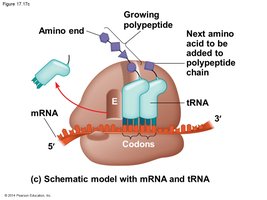
Stages of Translation
Translation occurs in three main stages:
Initiation: The small ribosomal subunit binds to mRNA and the initiator tRNA; the large subunit then completes the initiation complex.
Elongation: Amino acids are added one by one to the growing polypeptide chain.
Termination: Occurs when a stop codon is reached; a release factor binds, causing the release of the polypeptide and disassembly of the translation complex.
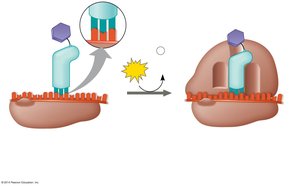
Coupling of Transcription and Translation in Prokaryotes
In prokaryotes, transcription and translation are coupled, allowing rapid protein synthesis. In eukaryotes, these processes are separated by the nuclear envelope, and mRNA must be processed and exported before translation.
Summary Table: Key Differences in Gene Expression
Feature | Prokaryotes | Eukaryotes |
|---|---|---|
Location of Transcription | Cytoplasm | Nucleus |
RNA Processing | Absent | Present (capping, polyadenylation, splicing) |
Coupling of Transcription and Translation | Yes | No |
Introns | Rare | Common |
