 Back
BackGene Expression: From Gene to Protein (Campbell Biology, Ch. 17) – Study Notes
Study Guide - Smart Notes
 Tailored notes based on your materials, expanded with key definitions, examples, and context.
Gene Expression: From Gene to Protein
Overview of Gene Expression
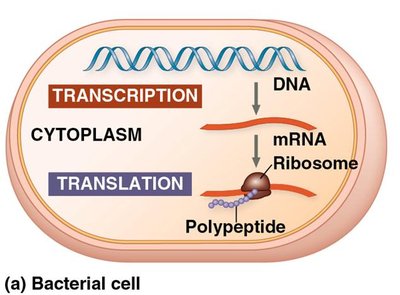
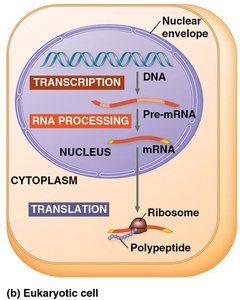
Gene expression is the process by which information encoded in DNA directs the synthesis of proteins, which are essential for cellular structure and function. This process involves two main stages: transcription (DNA to RNA) and translation (RNA to protein).
Central Dogma: The flow of genetic information is summarized as DNA → RNA → Protein.
Transcription: Synthesis of RNA using DNA as a template.
Translation: Synthesis of a polypeptide using the information in mRNA.
Ribosomes: Sites of protein synthesis.
Transcription: DNA to RNA
Basic Principles of Transcription
Transcription is the process by which a segment of DNA is used as a template to synthesize a complementary RNA strand. In eukaryotes, this occurs in the nucleus; in prokaryotes, it occurs in the cytoplasm.
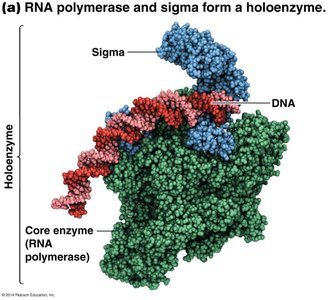
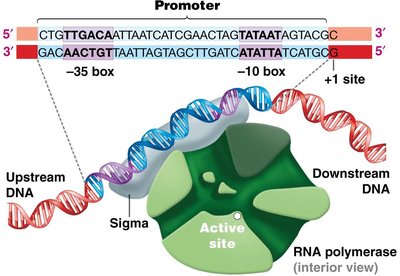
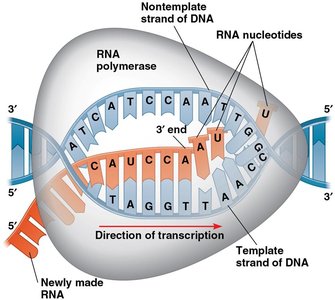
RNA Polymerase: Enzyme that synthesizes RNA in the 5′ to 3′ direction, does not require a primer.
Template Strand: The DNA strand used as a template for RNA synthesis.
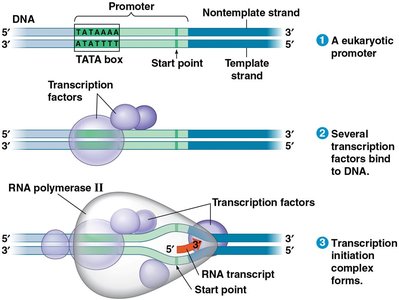
Promoter: DNA sequence where RNA polymerase attaches and initiates transcription.
Terminator: Sequence signaling the end of transcription (in prokaryotes).
Stages of Transcription
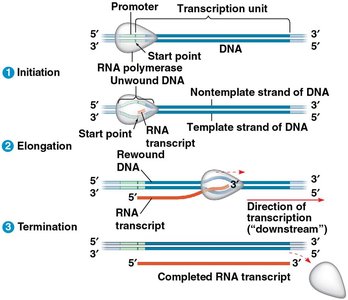
Initiation: RNA polymerase binds to the promoter with the help of sigma factor (in bacteria) or transcription factors (in eukaryotes).
Elongation: RNA polymerase moves along the DNA, unwinding the helix and synthesizing RNA.
Termination: In bacteria, transcription ends at a terminator sequence; in eukaryotes, RNA polymerase II transcribes a polyadenylation signal, and the transcript is released.
RNA Processing in Eukaryotes
In eukaryotes, the primary RNA transcript (pre-mRNA) undergoes several modifications before becoming mature mRNA:
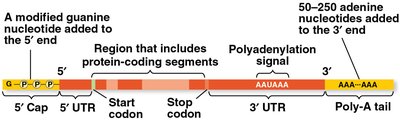
5′ Cap: Modified guanine nucleotide added to the 5′ end for stability and ribosome binding.
3′ Poly-A Tail: 50–250 adenine nucleotides added to the 3′ end for stability and export from the nucleus.
Splicing: Removal of noncoding regions (introns) and joining of coding regions (exons).
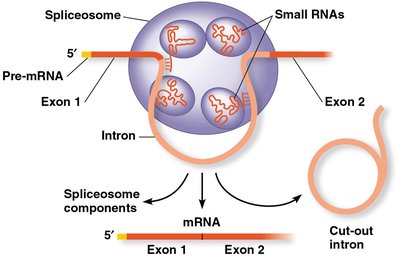
Alternative Splicing and Exon Shuffling
Alternative splicing allows a single gene to code for multiple proteins by varying the combination of exons included in the final mRNA. Exon shuffling can create new proteins by mixing exons from different genes.
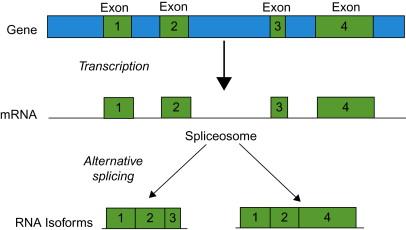
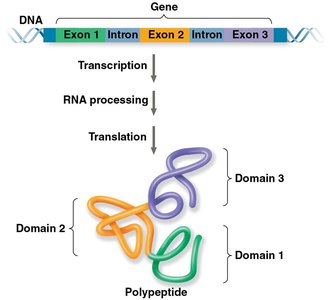
Translation: RNA to Protein
Genetic Code and Codons
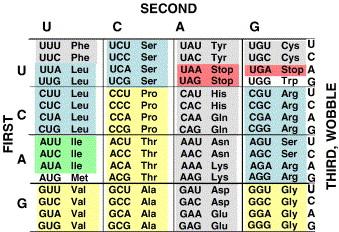
The genetic code is a set of rules by which the nucleotide sequence of mRNA is translated into the amino acid sequence of a protein. Each group of three nucleotides (codon) specifies one amino acid.
Start Codon: AUG (methionine) signals the start of translation.
Stop Codons: UAA, UAG, UGA signal the end of translation.
Redundancy: Multiple codons can code for the same amino acid.
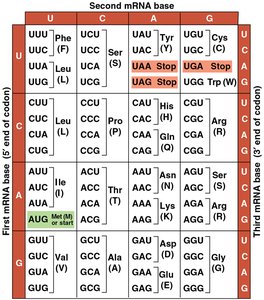
tRNA and Aminoacyl-tRNA Synthetases
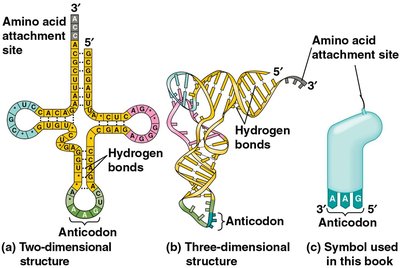
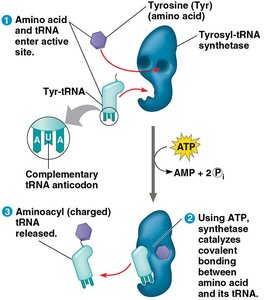
Transfer RNA (tRNA) molecules bring amino acids to the ribosome and match them to the mRNA codons via their anticodon region. Aminoacyl-tRNA synthetases are enzymes that attach the correct amino acid to its corresponding tRNA.
Wobble Base Pairing
Wobble refers to the flexible pairing at the third base of a codon, allowing some tRNAs to recognize more than one codon, reducing the number of tRNAs needed.
Ribosomes and Sites of Translation
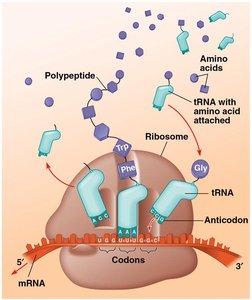
Ribosomes are composed of large and small subunits, each made of rRNA and proteins. They have three binding sites for tRNA:
A site (Aminoacyl): Holds the tRNA carrying the next amino acid.
P site (Peptidyl): Holds the tRNA with the growing polypeptide chain.
E site (Exit): Where discharged tRNAs leave the ribosome.
Stages of Translation
Initiation: The small ribosomal subunit binds to mRNA, and the initiator tRNA binds to the start codon. The large subunit then joins to form the complete initiation complex.
Elongation: Amino acids are added one by one to the growing polypeptide chain as the ribosome moves along the mRNA.
Termination: When a stop codon is reached, a release factor binds, causing the polypeptide to be released and the ribosome to dissociate.
Post-Translational Modifications and Protein Targeting
Protein Folding and Modifications
After translation, polypeptides fold into their functional three-dimensional shapes. Some proteins undergo post-translational modifications, such as cleavage, phosphorylation, or glycosylation, to become fully functional.
Targeting Proteins to Specific Locations
Proteins may contain signal peptides that direct them to specific cellular locations, such as the endoplasmic reticulum (ER) for secretion or membrane insertion.
Polyribosomes
Multiple ribosomes can simultaneously translate a single mRNA, forming a polyribosome (polysome), which increases the efficiency of protein synthesis.
Mutations and Their Effects on Proteins
Types of Mutations
Point Mutations: Changes in a single nucleotide pair. Can be silent (no effect), missense (change one amino acid), or nonsense (introduce a stop codon).
Insertions and Deletions (Indels): Addition or loss of nucleotides, which may cause frameshift mutations, altering the reading frame and often resulting in nonfunctional proteins.
Consequences of Mutations
Mutations can lead to genetic disorders or hereditary diseases if they adversely affect phenotype.
Mutations in noncoding regions can affect gene expression and regulation.
Summary Table: Key Differences in Gene Expression
Feature | Prokaryotes | Eukaryotes |
|---|---|---|
Location of Transcription | Cytoplasm | Nucleus |
RNA Processing | Absent | Present (capping, poly-A tail, splicing) |
Coupling of Transcription & Translation | Yes | No |
Number of RNA Polymerases | 1 | 3 (I, II, III) |
