 Back
Gene Expression: From Transcription to Translation
Study Guide - Smart Notes
 Tailored notes based on your materials, expanded with key definitions, examples, and context.
Gene Expression: From Transcription to Translation
Introduction
Gene expression is the process by which information encoded in a gene is used to direct the synthesis of a functional gene product, typically a protein. This process involves two main stages: transcription and translation, which together ensure that genetic information is accurately conveyed from DNA to protein.
11.1 The Relationship between Genes and Proteins
Genes as Information Stores
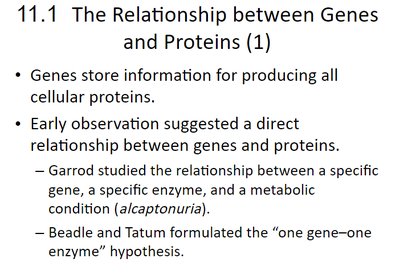
Genes store the information required for the production of all cellular proteins.
Early observations indicated a direct relationship between genes and proteins.
Garrod's studies on alcaptonuria linked specific genes to specific enzymes and metabolic conditions.
Beadle and Tatum formulated the "one gene–one enzyme" hypothesis, suggesting each gene encodes a single enzyme.
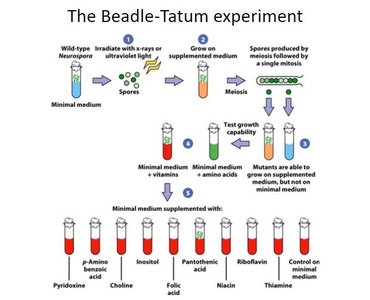
The Beadle-Tatum Experiment
Beadle and Tatum used the fungus Neurospora to demonstrate that genes act by regulating distinct chemical events.
Mutants unable to grow on minimal medium were supplemented with specific nutrients to identify the metabolic block.
This experiment provided strong evidence for the one gene–one enzyme hypothesis.
Refinement of the Gene-Protein Relationship
The hypothesis was later modified to "one gene–one polypeptide chain," recognizing that some proteins are composed of multiple polypeptides.
Mutations in a single gene can result in a single amino acid substitution in a protein, affecting its function.
Flow of Genetic Information
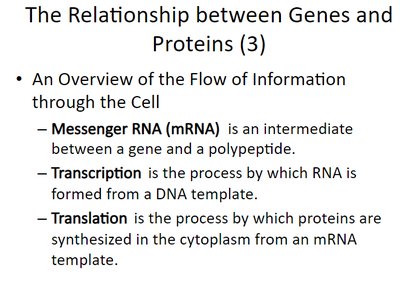
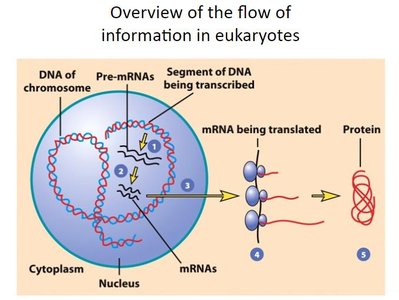
Messenger RNA (mRNA) serves as an intermediate between DNA (gene) and the polypeptide (protein).
Transcription is the synthesis of RNA from a DNA template.
Translation is the synthesis of proteins in the cytoplasm from an mRNA template.
Classes of RNA
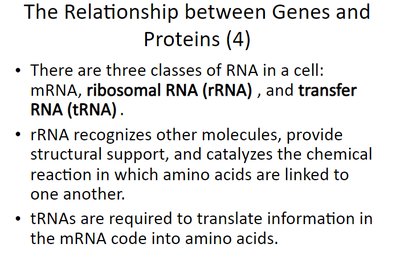
There are three main classes of RNA in cells:
mRNA (messenger RNA): Carries genetic information from DNA to the ribosome.
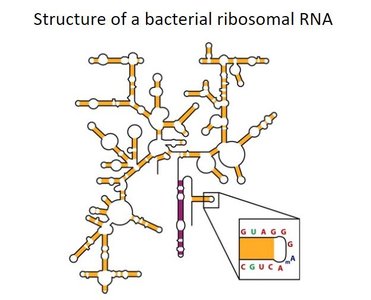
rRNA (ribosomal RNA): Provides structural support and catalyzes peptide bond formation in the ribosome.
tRNA (transfer RNA): Translates the mRNA code into amino acids during protein synthesis.
11.2 An Overview of Transcription and Translation in Both Prokaryotic and Eukaryotic Cells
RNA Polymerases and the Transcription Process
DNA-dependent RNA polymerases (or RNA polymerases) are enzymes responsible for transcription in both prokaryotes and eukaryotes.
These enzymes synthesize RNA by incorporating nucleotides complementary to the DNA template.
The promoter is the DNA sequence where RNA polymerase binds to initiate transcription, often with the help of transcription factors.
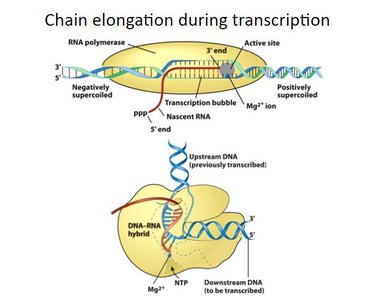
Chain Elongation during Transcription
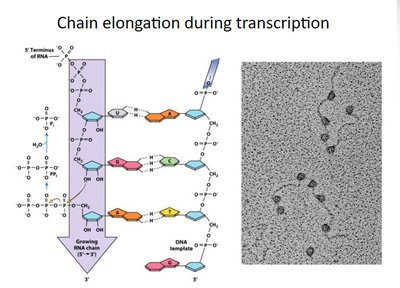
RNA polymerase unwinds the DNA and synthesizes a complementary RNA strand in the 5' to 3' direction.
The enzyme remains attached to the DNA for processivity and moves nucleotide by nucleotide.
Nucleotides are added as triphosphate precursors, and the reaction is driven by the hydrolysis of pyrophosphate:
Experimental Techniques to Study RNA Polymerase
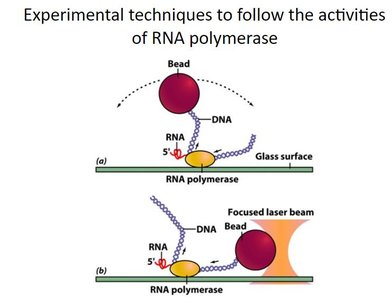
Experimental setups can track the movement and activity of RNA polymerase on DNA using beads and laser beams.
These techniques help elucidate the mechanics of transcription at the molecular level.
Completion of Transcription and Enzymatic Activities
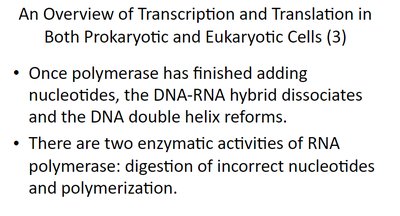
After RNA synthesis, the DNA-RNA hybrid dissociates, and the DNA double helix reforms.
RNA polymerase has two main enzymatic activities: polymerization of RNA and digestion of incorrect nucleotides (proofreading).
Transcription in Bacteria
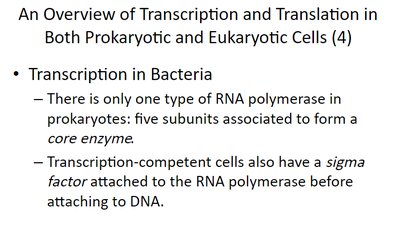
Bacteria have a single type of RNA polymerase composed of five subunits forming a core enzyme.
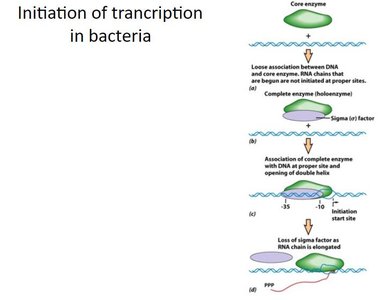
A sigma factor associates with the core enzyme to form a holoenzyme, which is necessary for promoter recognition and initiation of transcription.
Summary Table: Key Steps in Transcription
Step | Description |
|---|---|
Initiation | RNA polymerase binds to promoter with help of sigma factor (in bacteria) |
Elongation | RNA polymerase synthesizes RNA strand, adding nucleotides in 5' to 3' direction |
Termination | RNA polymerase releases the completed RNA and detaches from DNA |
Additional info: In eukaryotes, transcription involves multiple RNA polymerases (I, II, III) and more complex regulation, including extensive processing of the primary RNA transcript (capping, splicing, polyadenylation).
