 Back
Gene Expression: Transcription and RNA Processing
Study Guide - Smart Notes
 Tailored notes based on your materials, expanded with key definitions, examples, and context.
Gene Expression and the Central Dogma
Overview of Gene Expression
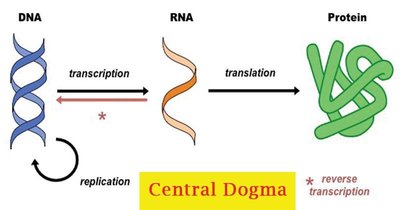
Gene expression is the process by which information encoded in DNA directs the synthesis of proteins or, in some cases, functional RNAs. This process is fundamental to all living organisms and is described by the Central Dogma of molecular biology.
Central Dogma: DNA is transcribed into RNA, which is then translated into protein.
Transcription: The synthesis of RNA from a DNA template.
Translation: The synthesis of a polypeptide (protein) using the genetic information encoded in an RNA molecule.
Replication: The process by which DNA is copied for cell division.
Cellular Compartmentalization
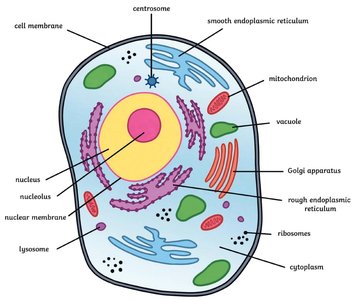
In eukaryotic cells, DNA is located in the nucleus, while protein synthesis occurs in the cytoplasm at ribosomes. This spatial separation necessitates the creation of an RNA messenger to carry genetic information from the nucleus to the cytoplasm.
Nucleus: Site of DNA and transcription.
Cytoplasm: Site of translation and protein synthesis.
Transcription: Synthesis of RNA from DNA
Transcription Process
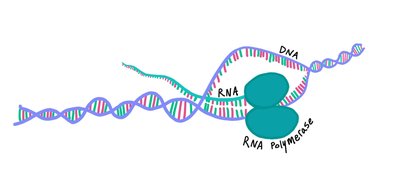
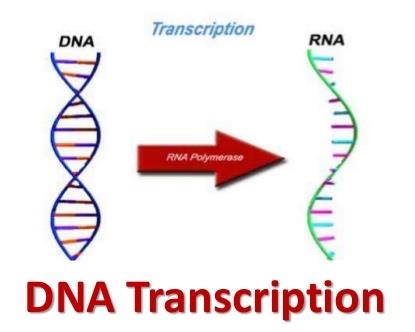
Transcription is the process by which a specific segment of DNA is copied into RNA by the enzyme RNA polymerase. Only one gene is transcribed at a time, and only one strand of DNA serves as the template.
Template Strand: The DNA strand used to synthesize RNA; the other strand is the coding strand.
Direction: RNA is synthesized in the 5’ to 3’ direction, antiparallel to the template strand.
Base Pairing: DNA uses A, G, C, T; RNA uses A, G, C, U. During transcription, A in DNA pairs with U in RNA, T with A, C with G, and G with C.
Stages of Transcription
Transcription occurs in three main stages:
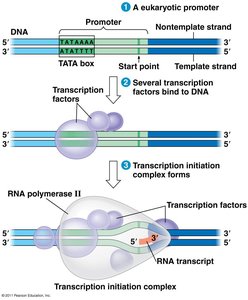
Initiation: RNA polymerase binds to the promoter region of DNA, forming the transcription initiation complex. In eukaryotes, transcription factors are required for RNA polymerase to bind. The TATA box is a common promoter element in eukaryotes. The start point marks where transcription begins.
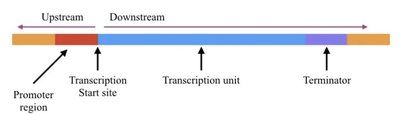
Elongation: RNA polymerase unwinds DNA and adds RNA nucleotides complementary to the DNA template strand, extending the RNA molecule at its 3’ end.
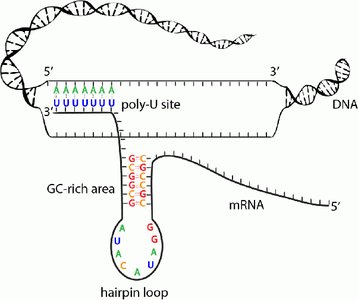
Termination: In bacteria, transcription ends when RNA polymerase reaches a terminator sequence, often forming a hairpin loop in the RNA. In eukaryotes, a polyadenylation signal (AAUAAA) triggers cleavage of the newly formed RNA.
RNA Processing in Eukaryotes
Modification of Pre-mRNA
In eukaryotes, the initial RNA transcript (pre-mRNA) must be processed before it can be translated. This processing includes modifications to both ends and removal of non-coding regions.
5’ Cap: Addition of a modified guanine nucleotide to the 5’ end.
Poly-A Tail: Addition of 50–250 adenine nucleotides to the 3’ end.
Functions: These modifications protect mRNA from degradation, aid in export from the nucleus, and help ribosome attachment.

RNA Splicing
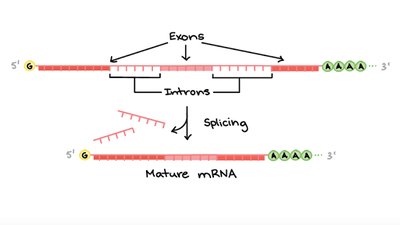
Most eukaryotic genes contain introns (non-coding regions) and exons (coding regions). Introns are removed from pre-mRNA in a process called splicing, performed by a complex called the spliceosome.
Introns: Intervening sequences that are not translated into protein.
Exons: Expressed sequences, usually translated into protein.
Spliceosome: A large complex of proteins and RNA that removes introns and joins exons.
UTRs: Untranslated regions at the ends of mRNA are included in exons but are not translated.

Alternative RNA Splicing
Alternative splicing allows a single gene to produce multiple mRNA variants, resulting in different proteins. This process can include or exclude specific exons, leading to proteins with different functional domains.
Functional Domains: Exons can correspond to structural and functional regions of proteins, such as DNA binding domains or enzyme active sites.
Significance: Alternative splicing increases protein diversity and allows for regulation of gene expression.
Summary Table: Key Steps in Gene Expression
Step | Location | Key Enzyme/Complex | Product |
|---|---|---|---|
DNA Replication | Nucleus | DNA Polymerase | DNA copy |
Transcription | Nucleus (Eukaryotes), Cytoplasm (Prokaryotes) | RNA Polymerase | Pre-mRNA (Eukaryotes), mRNA (Prokaryotes) |
RNA Processing | Nucleus (Eukaryotes) | Spliceosome, capping/polyadenylation enzymes | Mature mRNA |
Translation | Cytoplasm | Ribosome | Protein (polypeptide) |
Key Equations and Concepts
Base Pairing in Transcription:
Direction of Synthesis:
Example: Transcription and RNA Processing
Example: A gene with three exons and two introns is transcribed into pre-mRNA. The introns are removed by splicing, and the exons are joined to form mature mRNA. The mRNA receives a 5’ cap and a poly-A tail before being exported to the cytoplasm for translation.
Additional info:
Alternative splicing is a major mechanism for increasing protein diversity in multicellular organisms.
In prokaryotes, transcription and translation can occur simultaneously because there is no nuclear membrane.
