 Back
BackGene Expression: Transcription and Translation – The Central Dogma of Biology
Study Guide - Smart Notes
 Tailored notes based on your materials, expanded with key definitions, examples, and context.
Gene Expression and the Central Dogma of Biology
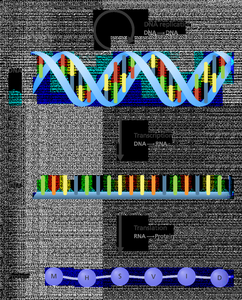
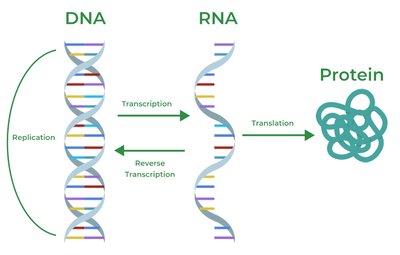
Overview of the Central Dogma
The central dogma of biology describes the flow of genetic information within a biological system. It explains how DNA codes for proteins through two main processes: transcription and translation. This concept is fundamental to understanding molecular biology and gene expression.
DNA serves as the information storage molecule.
RNA acts as the information carrier, specifically messenger RNA (mRNA).
Protein is the final product, functioning as structural and functional units in cells.
Gene expression occurs in two stages: transcription and translation.
Transcription: DNA to RNA
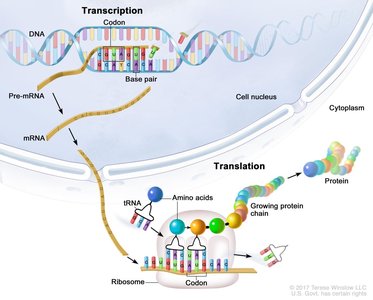
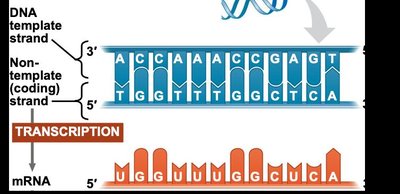
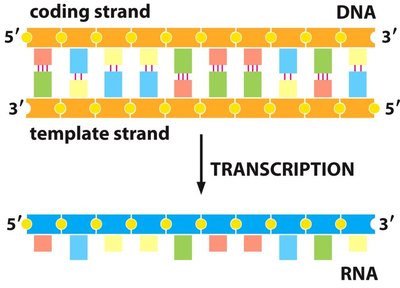
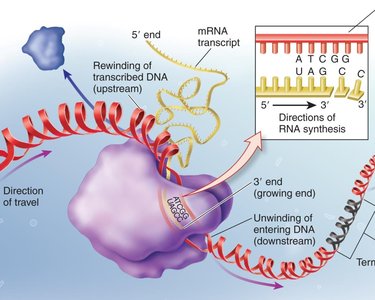
Transcription is the process by which a segment of DNA is used as a template to synthesize a complementary RNA molecule. This step does not change the "language" of nucleic acids but simply copies the information.
Template strand: The DNA strand used by RNA polymerase to synthesize RNA.
Coding strand: The DNA strand whose sequence matches the RNA (except for T/U substitution).
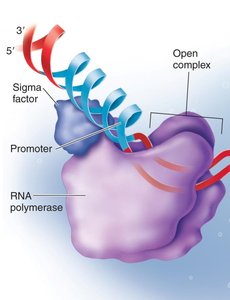
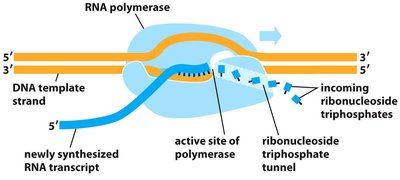
RNA polymerase: The enzyme responsible for synthesizing RNA from the DNA template.
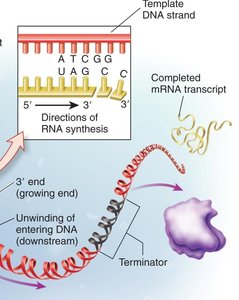
Transcription occurs in the 5' to 3' direction.
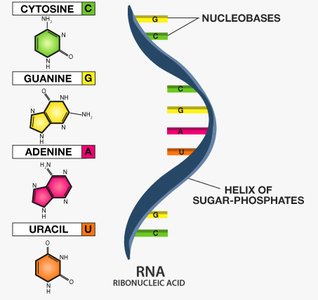
RNA is single-stranded, contains ribose sugar, and uses uracil (U) instead of thymine (T).
Anatomy of a Gene
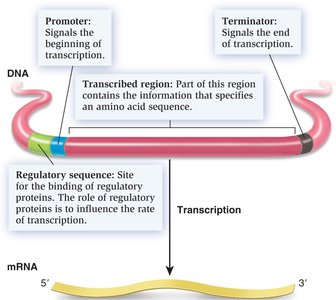
Genes contain specific regions that regulate transcription and define the coding sequence.
Promoter: Site where RNA polymerase binds to initiate transcription.
Regulatory sequences: Sites for binding of transcription factors that influence transcription rate.
Terminator: Sequence signaling the end of transcription.
Stages of Transcription
Transcription occurs in three main stages: initiation, elongation, and termination.
Initiation: RNA polymerase binds to the promoter and unwinds DNA locally.
Elongation: RNA polymerase synthesizes RNA in the 5' to 3' direction, adding nucleotides complementary to the template strand.
Termination: RNA polymerase encounters a terminator sequence, releases the RNA transcript, and detaches from DNA.
RNA Polymerase vs. DNA Polymerase
Both enzymes synthesize nucleic acids, but they differ in substrate, product, and requirements.
Similarities: Use nucleoside triphosphates as substrates and energy sources; base pairing rules apply.
Differences: RNA polymerase synthesizes single-stranded RNA, does not require a primer, and only copies one strand.
Eukaryotic RNA Processing
In eukaryotes, pre-mRNA undergoes several modifications before becoming mature mRNA. These steps are essential for stability, export, and translation.
5' capping: Addition of a modified guanine nucleotide to the 5' end.
Splicing: Removal of introns and joining of exons by the spliceosome.
Polyadenylation: Addition of a poly-A tail (50–250 adenine nucleotides) to the 3' end.
Transport: Mature mRNA is exported from the nucleus to the cytoplasm.
Translation: RNA to Protein
The Genetic Code
Translation is the process by which the sequence of bases in mRNA is decoded to synthesize a polypeptide. The genetic code is read in triplets called codons.
Codon: Three consecutive nucleotides in mRNA that specify an amino acid.
The code is degenerate: most amino acids are specified by more than one codon.
The code is universal: nearly all organisms use the same code.
Start codon: AUG (methionine); Stop codons: UGA, UAA, UAG.
Transfer RNA (tRNA) and Translation
tRNAs are adapter molecules that bring specific amino acids to the ribosome based on the codon sequence in mRNA.
Amino acid attachment site: 3' end of tRNA where the amino acid is covalently attached.
Anticodon: A triplet of bases that pairs with the complementary codon in mRNA.
Aminoacyl-tRNA synthetase: Enzyme that matches tRNA with its correct amino acid using ATP.
Ribosome Structure and Function
Ribosomes are the sites of protein synthesis, composed of rRNA and protein. They consist of two subunits and three functional sites.
Small subunit: Binds mRNA.
Large subunit: Binds tRNA and catalyzes peptide bond formation.
A site: Accepts incoming tRNA with amino acid.
P site: Holds tRNA with growing polypeptide chain.
E site: Exit site for discharged tRNA.
Stages of Translation
Translation occurs in three stages: initiation, elongation, and termination.
Initiation: Small ribosomal subunit binds mRNA, initiator tRNA binds start codon, large subunit joins.
Elongation: tRNA enters A site, peptide bond forms, ribosome translocates, tRNA exits via E site.
Termination: Stop codon encountered, release factor binds, polypeptide released, complex dissociates.
Types of RNA
Three main types of RNA are involved in translation, each with distinct roles.
mRNA (messenger RNA): Carries genetic information from DNA to ribosomes.
tRNA (transfer RNA): Brings amino acids to the ribosome based on codon-anticodon pairing.
rRNA (ribosomal RNA): Structural and catalytic component of ribosomes.
Mutations and Their Effects
Types of Mutations
Mutations are permanent changes in the DNA sequence. They can affect gene expression and protein function, and are a source of genetic variation.
Silent mutation: No change in amino acid sequence.
Missense mutation: Changes one amino acid in the sequence.
Nonsense mutation: Introduces a premature stop codon.
Frameshift mutation: Alters the reading frame by insertion or deletion.
Mutation Type | Effect |
|---|---|
Silent | No change in protein |
Missense | One amino acid changed |
Nonsense | Protein truncated |
Frameshift | Multiple amino acids changed |
Summary Table: DNA, RNA, and Protein
Molecule | Function | Structure |
|---|---|---|
DNA | Information storage | Double helix, deoxyribose, A/T/C/G |
RNA | Information carrier | Single strand, ribose, A/U/C/G |
Protein | Functional product | Polypeptide chain, amino acids |
Key Equations and Concepts
Number of nucleotides required for a protein:
Base pairing rules:
Additional info: These notes expand on the lecture outline and provide context for each step of gene expression, including definitions, examples, and diagrams. Images included are directly relevant to the explanation of transcription, translation, and gene structure.
