 Back
Gene Expression: Transcription, RNA Processing, and Translation
Study Guide - Smart Notes
 Tailored notes based on your materials, expanded with key definitions, examples, and context.
Gene Expression Overview
Central Dogma of Molecular Biology
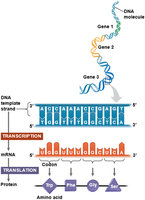
Gene expression is the process by which information from a gene is used to synthesize a functional gene product, typically a protein. The central dogma describes the flow of genetic information from DNA to RNA to protein.
Transcription: The process of copying information from DNA to a complementary RNA sequence.
Translation: The process of converting the RNA sequence into an amino acid sequence, forming a polypeptide (protein).
Ribosomes: The cellular structures where translation occurs.

Transcription: Basic Principles
Role of RNA Polymerase
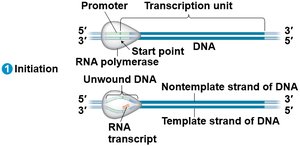
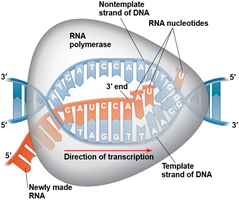
Transcription is catalyzed by RNA polymerase, which separates the DNA strands and assembles RNA nucleotides complementary to the DNA template strand.
RNA polymerase: Does not require a primer to initiate synthesis.
Base-pairing rules: Adenine pairs with uracil in RNA (instead of thymine).
Direction: RNA is synthesized in the 5' to 3' direction.

Stages of Transcription
Initiation
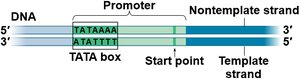
Initiation begins at a promoter region, which signals where transcription should start and which strand to use as a template. In eukaryotes, the TATA box is a crucial promoter element.
Promoter: DNA sequence where RNA polymerase binds.
TATA box: A specific promoter sequence in eukaryotes.
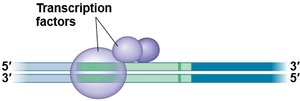
Transcription factors: Proteins that help RNA polymerase bind to the promoter.
Elongation
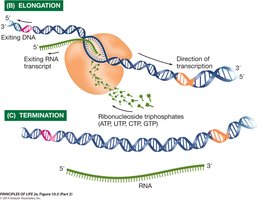
During elongation, RNA polymerase moves along the DNA, adding nucleotides to the 3' end of the growing RNA strand.
Antiparallel synthesis: RNA is built 5' to 3', complementary to the DNA template.
Proofreading: RNA polymerase proofreads, but less efficiently than DNA polymerase.
Termination
Termination differs between prokaryotes and eukaryotes.
Prokaryotes: Terminator sequence causes RNA polymerase to detach and release the RNA transcript.
Eukaryotes: Multiple proteins recognize the termination sequence and release the pre-mRNA, which requires further processing.
Transcription and Translation: Prokaryotes vs. Eukaryotes
Prokaryotic Cells
In prokaryotes, transcription and translation occur simultaneously in the cytoplasm, as there is no nuclear envelope. 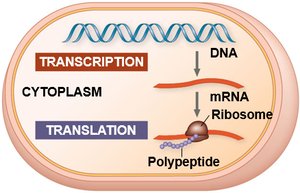
Eukaryotic Cells
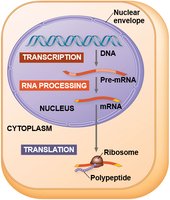
In eukaryotes, transcription occurs in the nucleus, and translation occurs in the cytoplasm. Pre-mRNA must be processed before translation. 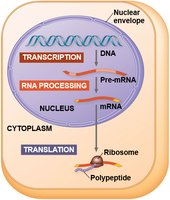
RNA Processing in Eukaryotes
Modification of Pre-mRNA
Eukaryotic pre-mRNA undergoes several modifications before becoming mature mRNA.
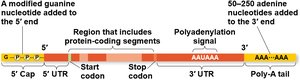
5' Cap: Addition of a modified guanine nucleotide to the 5' end.
Poly-A Tail: Addition of 50-250 adenine nucleotides to the 3' end.
Functions: Facilitate export, protect from degradation, and aid ribosome binding.
RNA Splicing
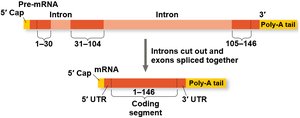
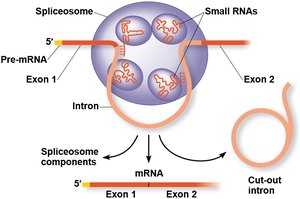
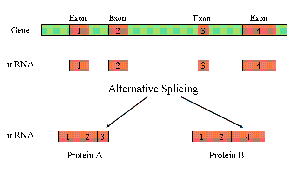
RNA splicing removes noncoding introns and joins coding exons, creating a continuous coding sequence.
Introns: Noncoding regions removed from pre-mRNA.
Exons: Coding regions joined together.
Spliceosome: Complex of proteins and small RNAs that catalyze splicing.
Alternative RNA Splicing
Alternative splicing allows a single gene to code for multiple proteins by varying which exons are included in the final mRNA.
Functional diversity: Increases the number of proteins an organism can produce.
Summary Table: Prokaryotic vs. Eukaryotic Transcription and Translation
Feature | Prokaryotes | Eukaryotes |
|---|---|---|
Location of Transcription | Cytoplasm | Nucleus |
RNA Processing | None | 5' cap, poly-A tail, splicing |
Translation | Can begin before transcription ends | Occurs after mRNA is processed and exported |
Termination | Terminator sequence | Complex protein-mediated process |
Learning Objectives
Predict consequences of changes in DNA or errors in transcription/translation for gene products.
Label diagrams of transcription and translation, identifying key components and directions.
Use the genetic code to predict amino acid sequences from mRNA or DNA fragments, identifying start and stop codons.
Additional info: The notes expand on brief points by providing definitions, examples, and comparisons to ensure completeness and academic quality.
