 Back
BackGene Expression: Transcription, Translation, and Mutations
Study Guide - Smart Notes
 Tailored notes based on your materials, expanded with key definitions, examples, and context.
Gene Expression: Transcription, Translation, and Mutations
Central Dogma of Molecular Biology
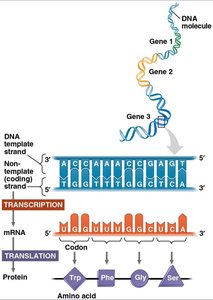
The central dogma describes the flow of genetic information within a biological system: DNA is transcribed into RNA, which is then translated into protein. This process underlies how genetic information results in observable traits.
DNA: The hereditary material containing genes.
RNA: The intermediary molecule transcribed from DNA.
Protein: The functional molecules that determine phenotype.
Structure and Function of DNA
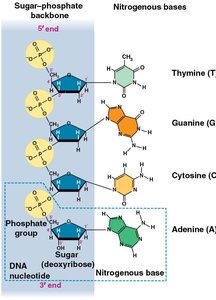
DNA is a polymer of nucleotides, each consisting of a nitrogenous base, a deoxyribose sugar, and a phosphate group. The sequence of bases encodes genetic information.
Chargaff’s Rules: In any species, the amount of adenine (A) equals thymine (T), and the amount of guanine (G) equals cytosine (C).
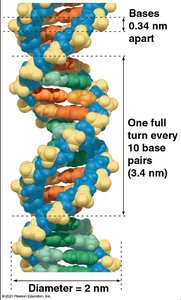
Double Helix: DNA consists of two antiparallel strands forming a helical structure.
Discovery of DNA Structure
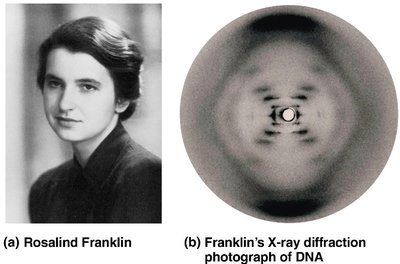
X-ray crystallography, performed by Rosalind Franklin, provided critical evidence for the helical structure of DNA, which was interpreted by Watson and Crick to deduce the double helix model.
DNA as Genetic Material
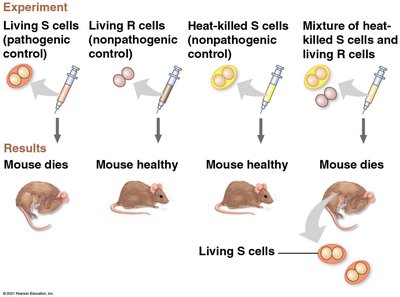
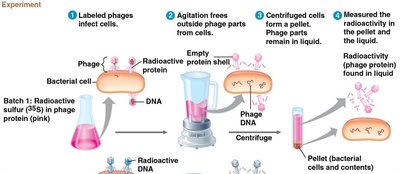
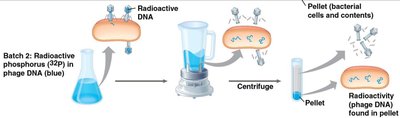
Experiments by Frederick Griffith, and later by Hershey and Chase, demonstrated that DNA is the molecule responsible for heredity.
Griffith’s Experiment: Showed that a "transforming principle" from dead pathogenic bacteria could make non-pathogenic bacteria virulent.
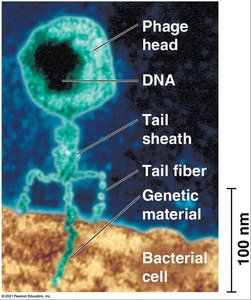
Hershey-Chase Experiment: Used bacteriophages to show that DNA, not protein, is the genetic material transferred to bacteria during infection.
Transcription: DNA to RNA
Overview of Transcription
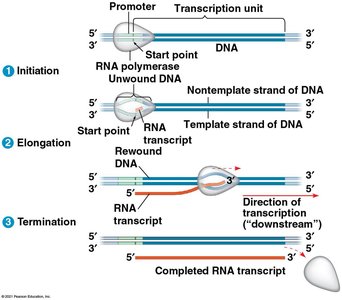
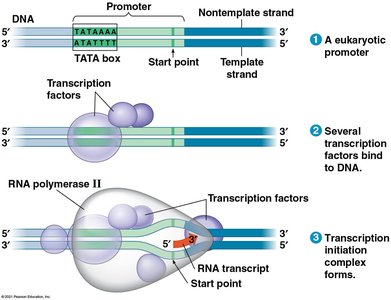
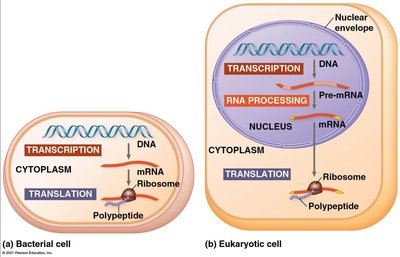
Transcription is the synthesis of RNA from a DNA template, catalyzed by RNA polymerase. In eukaryotes, this occurs in the nucleus; in prokaryotes, it occurs in the cytoplasm.
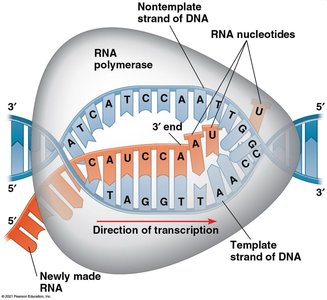
Template Strand: The DNA strand used as a template for RNA synthesis.
Coding Strand: The non-template DNA strand, which has the same sequence as the RNA (except T is replaced by U).
Stages of Transcription
Initiation: RNA polymerase binds to the promoter region with the help of transcription factors (in eukaryotes).
Elongation: RNA polymerase moves along the DNA, synthesizing RNA in the 5' to 3' direction.
Termination: Transcription ends when RNA polymerase encounters a termination sequence.
Directionality of Nucleic Acids
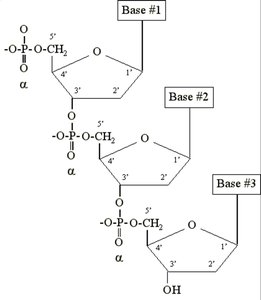
Both DNA and RNA have directionality, defined by their 5' and 3' ends. RNA polymerase reads the DNA template from 3' to 5', synthesizing RNA from 5' to 3'.
Transcription in Prokaryotes vs. Eukaryotes
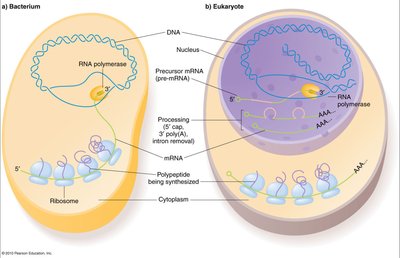
In prokaryotes, transcription and translation are coupled in the cytoplasm. In eukaryotes, transcription occurs in the nucleus, and the RNA transcript (pre-mRNA) undergoes processing before translation in the cytoplasm.
RNA Processing in Eukaryotes
Pre-mRNA undergoes several modifications before becoming mature mRNA:
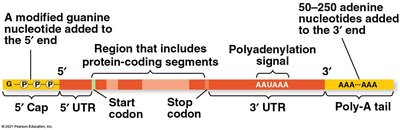
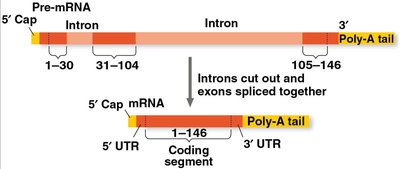
5' Capping: Addition of a modified guanine nucleotide to the 5' end.
Polyadenylation: Addition of a poly-A tail to the 3' end.
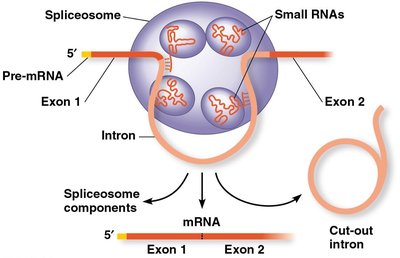
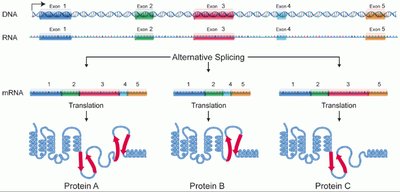
Splicing: Removal of noncoding introns and joining of exons by the spliceosome.
Translation: RNA to Protein
Overview of Translation
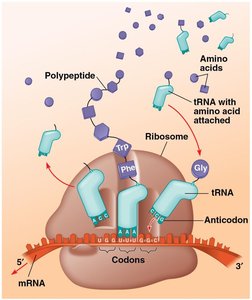
Translation is the process by which ribosomes synthesize proteins using the sequence of codons in mRNA. Each codon (a sequence of three nucleotides) specifies an amino acid.
Ribosome: The molecular machine that facilitates translation.
tRNA: Transfer RNA molecules bring amino acids to the ribosome, matching codons with their anticodons.
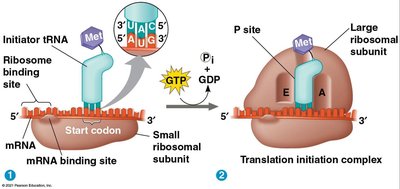
Genetic Code
The genetic code consists of 64 codons, 61 of which code for amino acids and 3 are stop signals. The code is redundant but not ambiguous.
Start Codon: AUG (codes for methionine, Met)
Stop Codons: UAA, UAG, UGA (signal termination of translation)
Codon | Amino Acid |
|---|---|
AUG | Met (Start) |
UUU, UUC | Phe |
UAA, UAG, UGA | Stop |
Translation Steps
Initiation: Ribosome assembles at the start codon of mRNA.
Elongation: tRNAs bring amino acids to the ribosome, which are joined to form a polypeptide.
Termination: Translation ends at a stop codon; the completed polypeptide is released.
Mutations and Their Effects
Types of Mutations
Mutations are changes in the genetic material that can affect protein structure and function. They may arise spontaneously or be induced by mutagens.
Point Mutation: Change in a single nucleotide pair.
Substitution: One base pair is replaced by another.
Insertion/Deletion: Addition or loss of nucleotide pairs.
Frameshift Mutation: Insertions or deletions that alter the reading frame.
Silent Mutation: No change in the amino acid sequence.
Missense Mutation: Change in one amino acid.
Nonsense Mutation: Change to a stop codon, leading to a truncated protein.
Examples of Mutation Effects
Different alleles of a gene can result from various mutations, leading to changes in the mRNA and protein product. The effect depends on the type and location of the mutation.
Allele | DNA Sequence Change | Protein Change | Mutation Type |
|---|---|---|---|
B | One base pair changed | No change | Silent, substitution, point |
C | One base pair changed | Premature stop codon | Nonsense, substitution, point |
D | Insertion of two base pairs | Frameshift, many amino acids changed, early stop | Insertion, frameshift, nonsense |
Summary Table: DNA Replication vs. Gene Expression
Process | Template | Product | Enzyme |
|---|---|---|---|
DNA Replication | DNA | DNA | DNA Polymerase |
Transcription | DNA | RNA | RNA Polymerase |
Translation | mRNA | Protein | Ribosome |
Additional info: The redundancy of the genetic code means that some mutations (silent mutations) do not alter the amino acid sequence of the protein. However, missense and nonsense mutations can have significant effects on protein function, potentially leading to disease.
