 Back
Gene Expression: Transcription, Translation, and Mutations
Study Guide - Smart Notes
 Tailored notes based on your materials, expanded with key definitions, examples, and context.
Gene Expression and the Central Dogma
Overview of Gene Expression
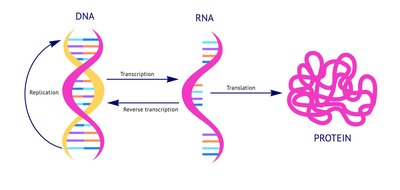
Gene expression is the process by which information encoded in DNA is used to produce functional RNA or protein molecules. This process connects an organism's genotype (genetic makeup) with its phenotype (observable traits). For protein-coding genes, gene expression involves two main stages: transcription and translation.
Transcription: DNA is transcribed into RNA.
Translation: RNA is translated into protein.
Example: The central dogma of molecular biology describes the flow of genetic information: DNA → RNA → Protein. 
Transcription
Mechanism of Transcription
Transcription is the process of synthesizing RNA from a DNA template. The enzyme RNA polymerase unwinds the DNA and builds an RNA strand using one DNA strand as a template. RNA synthesis proceeds in the 5′ to 3′ direction, matching complementary bases (A pairs with U, G with C).
Initiation: RNA polymerase assembles at the promoter with the help of transcription factors (in eukaryotes).
Elongation: RNA polymerase travels along the DNA template, adding complementary RNA nucleotides.
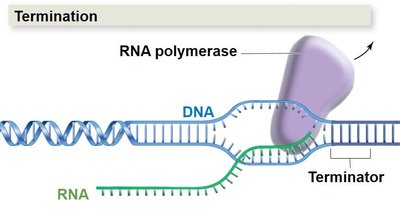
Termination: Signals mark where transcription should end, and RNA polymerase detaches from the DNA.
Example: The coding strand of DNA matches the RNA sequence except for T (thymine) replaced by U (uracil) in RNA. 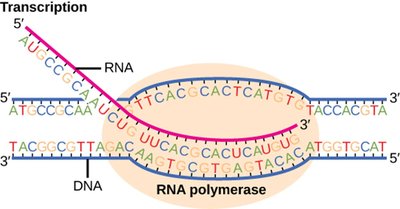
Initiation of Transcription
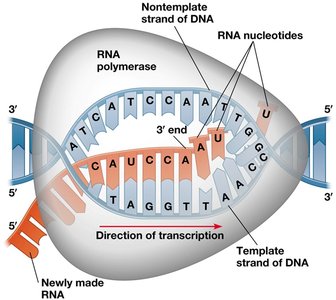
In eukaryotes, transcription factors help RNA polymerase assemble at the promoter. The DNA strands separate near the start site, and RNA polymerase uses one strand as the template. The other strand is the coding strand, which matches the RNA sequence except for T/U differences. 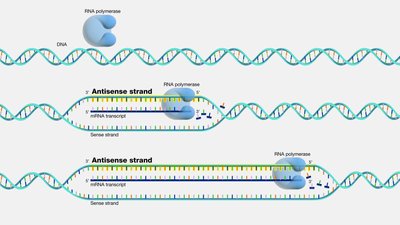
Elongation of the RNA Strand
RNA polymerase adds nucleotides to the growing RNA strand in the 5′ to 3′ direction. Uracil is incorporated in place of thymine. The DNA strands separate only where the enzyme is working and rejoin after the polymerase passes. 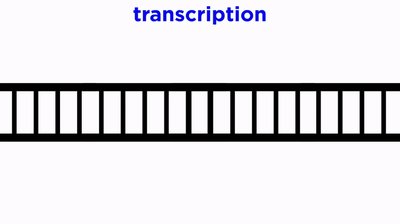
Termination of Transcription
Transcription ends when RNA polymerase encounters a termination signal. The enzyme stops RNA synthesis and detaches from the DNA.
RNA Processing (Eukaryotes)
Pre-mRNA Processing
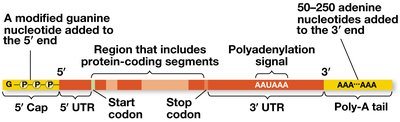
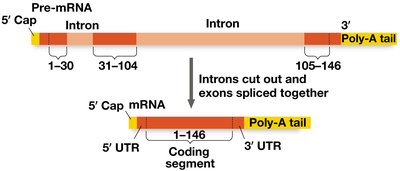
In eukaryotes, the initial transcript (pre-mRNA) requires processing before export from the nucleus. Processing includes:
5′ capping: Addition of a modified guanine nucleotide to the 5′ end.
Splicing: Removal of introns and joining of exons.
3′ poly-A tail: Addition of a string of adenine nucleotides to the 3′ end.
Example: Mature mRNA contains only exons and is ready for translation. 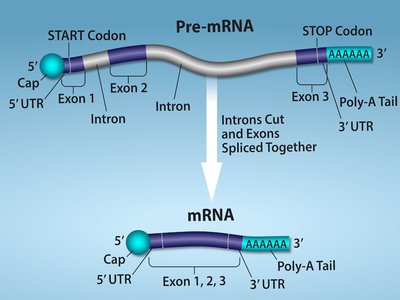
Translation
Mechanism of Translation
Translation converts the mRNA’s nucleotide sequence into a chain of amino acids, forming a protein. This process occurs in the cytoplasm on ribosomes. tRNAs bring the correct amino acids to the ribosome by reading the code on the mRNA. Translation includes three stages: initiation, elongation, and termination. 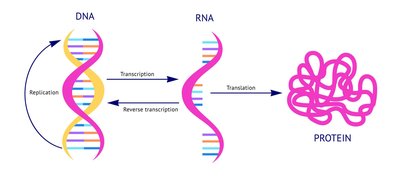
The Genetic Code
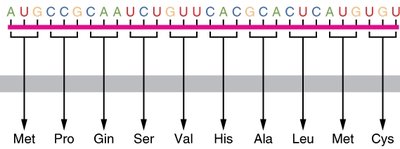
Ribosomes read mRNA in three-nucleotide units called codons. Most codons specify an amino acid; several codons can specify the same amino acid (redundancy). Three codons serve as stop signals. 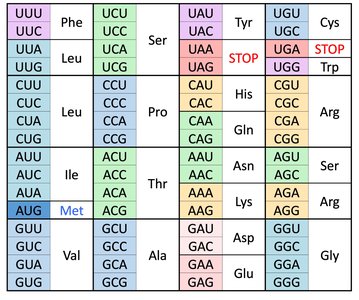
tRNA Structure and Function
tRNA molecules bring amino acids to the ribosome. Each tRNA has an anticodon that pairs with a codon on the mRNA and carries a specific amino acid. 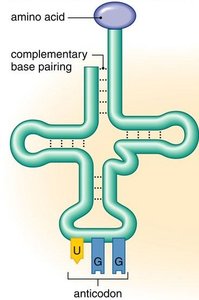
Ribosome Structure and Function
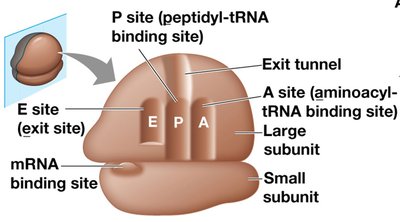
Ribosomes consist of a small and a large subunit. The A, P, and E sites are involved in tRNA binding and polypeptide synthesis.
A site: Accepts the next tRNA with its amino acid.
P site: Holds the tRNA attached to the polypeptide chain.
E site: Holds the tRNA before it exits.
Initiation of Translation
The small ribosomal subunit binds to the mRNA and locates the start codon (AUG). An initiator tRNA carrying methionine pairs with the start codon. Energy (GTP) and helper proteins stabilize the pairing, and the large subunit joins to form a working ribosome. 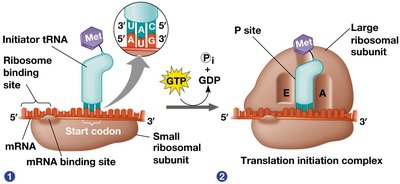
Elongation of Translation
A new tRNA with an anticodon matching the next codon enters the A site. The ribosome forms a peptide bond between the new amino acid and the growing chain. The chain is transferred onto the tRNA in the A site, and the ribosome moves forward on the mRNA. 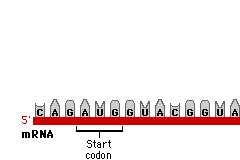
Termination of Translation
Translation ends when a stop codon enters the A site. No tRNA matches stop codons; instead, a release factor binds, freeing the completed polypeptide. The ribosome subunits separate and can be reused. 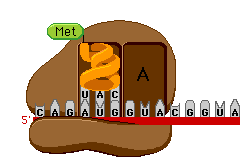
Transcription and Translation in Bacteria vs. Eukaryotes
Bacterial Cells
In bacteria, transcription and translation occur in the cytoplasm. Ribosomes can begin translation while RNA polymerase is still transcribing the RNA. Bacterial mRNA does not require capping, splicing, or poly-A tail. 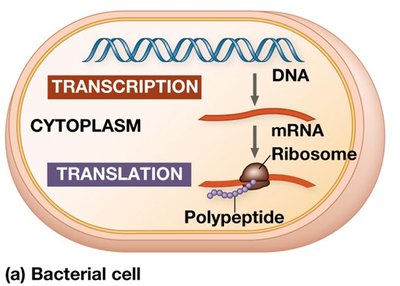
Eukaryotic Cells
In eukaryotes, transcription occurs in the nucleus, and translation occurs in the cytoplasm. Pre-mRNA undergoes processing before export. 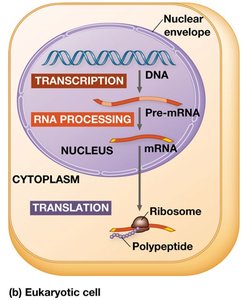
Mutations
Mutations and Errors in Gene Expression
A mutation is a change in the DNA sequence that can arise during replication or after DNA damage. Mutations can affect future RNA and protein molecules and may be inherited by daughter cells.
Transcription errors: Change an RNA molecule, possibly producing altered proteins.
Translation errors: Affect the polypeptide produced during that event.
Example: Mutations can be spontaneous or caused by agents such as UV light, chemicals, or radiation.
Types of Mutations
Base substitution: One nucleotide is replaced by another.
Insertion or deletion: One or more nucleotides are added or removed.
Frameshift: An insertion or deletion within a protein-coding sequence shifts the codon groups if the number of nucleotides is not a multiple of three.
Type of Mutation | Description | Effect |
|---|---|---|
Base Substitution | One nucleotide replaced by another | May change one amino acid or have no effect |
Insertion/Deletion | One or more nucleotides added or removed | May cause frameshift or disrupt protein |
Frameshift | Insertion/deletion not a multiple of three | Shifts reading frame, alters many amino acids |
Additional info: Mutations can be silent, missense, or nonsense, depending on their effect on the protein product. ----------------------------------------
