 Back
Gene Expression: Translation – Mini-Textbook Study Notes
Study Guide - Smart Notes
 Tailored notes based on your materials, expanded with key definitions, examples, and context.
Gene Expression: Translation
Overview of Translation
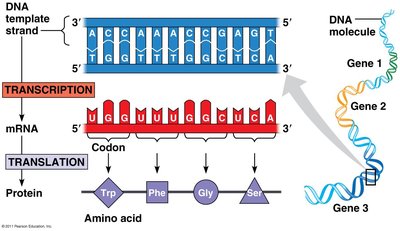
Translation is the process by which the genetic information encoded in messenger RNA (mRNA) is used to synthesize a polypeptide, ultimately forming a functional protein. This process involves converting the nucleotide sequence of mRNA into the amino acid sequence of a protein, representing a change in the 'language' of biological information.
Translation: Synthesis of a polypeptide using mRNA as a template.
Key molecules: mRNA, ribosomal RNA (rRNA), transfer RNA (tRNA).
Location: Occurs in the cytoplasm at the ribosome.
The Genetic Code
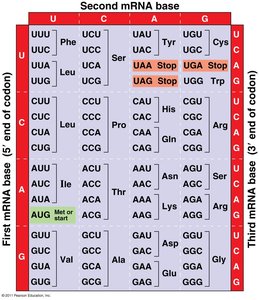
The genetic code is the set of rules by which information encoded in mRNA is translated into proteins. It is based on triplets of nucleotides called codons, each specifying a particular amino acid.
Codon: A sequence of three mRNA nucleotides that codes for a specific amino acid.
Triplet code: 64 possible codons () for 20 amino acids.
Redundancy: Multiple codons can code for the same amino acid.
Unambiguity: Each codon specifies only one amino acid.
Start codon: AUG (codes for methionine).
Stop codons: UAA, UAG, UGA (do not code for any amino acid).
Reading Frames and Translation Initiation
Each mRNA can be read in three possible frames, but only one is correct. The reading frame is established by the first AUG codon encountered by the ribosome.
Reading frame: The way nucleotides are grouped into codons for translation.
Initiation: Begins at the first AUG codon in the mRNA sequence.
Universality of the Genetic Code
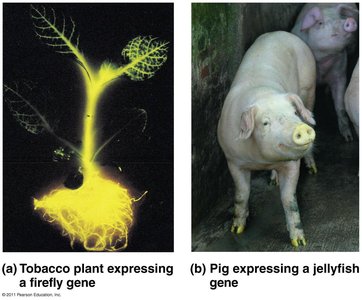
The genetic code is nearly universal, used by almost all organisms, with only minor exceptions. This universality supports the concept of a common ancestor for all life and is a powerful tool in molecular biology and biotechnology.
Applications: Expression of genes across species (e.g., GFP in plants, luciferase in animals).
Key Players in Translation
Messenger RNA (mRNA)
mRNA carries genetic information transcribed from DNA to the ribosome, where it is translated into protein.
Ribosomal RNA (rRNA) and Ribosomes
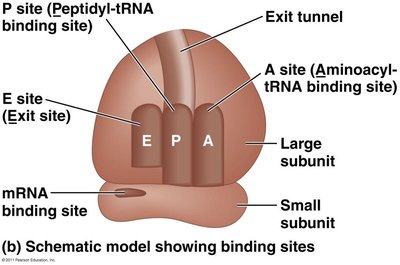
Ribosomes are complexes of rRNA and protein, consisting of a large and a small subunit. rRNA acts as a ribozyme, catalyzing peptide bond formation.
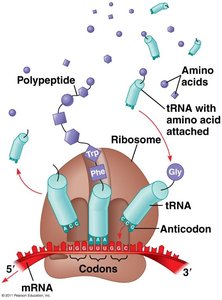
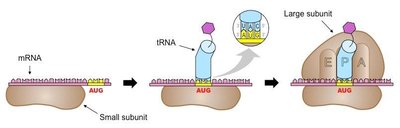
Ribosome structure: Contains A (aminoacyl), P (peptidyl), and E (exit) sites for tRNA binding.
Transfer RNA (tRNA)
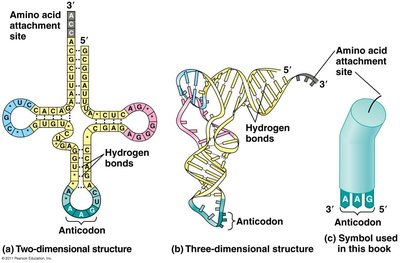
tRNA molecules carry amino acids to the ribosome and match them to the codons in mRNA via their anticodon region.
Anticodon: Three-nucleotide sequence on tRNA complementary to the mRNA codon.
Aminoacyl-tRNA synthetase: Enzyme that attaches the correct amino acid to its tRNA ('charging').
20 synthetases: One for each amino acid.
Mechanism of Translation
Initiation
Translation initiation involves assembly of the ribosome, mRNA, and initiator tRNA. In eukaryotes, the small ribosomal subunit binds the 5' cap of mRNA and scans for the start codon.
Initiation complex: Formed when the large ribosomal subunit joins the small subunit, mRNA, and initiator tRNA.
Energy input: GTP hydrolysis is required.
Elongation
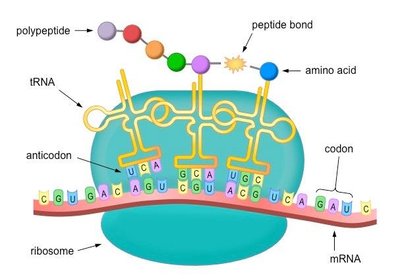
Elongation is the process of adding amino acids to the growing polypeptide chain. Each cycle involves codon recognition, peptide bond formation, and translocation.
Peptide bond formation: Catalyzed by rRNA in the ribosome.
Directionality: Polypeptides are synthesized from N-terminus to C-terminus.
Energy input: GTP hydrolysis ensures accuracy and efficiency.
Termination
Termination occurs when a stop codon enters the A site. A release factor binds, freeing the polypeptide and disassembling the ribosomal complex.
Release factor: Protein that mimics tRNA but does not carry an amino acid.
Energy input: GTP hydrolysis is required for disassembly.
Polysomes
Multiple ribosomes can translate a single mRNA simultaneously, forming a polyribosome or polysome, which increases the efficiency of protein synthesis.
Post-Translational Modifications
After translation, polypeptides may undergo modifications such as folding, addition of functional groups, cleavage, or targeting to specific cellular locations.
Chaperonins: Assist in protein folding.
Signal peptides: Direct proteins to the endoplasmic reticulum or other organelles.
Mutations and Their Effects
Mutations are changes in the DNA sequence that can affect protein structure and function. They may be beneficial, harmful, or neutral.
Point mutations: Change a single nucleotide pair.
Silent mutations: No change in amino acid sequence.
Missense mutations: Change one amino acid; effect depends on location and properties.
Nonsense mutations: Create a premature stop codon, usually resulting in nonfunctional proteins.
Insertions/deletions: Can cause frameshift mutations, altering the reading frame and protein sequence.
Mutagens: Physical or chemical agents that cause mutations (e.g., X-rays, UV light, carcinogens).
The Central Dogma of Molecular Biology
The central dogma describes the flow of genetic information: DNA is transcribed into RNA, which is then translated into protein.
Transcription: DNA → RNA
Translation: RNA → Protein
Summary Table: Types of Mutations
Mutation Type | Description | Effect on Protein |
|---|---|---|
Silent | Codon change, same amino acid | No effect |
Missense | Codon change, different amino acid | Variable: may be minor or major |
Nonsense | Codon change to stop codon | Usually nonfunctional protein |
Frameshift | Insertion/deletion alters reading frame | Major changes, often nonfunctional |
Summary Table: Key Steps in Translation
Step | Description | Key Molecules |
|---|---|---|
Initiation | Assembly of ribosome, mRNA, initiator tRNA | mRNA, ribosome, tRNAMet, GTP |
Elongation | Addition of amino acids to polypeptide | tRNA, ribosome, elongation factors, GTP |
Termination | Release of polypeptide at stop codon | Release factor, ribosome, GTP |
Key Equations
Number of possible codons:
Peptide bond formation:
Additional info:
Some content expanded for clarity, including definitions and context for mutations and translation steps.
Tables inferred for summary and comparison purposes.
