 Back
Gene Regulation and Expression in Prokaryotes and Eukaryotes
Study Guide - Smart Notes
 Tailored notes based on your materials, expanded with key definitions, examples, and context.
Gene Regulation: Concepts and Mechanisms
Overview of Gene Regulation
Gene regulation is the process by which cells control the expression and timing of genes, allowing adaptation to environmental changes and specialization of cell types. Regulation can occur at multiple stages, from transcription to post-translational modification. - Gene regulation ensures that the correct proteins are produced at the right time and in appropriate amounts. - Feedback inhibition is a mechanism where the end product of a pathway inhibits an enzyme involved earlier in the pathway, preventing overproduction. - Operon model is a fundamental mechanism in prokaryotes for regulating groups of genes. 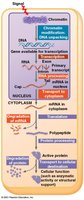
The Operon Model in Prokaryotes
The operon model describes how functionally related genes are regulated together in bacteria. An operon consists of an operator, promoter, and the genes they control. - Operator: DNA segment acting as an on/off switch. - Promoter: DNA region where RNA polymerase binds to initiate transcription. - Structural genes: Genes encoding proteins with related functions.
Types of Operons
- Inducible operons: Usually off; can be turned on by an inducer. Example: Lac operon (catabolic pathway). - Repressible operons: Usually on; can be turned off by a repressor and corepressor. Example: Trp operon (anabolic pathway). - Positive regulation: Activator proteins (e.g., CRP) increase transcription when bound to the promoter.
Comparison of Operon Types
Type | Default State | Regulation Mechanism | Example |
|---|---|---|---|
Inducible | Off | Inducer removes repressor | Lac operon |
Repressible | On | Corepressor activates repressor | Trp operon |
Positive | Varies | Activator protein stimulates transcription | CRP in lac operon |
Regulation of Gene Expression in Eukaryotes
Differential Gene Expression
Eukaryotic cells regulate gene expression at many stages, resulting in different cell types from the same genome. Abnormal gene expression can lead to diseases such as cancer.
Regulation of Chromatin Structure
Chromatin structure plays a crucial role in gene expression. - Heterochromatin: Tightly packed, generally not expressed. - Euchromatin: Loosely packed, accessible for transcription. - Histone modification: Chemical changes to histone tails affect chromatin structure and gene accessibility. 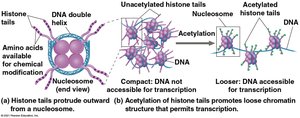
Histone Acetylation and DNA Methylation
- Histone acetylation: Addition of acetyl groups opens chromatin, promoting transcription. - DNA methylation: Addition of methyl groups condenses chromatin, reducing transcription. - Genomic imprinting: Methylation regulates expression of maternal or paternal alleles.
Epigenetic Inheritance
Chromatin modifications can be inherited without altering DNA sequence, explaining phenomena such as discordant disease development in identical twins. 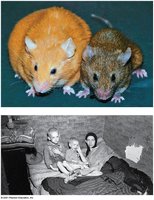
Regulation of Transcription Initiation
Transcription initiation is controlled by chromatin-modifying enzymes and DNA control elements. - Control elements: Noncoding DNA segments serving as binding sites for transcription factors. - Transcription factors: Proteins that regulate transcription; classified as general (required for all genes) or specific (regulate particular genes).
Enhancers and Activators
- Enhancers: Distal control elements that can be far from the gene. - Activators: Proteins binding to enhancers to stimulate transcription.
Combinatorial Control of Gene Activation
Multiple control elements and activators allow precise regulation of gene expression in different cell types. 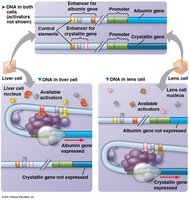
Coordinately Controlled Genes in Eukaryotes
Unlike prokaryotes, eukaryotic co-expressed genes are not organized in operons but share control elements recognized by activator proteins.
Post-Transcriptional Regulation Mechanisms
Regulation can occur after transcription, allowing rapid response to environmental changes. - RNA processing: Alternative splicing produces different mRNAs from the same gene. 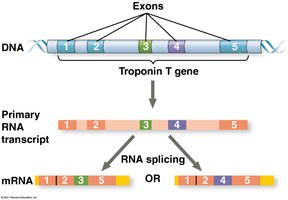 - Initiation of translation: Regulatory proteins can block translation of specific mRNAs. - mRNA degradation: The lifespan of mRNA affects protein synthesis; sequences in the 3' UTR influence stability. - Protein processing and degradation: Proteins are modified and selectively degraded, often marked by ubiquitin for destruction by proteasomes.
Noncoding RNAs in Gene Regulation
MicroRNAs (miRNAs) and Small Interfering RNAs (siRNAs)
Noncoding RNAs regulate gene expression by affecting mRNA stability and translation. - miRNAs: Bind to complementary mRNA sequences, causing degradation or blocking translation. 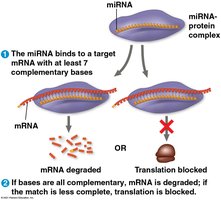 - siRNAs: Similar to miRNAs; their action is called RNA interference (RNAi).
Chromatin Remodeling by ncRNAs
- piRNAs: Induce heterochromatin formation, silencing transposons. - lncRNAs: Long noncoding RNAs, some involved in X chromosome inactivation.
Differential Gene Expression in Development
Embryonic Development and Cell Differentiation
Gene expression programs drive the transformation from zygote to adult, involving cell division, differentiation, and morphogenesis. - Cell differentiation: Cells become specialized in structure and function. - Morphogenesis: Physical processes shaping the organism.
Cytoplasmic Determinants and Inductive Signals
Maternal substances in the egg (cytoplasmic determinants) and signals from nearby cells (induction) guide early development and cell fate. 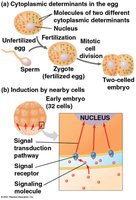
Sequential Regulation During Differentiation
- Determination: Commitment to a specific cell type, followed by differentiation. - MyoD: Master regulatory gene for muscle cell differentiation.
Pattern Formation and Body Plan
Pattern formation establishes spatial organization of tissues and organs, guided by positional information and morphogen gradients. 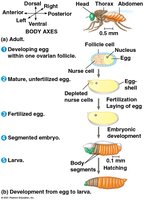
Bicoid Gene and Morphogen Gradient Hypothesis
The bicoid gene in Drosophila sets up the anterior-posterior axis; its protein forms a gradient essential for head development.
Cancer and Gene Regulation
Genetic Changes Leading to Cancer
Cancer arises from mutations affecting cell cycle control, often in genes regulating growth and division. - Oncogenes: Mutated proto-oncogenes that promote uncontrolled cell growth. - Tumor-suppressor genes: Normally inhibit cell division; mutations can lead to cancer.
Four Genetic Changes Converting Proto-oncogenes to Oncogenes
Change Type | Description |
|---|---|
Epigenetic changes | Alter gene expression without changing DNA sequence |
Translocations | Move gene to new location, possibly under new regulatory control |
Gene amplification | Increase number of gene copies |
Point mutations | Alter protein function or regulation |
Key Genes in Cancer: ras and p53
- ras: Mutations produce hyperactive Ras protein, stimulating cell division. - p53: Tumor-suppressor gene; mutations prevent cell cycle suppression and DNA repair, leading to cancer.
Multistep Model of Cancer Development
Multiple mutations are required for cancer; incidence increases with age. Both oncogenes and mutated tumor-suppressor genes are typically present in cancer cells.
Role of Viruses in Cancer
Some viruses can cause cancer by integrating into host DNA and disrupting normal gene regulation. Additional info: Epigenetic inheritance and noncoding RNAs are emerging fields explaining complex gene regulation and disease susceptibility.
