 Back
Gene Regulation and Regulatory Switches in Eukaryotes – Study Guidance
Study Guide - Smart Notes
 Tailored notes based on your materials, expanded with key definitions, examples, and context.
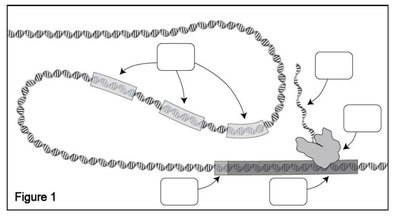
Q1. Figure 1 is a diagram, similar to the one shown in the film (6:00–8:34), showing key components of gene transcription. Label the boxes in Figure 1 with the letters a–e, which correspond to the terms listed below. For example, write letter “a” in the box pointing at the protein-coding region of a gene.
a. Protein-coding region
b. Regulatory switches (or enhancers)
c. Promoter
d. mRNA
e. RNA polymerase
Background
Topic: Eukaryotic Gene Regulation and Transcription
This question tests your understanding of the molecular components involved in eukaryotic gene transcription, including the roles of promoters, enhancers, RNA polymerase, and the resulting mRNA.
Key Terms and Concepts:
Protein-coding region: The part of the gene that contains the information to make a protein.
Regulatory switches (enhancers): DNA sequences that increase the likelihood of transcription of a particular gene.
Promoter: A DNA sequence where RNA polymerase binds to initiate transcription.
mRNA: The RNA copy of the gene that is produced during transcription.
RNA polymerase: The enzyme that synthesizes mRNA from the DNA template.
Step-by-Step Guidance
Examine Figure 1 and identify the different components shown: look for the DNA strand, a region where a large enzyme is bound, and the RNA strand being produced.
Recall that the promoter is the site on DNA where RNA polymerase binds to start transcription. Find the region just upstream of where the enzyme is attached.
Locate the protein-coding region—this is the stretch of DNA that is being transcribed into mRNA.
Identify the regulatory switches (enhancers)—these are often shown as separate DNA elements that interact with the transcription machinery via looping.
Find the mRNA—this is the new strand being synthesized by the enzyme.
Try solving on your own before revealing the answer!
Final Answer:
a. Protein-coding region: The long, shaded region of DNA being transcribed.
b. Regulatory switches (or enhancers): The boxed DNA elements upstream, connected by arrows/loops.
c. Promoter: The region immediately upstream of the protein-coding region, where RNA polymerase is bound.
d. mRNA: The strand coming off the DNA, representing the transcript.
e. RNA polymerase: The large enzyme complex attached to the DNA at the promoter.
Correctly labeling these components helps you understand the flow of genetic information from DNA to RNA in eukaryotic cells.
Q2. Assume a fish inherits a deletion mutation in the pituitary switch which inactivates that switch. You isolate DNA from jaw, pelvic, eye, and pituitary tissues. In the DNA of which tissue(s) would you expect the pituitary switch mutation? Draw an “X” over the mutated switch in the appropriate tissue(s).

Background
Topic: Tissue-Specific Gene Regulation and Mutations
This question tests your understanding of how regulatory switches (enhancers) control gene expression in a tissue-specific manner, and how a mutation in a regulatory switch would be present in the DNA of different tissues.
Key Terms and Concepts:
Regulatory switch (enhancer): A DNA sequence that controls gene expression in a specific tissue.
Deletion mutation: A type of mutation where a segment of DNA is missing.
Tissue-specific expression: The concept that certain regulatory elements control gene expression only in certain tissues.
Step-by-Step Guidance
Recall that a mutation in the DNA will be present in all cells of the organism if it is inherited (germline mutation).
Consider that each tissue (jaw, pelvic, eye, pituitary) contains the same genomic DNA, including any mutations present.
Think about what it means for a regulatory switch to be mutated: the mutation will be present in the DNA of every tissue, regardless of whether the switch is active in that tissue.
Identify which switch is the pituitary switch in each tissue diagram.
Try solving on your own before revealing the answer!
Final Answer:
The pituitary switch mutation would be present in the DNA of all tissues (jaw, pelvic, eye, and pituitary), because all cells contain the same genome. You would draw an “X” over the pituitary switch in each tissue diagram.
This illustrates that regulatory mutations are present in all cells, but only affect gene expression in tissues where that switch is normally active.
Q3. Based on what you know about the molecular mechanisms that control the development of stickleback pelvic spines, circle the figure below that likely represents what the Pitx1 gene region looked like in these stickleback fish that lacked pelvic spines. The X represents a mutation that inactivates that particular gene region.

Background
Topic: Evolutionary Genetics and Regulatory Mutations
This question tests your understanding of how mutations in regulatory switches (enhancers) can lead to evolutionary changes in morphology, such as the loss of pelvic spines in stickleback fish.
Key Terms and Concepts:
Pitx1 gene: A gene involved in the development of pelvic structures in vertebrates.
Regulatory switch (enhancer): Controls expression of Pitx1 in specific tissues (e.g., pelvis, jaw, pituitary).
Mutation (X): Indicates inactivation of a specific regulatory switch.
Step-by-Step Guidance
Recall that loss of pelvic spines in stickleback fish is due to a mutation that inactivates the pelvic enhancer of the Pitx1 gene.
Examine each diagram (A–D) and identify which regulatory switch is marked with an “X” (mutation).
Determine which diagram shows the pelvic switch (enhancer) as mutated, while the other switches remain intact.
Remember that the correct answer should show only the pelvic enhancer inactivated, not the jaw or pituitary switches.
Try solving on your own before revealing the answer!
Final Answer:
The correct diagram is C, where the pelvic switch is marked with an “X” (mutated), indicating that the pelvic enhancer is inactivated. This prevents Pitx1 expression in the pelvis, leading to loss of pelvic spines, while other tissues are unaffected.
