 Back
Gene Regulation, Enhancers, and Developmental Genetics: Study Guide
Study Guide - Smart Notes
 Tailored notes based on your materials, expanded with key definitions, examples, and context.
Q1. Labeling Key Components of Gene Transcription
Background
Topic: Gene Expression and Regulation
This question tests your understanding of the molecular components involved in gene transcription, including promoters, enhancers (regulatory switches), protein-coding regions, mRNA, and RNA polymerase.
Key Terms and Concepts:
Protein-coding region: The part of a gene that contains the information to make a protein.
Regulatory switches (enhancers): DNA sequences that control when and where a gene is expressed by interacting with activator proteins.
Promoter: A DNA sequence where RNA polymerase binds to initiate transcription.
mRNA: Messenger RNA, the transcript produced from the gene that will be translated into protein.
RNA polymerase: The enzyme that synthesizes mRNA from the DNA template.
Step-by-Step Guidance
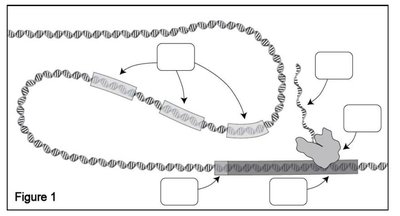
Examine the diagram and identify the different labeled boxes. Each box represents a different component of the gene transcription process.
Recall the function and typical location of each component:
The protein-coding region is a stretch of DNA that will be transcribed and translated into protein.
Regulatory switches (enhancers) are often located upstream or downstream of the coding region and interact with activators.
The promoter is usually just upstream of the coding region and is the binding site for RNA polymerase.
mRNA is the product of transcription and will be found as a single-stranded molecule leaving the DNA template.
RNA polymerase is the enzyme complex that moves along the DNA, synthesizing mRNA.
Match each label (a–e) to the correct box in the diagram based on these definitions and their positions relative to the DNA and transcription process.
Pay attention to the direction of arrows and the flow from DNA to mRNA, as this will help you distinguish between the coding region, promoter, and regulatory elements.
Try solving on your own before revealing the answer!
Final Answer:
a. Protein-coding region: The dark thick bar on the DNA (bottom right).
b. Regulatory switches (or enhancers): The small boxes upstream of the coding region (top and left).
c. Promoter: The box immediately upstream of the coding region (bottom left).
d. mRNA: The wavy line coming off the DNA (top right).
e. RNA polymerase: The large blob-shaped structure on the DNA (right, near the mRNA).
Correctly identifying these components is essential for understanding how genes are regulated and expressed in cells.
Q2. Predicting the Effect of a Deletion Mutation in a Regulatory Switch
Background
Topic: Tissue-Specific Gene Regulation and Mutations
This question asks you to apply your knowledge of how regulatory switches (enhancers) control gene expression in different tissues, and how a mutation in one switch affects all tissues of an organism.
Key Terms and Concepts:
Regulatory switch (enhancer): A DNA sequence that controls gene expression in a specific tissue.
Deletion mutation: A type of mutation where a segment of DNA is missing.
Tissue specificity: The idea that certain regulatory elements control gene expression only in certain tissues.
Step-by-Step Guidance
Understand that a deletion mutation in the pituitary switch will be present in the DNA of all cells of the fish, since all cells inherit the same genome.
Recall that regulatory switches are DNA elements, not proteins, so a mutation in a switch will be found in the DNA of every tissue, regardless of whether the gene is expressed there.
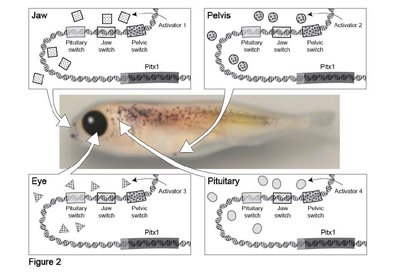
Look at the diagrams for jaw, pelvis, eye, and pituitary tissues. Each shows the Pitx1 gene with its associated switches.
Determine which switch is the pituitary switch in each tissue diagram, and consider that the mutation will be present in all tissues' DNA.

Try solving on your own before revealing the answer!
Final Answer:
The pituitary switch mutation (deletion) will be present in the DNA of all tissues: jaw, pelvis, eye, and pituitary. You should draw an "X" over the pituitary switch in each tissue diagram.
This is because all cells in the organism have the same DNA, so a mutation in a regulatory region will be found in every tissue, even if the switch only functions in one tissue.
Q3. Identifying the Likely Pitx1 Gene Region in Stickleback Fish Lacking Pelvic Spines
Background
Topic: Evolutionary Genetics and Regulatory Mutations
This question tests your understanding of how mutations in regulatory elements (enhancers) can lead to evolutionary changes in phenotype, such as the loss of pelvic spines in stickleback fish.
Key Terms and Concepts:
Pitx1 gene: A gene involved in hind limb (pelvic) development.
Regulatory switch (enhancer): Controls tissue-specific expression of Pitx1.
Mutation (X): Indicates a region that is inactivated, preventing gene expression in that tissue.
Step-by-Step Guidance
Recall that the loss of pelvic spines in stickleback fish is due to a mutation that inactivates the pelvic enhancer of the Pitx1 gene.
Examine the four diagrams (A–D), each showing a different regulatory switch (pituitary, jaw, or pelvic) marked with an "X" to indicate a mutation.
Identify which diagram shows the pelvic switch (enhancer) as inactivated (with an "X"), since this would prevent Pitx1 expression in the pelvis and result in the loss of pelvic spines.
Ignore diagrams where the mutation is in the coding region or in switches unrelated to pelvic development.


Try solving on your own before revealing the answer!
Final Answer:
The correct diagram is C, where the pelvic switch is marked with an "X". This represents a mutation in the pelvic enhancer, which inactivates Pitx1 expression in the pelvis and leads to the loss of pelvic spines.
This illustrates how changes in regulatory DNA, rather than coding DNA, can drive evolutionary changes in body structure.
